Derivatives of inverses and logs (Calc 1; Lecture 2-2; Fall 26)
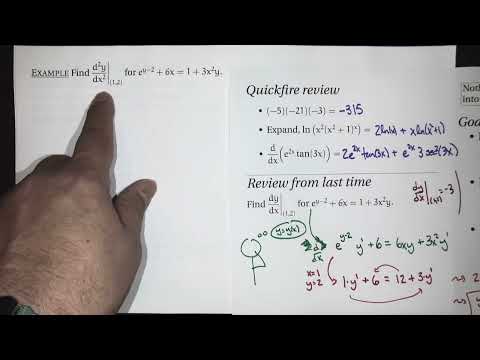 Watch on YouTube →
Overview
The lecture develops derivatives of inverse functions and natural logarithms, connecting both to implicit differentiation and the chain rule. It derives the inverse-function rule and the formula (ln f(x))' = f'(x)/f(x), then uses logarithmic differentiation to recover power rules and derivatives of a^x; worked examples include an inverse derivative of 1/9 and an implicit second derivative of 33/2.
Key takeaways
- For an inverse function, (f⁻¹)′(x) = 1/f′(f⁻¹(x)); first find the original input that produces x, then evaluate f′ there.
- Implicit differentiation treats y as a function of x, so differentiating e^(y−2) produces e^(y−2)y′ and differentiating again introduces y″.
- When only a derivative at a specified point is needed, substituting the point into the differentiated equation before solving can avoid unnecessary algebra.
- The natural-log derivative follows from e^(ln x) = x and is (ln x)′ = 1/x; by the chain rule, (ln f(x))′ = f′(x)/f(x).
- Logarithmic differentiation simplifies complicated products, quotients, and variable powers by converting multiplication and division into addition and subtraction.
- Logarithms distribute over multiplication, division, and exponents, but not addition: ln(a + b) is not ln a + ln b.
Chapters
0:00
Quickfire Review: Log Properties, Product Rule, and Chain Rule
- Expands ln(x²(x² + 1)^x) as 2 ln x + x ln(x² + 1), using product and power properties of logarithms.
- Reviews the derivative of e^(2x)tan(3x): apply the product rule and chain rule to both factors.
- Emphasizes that natural logarithms turn products into sums and bring exponents down as coefficients.
3:00
Implicit Differentiation at the Point (1, 2)
- For e^(y−2) + 6x = 1 + 3x²y, treat y as a function of x and differentiate both sides.
- The product rule gives e^(y−2)y′ + 6 = 6xy + 3x²y′.
- Substituting x = 1 and y = 2 yields y′ = −3 at that point; evaluate before solving when only a point value is needed.
10:00
Implicit Second Derivative: Differentiating Again Without Solving for y′
- Differentiate e^(y−2)y′ + 6 = 6xy + 3x²y′ again, retaining y′ and y″ rather than first isolating y′.
- Use the known values x = 1, y = 2, and y′ = −3 to simplify the second-derivative equation.
- The resulting equation is 2y″ = 33, so y″ = 33/2 at (1, 2).
20:00
Inverse Functions: Reflections and the Reciprocal-Slope Rule
- An inverse undoes a function: f(f⁻¹(x)) = x, and f⁻¹(x) is not the reciprocal 1/f(x).
- The graph of f⁻¹ is the reflection of f across y = x, which swaps input and output and turns tangent-line slopes into reciprocals.
- Implicit differentiation of f(y) = x gives (f⁻¹)′(x) = 1/f′(f⁻¹(x)).
25:00
Finding an Inverse Derivative Without an Inverse Formula
- For f(x) = x⁵ + 4x + 5 and g = f⁻¹, find g′(10) using g′(10) = 1/f′(g(10)).
- Determine g(10) by finding an input that maps to 10: f(1) = 10, so g(10) = 1.
- Since f′(x) = 5x⁴ + 4, f′(1) = 9 and g′(10) = 1/9.
30:00
Combining Inverse Derivatives, Chain Rule, and Table Values
- For f(x) = g⁻¹(h(x)), differentiate with the inverse-function rule and chain rule: f′(x) = h′(x)/g′(g⁻¹(h(x))).
- With f′(2) = 5, h(2) = 4, g⁻¹(4) = 6, and g′(6) = 2, solve to obtain h′(2) = 10.
- A table can supply each nested value in order: evaluate h(2), find the input whose g-output is 4, then read g′ at that input.
37:00
Natural Logarithm Derivative and Logarithm Rules
- Because ln x is the inverse of e^x, implicit differentiation of x = e^y gives (ln x)′ = 1/x.
- The chain rule gives (ln f(x))′ = f′(x)/f(x); place the inside function in the denominator and its derivative in the numerator.
- For ln(e^(3x) + x² + cos(4x)), differentiate the full inside expression, including the −4sin(4x) chain-rule term.
- Logarithms split products, quotients, and powers, but not sums: ln(a + b) cannot be rewritten as ln a + ln b.
44:00
Logarithmic Differentiation Recovers Power and Exponential Rules
- Use f′(x) = f(x)(ln f(x))′ to turn products and quotients into sums and differences before differentiating.
- For x^a with constant a, logarithmic differentiation yields a x^(a−1), extending the power rule beyond positive integer exponents.
- For a^x, the method gives a^x ln(a), explaining why e^x is especially convenient: ln(e) = 1.
48:00
Setting Up the Variable-Power Case x^x
- The lecture closes by posing x^x as a function involving both a variable base and a variable exponent.
- Its derivative cannot be handled by applying only the constant-exponent rule or only the constant-base exponential rule.
- Logarithmic differentiation is identified as the approach for resolving this mixed case in the next lecture.
Summary, takeaways, and chapters were generated by AI from the video's transcript and may contain errors. The video belongs to its creator, Beard Meets Calculus.