Derivative of trigonometric functions (Calc 1; Lecture 1-10; Fall 26)
 Watch on YouTube →
Overview
Beard Meets Calculus reviews limits, logarithms, higher derivatives, and motion before deriving the trigonometric derivative rules for Calc 1. The lecture establishes that d(sin x)/dx = cos x and d(cos x)/dx = −sin x, then applies them to a ladder-rate problem and uses the four-step derivative cycle of sine to evaluate the 137th derivative; quotient-rule results give the derivatives of tangent and secant.
Key takeaways
- The trigonometric limits sin h/h → 1 and (cos h − 1)/h → 0 are the key ingredients in deriving the sine and cosine derivatives from the limit definition.
- The fundamental trig derivative rules are d(sin x)/dx = cos x and d(cos x)/dx = −sin x; the negative sign in the cosine rule is easy to overlook.
- A particle’s position must be differentiated once for velocity and twice for acceleration; average acceleration uses the average rate of change of velocity, whereas instantaneous acceleration is the second derivative at a point.
- For x(t) = t³ − 6t² + 9t + 2, the arm is at rest at 1 and 3 seconds, has average acceleration −9 ft/s² from 0 to 1, and instantaneous acceleration −6 ft/s² at t = 1.
- The derivatives of sin x repeat every four differentiations, so the 137th derivative is cos x because 137 leaves remainder 1 when divided by 4.
- The quotient rule converts the sine and cosine rules into d(tan x)/dx = sec²x and d(sec x)/dx = sec x tan x.
Chapters
0:00
Quick Review: Log Expansion and the Cosine Limit
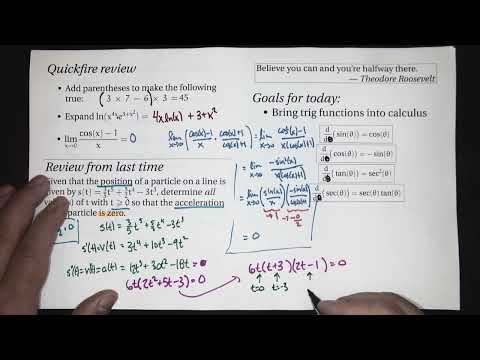
- Expand log(x^(4x)e^(3+x²)) as 4x ln x + 3 + x² using product and power rules for logarithms.
- Resolve lim(x→0) (cos x − 1)/x by multiplying by the conjugate cos x + 1.
- Rewrite the limit to expose sin x/x → 1; the remaining factor tends to zero, so the full limit is zero.
6:49
Finding When a Particle’s Acceleration Is Zero
- For s(t) = (3/5)t⁵ + (5/2)t⁴ − 3t³, differentiate twice to obtain a(t) = 12t³ + 30t² − 18t.
- Factor acceleration as 6t(2t² + 5t − 3) = 6t(2t − 1)(t + 3).
- The roots are t = 0, 1/2, and −3; the condition t ≥ 0 excludes −3, leaving t = 0 and t = 1/2.
13:35
Why Trigonometric Derivatives Matter
- The lecture adds trigonometric functions to the Calc 1 derivative toolkit alongside powers of x and eˣ.
- Triangle trigonometry supports measurements such as inferring a tree’s height from its shadow.
- Circle-based sine and cosine model periodic behavior, including sound waves and digital sound representations.
15:40
Machine-Arm Motion: Rest, Distance, and Acceleration
- For x(t) = t³ − 6t² + 9t + 2 feet on 0 ≤ t ≤ 4, velocity is x′(t) = 3t² − 12t + 9.
- Factoring x′(t) = 3(t − 1)(t − 3) shows the arm is at rest at t = 1 and t = 3 seconds.
- From t = 0 to the first rest time, displacement is x(1) − x(0) = 4 feet; subtracting starting position is essential.
- Average acceleration is [x′(1) − x′(0)]/(1 − 0) = −9 ft/s², while instantaneous acceleration x″(1) = −6 ft/s², directed left.
29:20
Trigonometric Identities and Limits for Derivative Proofs
- The key limits are sin h/h → 1 and (cos h − 1)/h → 0 as h → 0.
- The sine addition identity is sin(a + b) = sin a cos b + sin b cos a.
- The cosine addition identity is cos(a + b) = cos a cos b − sin a sin b; the quotient rule will extend results to other trig functions.
33:37
Deriving the Sine Rule: d(sin x)/dx = cos x
- Apply the limit definition using [sin(θ + h) − sin θ]/h and expand sin(θ + h) with the addition identity.
- Separate the resulting terms and apply sin h/h → 1 and (cos h − 1)/h → 0 to obtain cos θ.
- Use tangent slopes on the sine graph as a check: slope is 1 at zero, zero at a crest, and negative near a descending steep section.
36:52
Deriving the Cosine Rule and Tracking Its Negative Sign
- Using the cosine addition identity in the limit definition gives d(cos θ)/dθ = −sin θ.
- The negative sign reflects the graph’s initial downward slope from its maximum at θ = 0.
- Horizontal tangent lines on the cosine graph correspond to derivative zeros; checking signs and the graph helps catch a commonly missed minus sign.
39:24
A 10-Foot Ladder Connects Geometry to a Derivative
- With θ measured between a 10-foot ladder and the wall, the floor distance x is opposite θ and the ladder is the hypotenuse.
- The sine ratio gives sin θ = x/10, hence x = 10 sin θ.
- Differentiating with respect to θ yields dx/dθ = 10 cos θ, the rate of change of the floor distance per unit change in angle.
44:24
The 137th Derivative and Rules for Tangent and Secant
- Successive derivatives of sin x cycle sin x, cos x, −sin x, −cos x, then repeat every four derivatives.
- Since 137 = 4·34 + 1, the 137th derivative of sin x matches the first derivative: cos x.
- Writing tan x = sin x/cos x and applying the quotient rule gives d(tan x)/dx = sec²x.
- Writing sec x = 1/cos x gives d(sec x)/dx = sec x tan x; the lecture also notes d(cot x)/dx = −csc²x and d(csc x)/dx = −csc x cot x.
Summary, takeaways, and chapters were generated by AI from the video's transcript and may contain errors. The video belongs to its creator, Beard Meets Calculus.