Derivative at a point (Calc 1; Lecture 1-6; Fall 26)
 Watch on YouTube →
Overview
Beard Meets Calculus develops the derivative at a point from secant-line limits, showing that it measures instantaneous rate of change and gives the slope of the best local linear approximation. The lecture defines the derivative using both a variable point and an increment h, tests the definition on |x| and 2x² + 3x + 7, and uses point-slope form to find tangent lines, including y = 4x for sin(4x) at x = 0.
Key takeaways
- The derivative f′(a) is the limit of secant slopes as their two points approach one another, making it the instantaneous rate of change at a.
- The equivalent derivative definitions using b → a and h → 0 describe the same limit; the h form often simplifies algebra because cancellation can target h directly.
- For f(x) = |x|, the difference quotient at zero has one-sided values 1 and −1, so the derivative does not exist at the graph’s kink.
- Applying the difference quotient to 2x² + 3x + 7 yields f′(a) = 4a + 3 after expanding, canceling constant-in-h terms, and removing a factor of h.
- A tangent line at x = a has equation y = f(a) + f′(a)(x − a), combining the function value and derivative into a local linear approximation.
- The derivative of sin(4x) at zero is 4, since sin(4h)/h = 4·sin(4h)/(4h) approaches 4; its tangent line is y = 4x.
Chapters
0:00
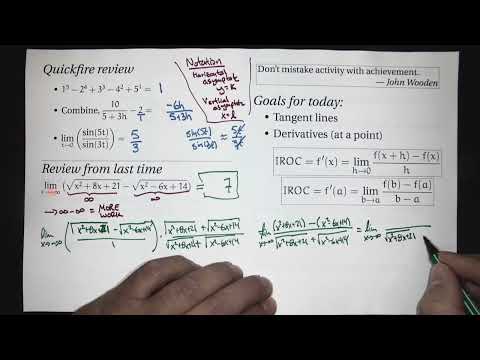
Quickfire Review: Fraction Simplification and a Sine Limit
- The opening arithmetic review gives 1 for the alternating powers expression.
- Combining the displayed fractions produces -6h/(5 + 3h).
- Using sin(u) ≈ u near zero, sin(5t)/sin(3t) approaches 5/3 as t approaches zero.
1:52
Asymptote Notation and an Indeterminate Limit at Negative Infinity
- Horizontal asymptotes are written as y = constant; vertical asymptotes are written as x = constant.
- The limit of √(x² + 8x + 21) − √(x² − 6x + 14) as x approaches −∞ has the indeterminate form ∞ − ∞.
- Because both radicals grow large, comparing their dominant behavior requires additional algebra rather than direct substitution.
6:15
Rationalizing the Radical Difference with a Conjugate
- Multiplying by the conjugate, √(x² + 8x + 21) + √(x² − 6x + 14), converts the numerator using a difference of squares.
- The numerator simplifies to 14x + 7, leaving a ratio with a sum of square roots in the denominator.
- As x approaches −∞, the numerator tends to −∞ and the denominator to +∞, so the expression still needs to be scaled.
11:10
Scaling by 1/x and Preserving the Sign at Negative Infinity
- Dividing numerator and denominator by x exposes the terms that vanish, including 7/x, 8/x, 21/x², −6/x, and 14/x².
- Inside the radicals, dividing by x² leaves each radicand approaching 1.
- Since x is negative near −∞, √(x²) = |x| = −x; retaining this sign gives the limit −14/2 = −7.
18:36
From Secant Lines to Two Definitions of the Derivative
- The derivative f′(a) is defined as limᵦ→ₐ [f(b) − f(a)]/(b − a), the limit of average rates of change as the two points meet.
- Setting b = a + h gives the equivalent form f′(a) = limₕ→₀ [f(a + h) − f(a)]/h, which often makes cancellation easier.
- The derivative is the instantaneous or local rate of change and supplies the slope of the tangent line that best approximates the function near a.
26:04
Why |x| Is Not Differentiable at the Origin
- The graph of f(x) = |x| remains V-shaped under any zoom at x = 0, so it does not locally resemble one line.
- The difference quotient at zero is |h|/h: it equals 1 for h > 0 and −1 for h < 0.
- Because the one-sided limits disagree, the limit does not exist and f′(0) is undefined.
31:21
Deriving the Polynomial Rule from the Difference Quotient
- For f(x) = 2x² + 3x + 7, substitute a + h everywhere x appears in f(a + h), using parentheses to avoid substitution errors.
- Expanding and subtracting f(a) cancels the terms without h; the remaining numerator is 4ah + 2h² + 3h.
- After factoring and canceling h, the limit as h approaches zero gives f′(a) = 4a + 3.
40:02
Reading Tangent-Line Information from Point-Slope Form
- At x = a, the tangent line passes through (a, f(a)) and has slope f′(a).
- Its equation is y = f(a) + f′(a)(x − a), which records both the function value and its local rate of change.
- If 3x − 7 is tangent to y = f(x) at x = 4, then f(4) = 5 and f′(4) = 3.
44:06
Finding the Tangent to sin(4x) at the Origin
- For f(x) = sin(4x), the point at x = 0 is (0, 0).
- The derivative quotient becomes limₕ→₀ sin(4h)/h; rewriting it as 4 · sin(4h)/(4h) gives slope 4.
- The tangent line through (0, 0) with slope 4 is y = 4x, matching the local approximation sin(4x) ≈ 4x.
Summary, takeaways, and chapters were generated by AI from the video's transcript and may contain errors. The video belongs to its creator, Beard Meets Calculus.