Derivative as a rate of change (Calc 1; Lecture 1-9; Fall 26)
 Watch on YouTube →
Overview
Beard Meets Calculus develops derivatives as practical tools: it reviews differentiation rules, explains higher-order derivatives and their units, and connects rates of change to geometry and motion. Examples include the eighth derivative of 2e^t + t^8, the area rate dA/dr = 2πr, and a projectile whose maximum height is 36 feet.
Key takeaways
- A derivative is a rate of change: differentiating circle area A = πr² with respect to radius gives 2πr, the circumference.
- Higher derivatives can be found efficiently by spotting patterns: for 2e^t + t^8, the eighth derivative at zero is 40,322, and all derivatives after the eighth evaluate to 2 at zero.
- For a function measured in units of y with input measured in units of x, its nth derivative has units of y/x^n; pressure per depth squared in the example is pounds per inch to the fourth power.
- Position, velocity, and acceleration are successive derivatives: v = s' and a = s'', with velocity retaining direction and speed equal to its magnitude.
- To find the projectile’s maximum height, solve s'(t) = 0 to locate the turning time, then substitute that time into s(t); the example reaches 36 feet at 1.5 seconds.
- Complex differentiation is manageable when expressions are treated as layers: identify the outer rule first, then apply the appropriate rules to each component.
Chapters
0:00
Quickfire Review: Exponential Equations and Vertical Asymptotes
- Rewrites e^(2q) - 4e^q = 45 as a quadratic by setting y = e^q; since y must be positive, q = ln(9).
- Finds denominator zeros x = 1 and x = 2 for a rational function, then checks the numerator to distinguish the hole at x = 1 from the vertical asymptote at x = 2.
5:00
Differentiation Rules: Powers, Products, Constants, and Linearity
- Rewrites cube roots and fractions as powers, such as y^(1/3) and y^(-3), to make expressions compatible with differentiation rules.
- Applies the product rule to y^(1/3)e^y and the power rule to y^(-3); the derivative of the constant 4π^5 is zero.
- Treats x, y, and t equally as variables: the differentiation symbol specifies which variable is changing.
10:00
Quotient Rule and Simplifying a Derivative with e^(-x)
- Rewrites e^(-x) as 1/e^x, then differentiates (x^2 + 2x + 2)/e^x using the quotient rule.
- The quotient-rule numerator simplifies through cancellation to -x^2e^x, leaving the derivative -x^2e^(-x).
- Uses the rule u'v - uv' over v^2 and recommends checking the order of terms to avoid a sign error.
17:00
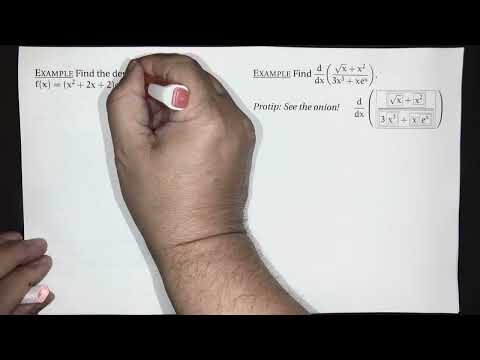
Layered Derivatives: Applying Rules One Onion Layer at a Time
- Breaks a quotient containing √x + x^2 over 3x^3 + xe^x into nested rules: quotient, linearity, power, constant multiple, and product.
- Differentiates xe^x as e^x + xe^x, then places the full unsimplified result over (3x^3 + xe^x)^2.
- Emphasizes identifying each rule layer and carefully copying unchanged terms rather than trying to simplify every expression.
22:00
Second and Higher Derivatives: Notation and Meaning
- Defines the second derivative as taking the derivative of the first derivative, with notations including f''(x) and d²y/dx².
- Introduces f^(n) for higher derivatives because counting many prime marks, such as 17, becomes impractical.
- Explains that each derivative is itself a function, so it can be sent through the differentiation process again.
25:00
Derivative Patterns in 2e^t + t^8
- Shows that every derivative of 2e^t retains the term 2e^t, while repeated differentiation reduces the power in t^8.
- The eighth derivative is 2e^t + 8!, so its value at t = 0 is 2 + 40,320 = 40,322.
- After eight derivatives the polynomial term disappears; the tenth and hundredth derivatives evaluated at zero are both 2.
30:00
Derivative Units: Pressure Change per Inch Squared
- For y measured in units of y and x measured in units of x, the nth derivative has units of y divided by x^n.
- If pressure P is measured in pounds per square inch and depth x in inches, P'' has units of pounds per inch to the fourth power.
- Units describe successive rates of change and can help identify which derivative is relevant in an applied problem.
36:00
Geometric Rates of Change: Circle Circumference and Sphere Surface Area
- From A = πr², differentiating with respect to radius gives dA/dr = 2πr, the circle’s circumference.
- A small increase in radius adds a thin outer halo whose area change is approximated by the circumference times the radius change.
- For a sphere, differentiating V = (4/3)πr³ gives dV/dr = 4πr², its surface area.
40:00
Particle Motion and a Projectile’s 36-Foot Maximum Height
- Models position as s(t), velocity as s'(t), and acceleration as s''(t); velocity includes direction, while speed is its magnitude.
- For the projectile path s(t) = -16t² + 48t feet, sets velocity -32t + 48 to zero to find the turning point at t = 3/2 seconds.
- Substituting t = 3/2 into position gives a maximum height of 36 feet above the firing point; the separate valley-impact speed question is posed but not worked through.
Summary, takeaways, and chapters were generated by AI from the video's transcript and may contain errors. The video belongs to its creator, Beard Meets Calculus.