Derivative as a function (Calc 1; Lecture 1-7; Fall 26)
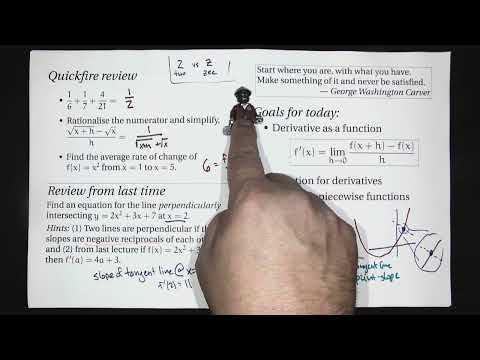 Watch on YouTube →
Overview
Beard Meets Calculus develops the derivative from its limit definition into a function that gives tangent-line slopes and instantaneous rates of change. Worked examples show how to compute derivatives with conjugates and common denominators, use derivative values to find tangent or normal lines, and test piecewise functions for differentiability by checking continuity and matching one-sided slopes.
Key takeaways
- For f(x)=√(2x+3), the limit definition and conjugate multiplication yield f′(x)=1/√(2x+3); the tangent parallel to slope 1/5 occurs at x=11.
- A normal line at a curve point uses the negative reciprocal of the tangent slope; for 2x²+3x+7 at x=2, its slope is −1/11 and its point is (2,21).
- Differentiability implies continuity, but continuity alone is insufficient: the piecewise example is continuous at x=0 yet not differentiable because its one-sided slopes are 0 and −1.
- At a piecewise join, differentiability requires both matching function values and matching one-sided derivative limits; the four-piece example passes this test at x=1 but fails at x=0 and x=2.
- Before taking a derivative, simplify the expression when possible: the rational expression in t reduces to the constant 1, whose derivative is 0.
- In limit-definition calculations, terms without h should cancel from the numerator before substituting h=0; their failure to cancel signals an algebra error.
Chapters
0:00
Quick Review: Fractions, Conjugates, and Average Rate of Change
- Combining 1/6 + 1/7 + 4/21 gives 1/2 by using a common denominator.
- Rationalizing (√(x+h) − √x)/h with the conjugate produces 1/(√(x+h) + √x) after canceling h.
- The average rate of change of f(x)=x² from x=1 to x=5 is 6, using (f(5)−f(1))/(5−1).
2:00
Finding a Normal Line from the Tangent Slope
- For f(x)=2x²+3x+7, the derivative is f′(x)=4x+3, so the tangent slope at x=2 is 11.
- A line perpendicular to the tangent has the negative reciprocal slope −1/11.
- Since f(2)=21, the normal line is y=21−(1/11)(x−2), in point-slope form.
10:27
George Washington Carver’s Advice and the Lecture Goals
- George Washington Carver, an Iowa State alumnus commemorated in Carver Hall, is introduced through the advice to start with what you have and keep improving.
- The lecture’s goals are to define the derivative as a function, introduce derivative notation, and examine derivatives of piecewise functions.
12:30
Using the Limit Definition to Find Parallel Tangents
- For f(x)=√(2x+3), a tangent parallel to y=(1/5)x−7 must have derivative 1/5.
- Applying the limit definition f′(a)=limₕ→₀[f(a+h)−f(a)]/h requires substituting a+h everywhere the original function has x.
- Multiplying by the conjugate cancels h and gives f′(a)=1/√(2a+3); setting this equal to 1/5 yields a=11.
- The point is (11,5), so the tangent line is y=5+(1/5)(x−11); the lecture also recommends retaining point-slope form to reduce arithmetic errors.
24:00
The Derivative Function, Differentiability, and Notation
- Replacing the fixed point a with x in the limit definition produces f′(x), a new function giving the derivative wherever it exists.
- A function is differentiable where it has a derivative; differentiability implies continuity, so a discontinuous function cannot be differentiable there.
- Derivative notation includes f′(x), dy/dx, and d/dx; the vertical bar in (dy/dx)|ₓ₌ₐ indicates evaluation at x=a.
- The derivative can be viewed as an operator that takes a function as input and returns another function.
29:30
Limit-Definition Example: Derivative of 3/(2x+5)
- Starting with f(x+h)−f(x) over h for f(x)=3/(2x+5), the two fractions are combined using the common denominator (2x+2h+5)(2x+5).
- Expanding the numerator gives cancellation of the terms without h; the remaining −6h cancels with the h in the denominator.
- Taking h→0 gives the derivative −6/(2x+5)².
- Cancellation is a useful error check: after the subtraction, terms independent of h should cancel before evaluating the limit.
38:30
Simplify the Expression Before Differentiating
- A complicated rational expression in t is rewritten over a common denominator before attempting the derivative.
- The resulting numerator and denominator both simplify to (t²+2)², so the original expression equals 1.
- Since the derivative of the constant 1 with respect to t is 0, simplifying first avoids unnecessary limit-definition algebra.
42:30
Piecewise Differentiability Requires Smooth Joins
- At a point where a piecewise function changes formulas, differentiability requires continuity and agreement of the left- and right-hand derivative limits.
- If continuity fails, differentiability fails automatically; there is no need to check derivative matching at that join.
- Away from join points, differentiate each formula on its own interval; the join points must be checked separately.
45:00
Checking the Joins of a Four-Piece Function
- For the example using x⁴, 2x²−x, x³, and 12x on successive intervals, the derivative formulas are 4x³, 4x−1, 3x², and 12.
- At x=0, the pieces meet continuously at 0, but the one-sided derivatives are 0 and −1, so the join has a kink and is not differentiable.
- At x=1, both pieces approach 1 and both derivative limits equal 3, so the function is differentiable there.
- At x=2, the left and right function limits are 8 and 24, so the function is discontinuous and cannot be differentiable.
Summary, takeaways, and chapters were generated by AI from the video's transcript and may contain errors. The video belongs to its creator, Beard Meets Calculus.