CSCE145 F2026 06 Classes and Objects Part 03
 Watch on YouTube →
Overview
Java classes organize data and methods, while objects are dynamically allocated on the heap and method calls use the call stack. Static fields and methods are class-level members shared across instances; the Pet example demonstrates using static factory and cloning methods to create objects without tying those operations to a particular Pet.
Key takeaways
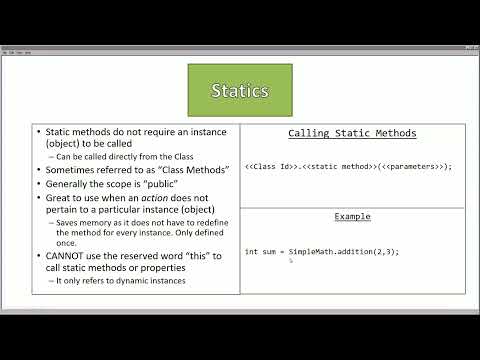
- A Java static method belongs to the class rather than an individual object, so it can be called with the class name and cannot directly use `this` or instance methods.
- Instance fields such as a Pet's name and weight vary from object to object, while static members provide shared class-level functionality.
- A static factory such as `Pet.createNewPet(type)` can construct and configure an instance internally, returning it without requiring a preexisting Pet object.
- A cloning method can copy an object's property values into a newly constructed object, producing equal contents but a distinct reference.
- Check for `null` before invoking instance methods on a method parameter, as demonstrated by the guard in `Pet.clonePet`.
- Java utility classes expose common static functionality: `Math` supplies numeric operations, wrapper classes provide parsing and numeric constants, and `Character` provides character tests and conversions.
Chapters
0:00
Java Object Memory and the Difference Between Static and Instance Members
- Java organizes software into projects, classes, and methods; classes define shared characteristics for their objects.
- Method calls are pushed onto and popped from the call stack, while objects created with `new` are dynamically allocated on the heap.
- Static fields and methods are described as class-level members created once in the data section, unlike instance members that belong to individual objects.
- Because static members are shared rather than tied to one object, static code cannot use `this` to access instance members.
8:34
Calling Static Methods in Math and Java Wrapper Classes
- Call static methods through the class name, such as `Math.pow`, `Math.abs`, `Math.max`, and `Math.sqrt`, without constructing a `Math` object.
- `Math.round` has overloaded forms that accept `float` and `double` parameters.
- `Integer.parseInt` converts a `String` to an integer, while `Integer.MAX_VALUE` and `Integer.MIN_VALUE` provide integer limits.
- `Double.parseDouble` and `Double`'s `MAX_VALUE` and `MIN_VALUE`, along with `Character` methods such as `isDigit` and `toUpperCase`, illustrate reusable static functionality.
12:26
Pet.createNewPet: A Static Factory Method for Pet Objects
- The Pet class stores instance-specific properties including name, age, weight, and an enumerated pet type.
- A `public static Pet createNewPet(PetType type)` method creates a default Pet, sets its type, and returns the new instance.
- Calling `Pet.createNewPet(PetType.HAMSTER)` from `PetPlace` creates a hamster without first constructing a Pet object to invoke the method.
- The static factory cannot call the instance mutator through `this`; it must create a Pet object before calling `setType`.
18:19
Pet.clonePet: Copying Properties While Creating a Distinct Object
- `Pet.clonePet(Pet p)` first checks whether `p` is `null`, returning `null` rather than calling methods on a missing object.
- For a valid Pet, the method constructs a new Pet with the parameterized constructor and copies name, age, weight, and type using getters.
- Cloning `pet04` into `pet05` produces a Pet with the same property values but a separate heap allocation.
- Use `equals` to compare object contents and `==` to compare references; the two cloned pets can be equal in content while `pet04 == pet05` is false.
Summary, takeaways, and chapters were generated by AI from the video's transcript and may contain errors. The video belongs to its creator, UofSC_CSCE145_CSCE146.