CSCE145 F2026 06 Classes and Objects Part 02
 Watch on YouTube →
Overview
UofSC_CSCE145_CSCE146 demonstrates how to build a Java `Pet` class using private fields, constructors, accessors, validated mutators, `toString`, and `equals`. The example introduces a `PetType` enum for a fixed set of pet categories, creates three pet objects in `PetPlace`, and shows method overloading by adding a `giveCompliment(int)` method.
Key takeaways
- Private fields in `Pet` preserve encapsulation, while getters and mutators provide controlled access to name, age, weight, and type.
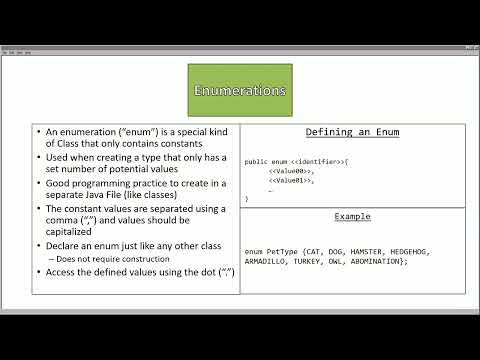
- A `PetType` enum is appropriate when a field has a fixed set of valid categories; the example defines eight values, including UNKNOWN.
- Mutators centralize validation: invalid ages reset to 0, nonpositive weights reset to 1.0, and null pet types reset to UNKNOWN.
- The parameterized `Pet` constructor reuses mutators, so validation is implemented once rather than duplicated in constructor logic.
- `equals(Pet)` compares a `String` name by contents, primitive fields by value, and enum constants with `==` after checking for a null argument.
- Overloading `giveCompliment()` with `giveCompliment(int)` lets one method name support either a single reaction or a counted loop of reactions.
Chapters
0:00
Classes as Blueprints and the Seven-Step Design Process
- Java organizes software into projects, classes, and methods; classes group shared data and actions for objects.
- Treat nouns such as `Pet` as candidates for classes and verbs as candidate methods.
- The recommended seven steps are define the class, add fields, write constructors, add accessors and mutators, implement methods such as `equals` and `toString`, then create objects.
2:05
Modeling Pets with Private Fields and a PetType Enum
- The `Pet` class begins with private `name` (`String`), `age` (`int`), and `weight` (`double`) fields to support encapsulation.
- A separate `PetType` enum represents the fixed categories CAT, DOG, HAMSTER, HEDGEHOG, ARMADILLO, TURKEY, OWL, and UNKNOWN.
- Using an enum constrains pet types to known values and avoids validating arbitrary strings against every allowed category.
11:08
Default and Parameterized Pet Constructors
- The no-argument constructor initializes `name` to "none", `age` to 0, `weight` to 1.0, and `type` to `PetType.UNKNOWN`.
- The parameterized constructor accepts a name, age, weight, and `PetType` value to initialize a pet in one call.
- Rather than duplicating validation logic, the parameterized constructor delegates each value to its corresponding mutator.
14:16
Accessors and Mutators for Controlled Pet Data
- Public getters such as `getName()`, `getAge()`, `getWeight()`, and `getType()` expose private fields without making the fields public.
- Mutators validate incoming values: negative ages become 0, nonpositive weights become 1.0, and a null type becomes `PetType.UNKNOWN`.
- `setName` checks whether its `String` argument is null before assigning it; the example assigns null in the null case.
- Java permits omitting braces around a one-statement `if` or `else`, though braces remain optional style guidance.
22:26
Pet String Output, Equality Checks, and Compliments
- `toString()` concatenates a pet's name, age, weight, and type into a printable string.
- `equals(Pet)` first checks that the other pet is not null, then compares names with `String.equals`, primitive fields with `==`, and enum values with `==`.
- The no-argument `giveCompliment()` method prints the pet's name followed by a joyful reaction.
29:06
Creating Pet Objects in the PetPlace Main Method
- `PetPlace` provides a `main` entry point and creates `pet01` with default values.
- A parameterized constructor creates Mr. Flufferkins as a 7-year-old, 8.6-weight cat and Rufus as a 3-year-old, 15-weight dog.
- Printing each pet invokes `toString()` implicitly, while calling `pet02.giveCompliment()` prints Mr. Flufferkins' reaction.
33:25
Overloading giveCompliment with a Count Parameter
- Method overloading keeps the `giveCompliment` name while giving the new version an `int` parameter for the number of compliments.
- A `for` loop runs from `i = 0` while `i < c`, calling the existing no-argument method once per iteration.
- Calling `giveCompliment(3)` on Rufus produces three reactions; the lecture closes by recapping classes, enums, and overloading.
Summary, takeaways, and chapters were generated by AI from the video's transcript and may contain errors. The video belongs to its creator, UofSC_CSCE145_CSCE146.