CSCE145 F2026 01Branching Statements Part 02
 Watch on YouTube →
Overview
The lesson explains how Java branching works through nested if statements, else-if chains, and the importance of matching control flow to whether conditions are dependent or independent. It builds a console-based prize-selection game with Scanner input, string comparisons, constants, and nested decisions, then demonstrates Eclipse breakpoints, the ternary operator, operator precedence, and short-circuit evaluation.
Key takeaways
- Nested if statements are appropriate when a later test only makes sense after an earlier condition succeeds; braces make each Java branch's scope unambiguous.
- An else-if chain checks alternatives only after earlier conditions fail, whereas separate if statements evaluate independent conditions even when previous tests were true.
- Java strings should be compared by content with equals() or equalsIgnoreCase(); the prize game uses equalsIgnoreCase() to accept box choices regardless of capitalization.
- A decision tree for contestant choices must account for every valid combination and invalid input; initializing prizes to "nothing" provides a default outcome.
- Eclipse breakpoints and Step Over expose the current execution line and variable values, making them useful for tracing branch selection and diagnosing logic errors.
- Java short-circuit evaluation can avoid unnecessary or unsafe boolean checks: && stops after a false left operand, and || stops after a true left operand.
Chapters
0:00
Nested If Statements and Why Java Braces Matter
- A nested if places another conditional inside an if or else body, allowing Java to test combinations such as A == B and then B == C.
- A flowchart can clarify the paths: a false outer condition skips its nested body, while a true outer condition proceeds to the inner test.
- Java allows braces to be omitted for a one-statement body, but an entire if-else counts as one statement and can produce surprising logic if indentation is mistaken for scope.
- Use curly braces consistently to make if and else bodies explicit and avoid dangling-else errors.
4:35
Else-If Chains Versus Independent If Checks
- An else-if is shorthand for an if statement inside the else of a preceding if, so it is considered only when earlier conditions are false.
- A chain of else-if statements runs at most one matching branch before continuing past the chain.
- Separate if statements are independent checks; later conditions can run even when an earlier condition was true.
- Use else-if when each choice depends on the preceding condition, and separate if statements when conditions should be tested independently.
8:51
Prize-Box Game: Decisions, Choices, and Java Input Setup
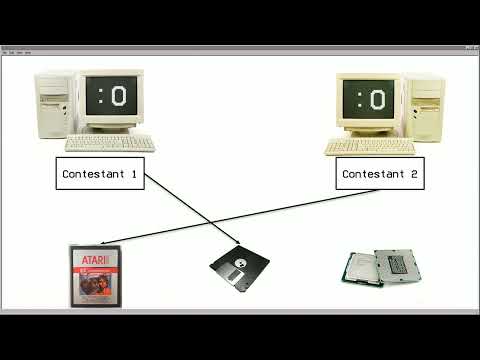
- The example game offers three boxes: box one contains an Atari 2600 copy of E.T., box two a floppy disk, and box three a new CPU.
- The Java program reads console input with java.util.Scanner and stores contestant prizes in String variables initialized to "nothing".
- The fixed prizes are represented as public static final String constants, conventionally written in uppercase to signal that they do not change.
- Contestants choose from the remaining boxes, so each choice determines which options should be prompted next.
11:00
Implementing Box Choices with String Comparisons and Nested Branches
- The program captures each choice with Scanner.nextLine() and compares string contents using equalsIgnoreCase(), not ==.
- Nested if/else-if/else branches assign the appropriate prize and handle invalid contestant-two input by leaving the prize as "nothing".
- The outer branches cover contestant one's choices of box one, two, or three; each branch prompts contestant two to select from the remaining boxes.
- If contestant one enters an invalid choice, the program reports the error and calls System.exit(0); otherwise it prints both prizes and a closing message.
25:48
Debugging Java Branches with Eclipse Breakpoints
- In Eclipse, double-clicking beside a line number sets a breakpoint, and launching with the bug icon pauses execution when the program reaches it.
- The Debug perspective displays variable values and the next line to execute; Step Over advances one line at a time.
- Tracing inputs such as "box one" and then "box three" shows how answer is reassigned, the matching else-if executes, and prize variables change.
- System.out.println statements offer a simple way to inspect program behavior when a full IDE debugger is unavailable.
30:44
Ternary Expressions, Operator Precedence, and Short-Circuiting
- Java's conditional (ternary) operator uses condition ? value1 : value2 to select a value, making it useful for concise assignments and print statements.
- The operator hierarchy discussed progresses through unary operators, multiplication/division/modulo, addition/subtraction, relational comparisons, equality checks, and boolean operators.
- Logical AND (&&) takes precedence over logical OR (||); parentheses help make mixed boolean expressions clear.
- Short-circuit evaluation skips unnecessary checks: false && expression is already false, and true || expression is already true.
Summary, takeaways, and chapters were generated by AI from the video's transcript and may contain errors. The video belongs to its creator, UofSC_CSCE145_CSCE146.