CS50x - Lecture 5 - Data Structures
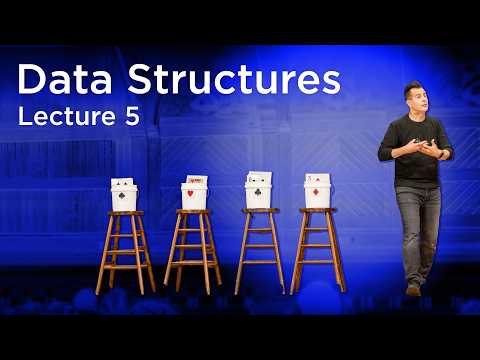 Watch on YouTube →
Overview
CS50's Lecture 5 introduces fundamental data structures: stacks (LIFO) and queues (FIFO), abstracting their behavior from implementation. The lecture then delves into arrays, demonstrating dynamic memory allocation with `malloc`, `realloc`, and `free` in C, highlighting trade-offs between static and dynamic sizing. It progresses to linked lists, explaining node structures and pointer manipulation for dynamic growth, and finally explores binary search trees and hash tables, emphasizing their performance benefits (logarithmic or constant time) and memory/collision trade-offs, culminating in a discussion of tries for optimal constant-time lookups at the cost of significant memory usage.
Key takeaways
- Data structures like stacks, queues, arrays, linked lists, BSTs, hash tables, and tries offer different trade-offs in time complexity, space complexity, and implementation ease.
- Dynamic memory allocation in C using `malloc`, `realloc`, and `free` is crucial for flexible data structures like linked lists and resizing arrays.
- Linked lists provide dynamic sizing but typically O(n) performance for most operations, unlike arrays' O(log n) search (if sorted) but static size limitations.
- Binary Search Trees offer O(log n) average performance but can degrade to O(n) if unbalanced; hash tables aim for O(1) average lookup but face collision challenges.
- Tries achieve true O(k) (effectively constant time for bounded keys) lookups by using character-based arrays in nodes, but at the cost of potentially high memory usage.
Chapters
- Week 5 focuses on data structures, transitioning from C to Python next week.
- Stacks (LIFO) and Queues (FIFO) are introduced as abstract data types.
- Queues use FIFO (First-In, First-Out) with operations NQ (enqueue) and DQ (dequeue).
- Stacks use LIFO (Last-In, First-Out) with operations PUSH and POP.
- A queue can be implemented using a fixed-size array and a size counter.
- This approach has limitations: fixed capacity leads to overflow or wasted memory.
- Stacks can use a similar array-based implementation.
- The core limitation of fixed-size arrays is the need to pre-determine capacity.
- Arrays typically require static allocation, but dynamic allocation with `malloc` is possible.
- Reallocating memory with `realloc` allows resizing arrays, copying data if necessary.
- Proper memory management requires checking `malloc`/`realloc` return values for `NULL` and using `free` to release allocated memory.
- Manual reallocation involves temporary pointers, copying data, freeing old memory, and updating the main pointer.
- Linked lists overcome array's fixed-size limitation by allocating nodes dynamically.
- Each node contains data and a pointer (`next`) to the subsequent node.
- A `list` pointer (node star) tracks the head of the list.
- Prepending elements to a linked list is O(1), but appending or searching is O(n).
- A `node` struct contains an integer (`number`) and a pointer to the next node (`next`).
- The `list` variable (node star) points to the first node, initialized to `NULL`.
- Nodes are allocated using `malloc` and linked by updating `next` pointers.
- Traversing the list for printing or deletion requires iterating through nodes until `NULL` is reached.
- Prepending to a linked list is O(1) due to direct pointer manipulation at the head.
- Searching, appending, and deleting elements in a basic linked list are O(n) in the worst case.
- Maintaining sorted order requires careful insertion logic, potentially increasing complexity.
- Freeing memory involves iterating through the list and freeing each node individually.
Summary, takeaways, and chapters were generated by AI from the video's transcript and may contain errors. The video belongs to its creator, CS50.