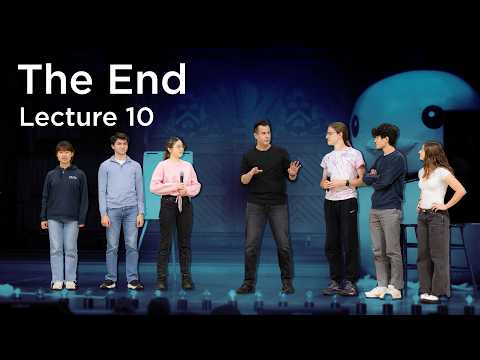
CS50x - Lecture 10 - The End
 Watch on YouTube →
Overview
CS50x's final lecture, "The End," reviews the course's progression from Scratch to C, Python, web programming, and AI, emphasizing problem-solving and the "delta" of student improvement. It features interactive "CS50 Pictionary" and "charades" to illustrate concepts like abstraction and algorithmic precision, and provides guidance on final projects, including leveraging AI tools like GitHub Copilot and setting up development environments with VS Code and Docker.
Key takeaways
- CS50 emphasizes student growth (the 'delta' from start to finish) as the primary measure of success, rather than relative performance.
- The 'CS50 Pictionary' exercise demonstrated that precise, unambiguous instructions and effective abstraction are crucial for algorithmic problem-solving.
- Students are encouraged to leverage AI tools like GitHub Copilot and cloud platforms like AWS/Google Cloud for their final projects, reflecting industry trends.
- The course provides a roadmap for continued learning through additional CS50 open courseware, development tools like VS Code and Docker, and community resources like Stack Overflow.
- The final lecture reinforces core computer science concepts through interactive games like charades and a quiz, covering topics from data structures to web protocols.
Chapters
0:00
Introduction and Course Reflection
- CS50x Week 10 marks the end of the course, celebrating student progress.
- The course emphasizes personal growth (delta from week 0 to week 10) over relative performance.
- The core of computer science is presented as problem-solving with algorithms, inputs, and outputs.
5:20
CS50 Pictionary: Algorithmic Precision Exercise
- Volunteer Gia provides verbal instructions to program the audience to draw a cube.
- The exercise highlights challenges in precise, unambiguous instruction and the importance of abstraction.
- Lack of abstraction led to confusion, demonstrating the need for clear, step-by-step instructions.
16:52
Audience Programming Presley: Verbal Instruction Exercise
- Volunteer Presley draws based on audience verbal commands.
- This exercise contrasts with Gia's role, with the audience providing instructions.
- It demonstrates the interplay between low-level details and high-level abstractions in programming.
26:55
CS50 Trajectory: From Scratch to Modern Paradigms
- Recap of the course's journey: Scratch (procedural fundamentals), C (foundational language), Python, SQL, Java.
- Discussion of data structures (hash tables, linked lists) and their trade-offs.
- Introduction to modern paradigms: web programming (HTML, CSS, JavaScript) and AI.
30:34
Final Project Guidance and AI Integration
- The final project encourages students to define their own problems and solutions, moving beyond guided problem sets.
- Students are encouraged to leverage AI tools like ChatGPT, Claude, and GitHub Copilot to amplify productivity.
- The goal is to build something of personal interest that solves a real problem or creates lasting value.
33:22
CS50 Hackathon and Fair: Project Support and Showcase
- The CS50 Hackathon provides a late-night opportunity for students to work on final projects with staff support.
- The CS50 Fair is an end-of-semester exhibition to present final projects to the wider community.
- Support structures include pizza, ice cream, and a trip to IHOP during the hackathon.
38:53
CS50 Charades: Review Game
- A game of charades is played with six volunteers to review CS50 concepts.
- Teams "Team A" and "Awesome Sauce" compete by acting out terms related to computer science.
- Examples of acted-out terms include recursion, abstraction, and binary search.
50:10
Development Environment: VS Code, Docker, and Command Line
- CS50.dev uses Visual Studio Code (VS Code), an industry-standard tool.
- Students can install VS Code locally and use Docker to run a CS50 environment for offline development.
- Introduction to Git for version control and collaboration, and VS Code's Live Share feature.
Summary, takeaways, and chapters were generated by AI from the video's transcript and may contain errors. The video belongs to its creator, CS50.