CS50 Business - Lecture 7 - Deploying Databases (live, unedited)
 Watch on YouTube →
Overview
David Malan introduces CS50 Business, focusing on deploying databases with SQL. He contrasts flat-file databases (like CSVs) with relational databases, demonstrating SQL's CRUD operations (Create, Read, Update, Delete) using SQLite. Malan explores one-to-one, one-to-many, and many-to-many relationships with IMDb data, highlighting the use of JOINs and nested queries, and discusses indexing for performance and the risks of race conditions and SQL injection attacks.
Key takeaways
- Relational databases, using SQL, offer structured data storage with powerful querying and integrity features, contrasting with simpler flat-file approaches.
- SQL's CRUD operations, JOINs, and aggregate functions enable complex data manipulation and analysis.
- Database design involves choosing appropriate relationships (one-to-one, one-to-many, many-to-many) and using keys (primary, foreign) for integrity.
- Indexing significantly improves query performance by optimizing data lookup, while transactions and parameterized queries are crucial for security and concurrency.
- NoSQL databases offer alternative hierarchical data storage, suitable for different use cases but often lacking SQL's strict constraints and mature indexing.
- Security vulnerabilities like race conditions and SQL injection require careful coding practices, including parameterized queries and transaction management.
Chapters
13:10
Introduction to Databases and Data Warehousing Concepts
- Databases store organized information, which can be textual or binary.
- Data warehouses aggregate data from multiple databases.
- Data marts are subsets of data, while data lakes are unorganized collections.
21:05
Flat File Databases and CSV Structure
- Flat file databases store data in a single file, like text or CSV.
- CSV (Comma Separated Values) uses commas to delimit data within rows.
- Header rows define column names, but flat files lack built-in query functionality.
24:30
Introduction to Relational Databases
- Relational databases store data in tables with defined relationships.
- They offer built-in functionality for querying, saving, and manipulating data.
- Relationships are established using unique identifiers (keys) across tables.
25:16
Addressing Data Redundancy and Ambiguity with Relational Models
- Storing 'Cambridge' multiple times for different universities creates redundancy.
- Disambiguating cities like 'Cambridge, UK' vs. 'Cambridge, MA' is necessary.
- Relational databases use unique IDs to avoid duplication and ensure clarity.
26:12
Introducing SQL: The Language for Relational Databases
- SQL (Structured Query Language) is used to interact with relational databases.
- It supports CRUD operations: Create, Read, Update, Delete.
- SQL is a declarative language, focusing on *what* data is needed, not *how* to get it.
28:15
Creating Tables with SQL's CREATE TABLE Command
- The `CREATE TABLE` command defines a new table with specified columns and data types.
- Example: `CREATE TABLE phone_book (name TEXT, number TEXT);`
- Data types include TEXT, INTEGER, REAL, NUMERIC, and BLOB.
29:25
Using SQLite and SQLite3 for Database Management
- SQLite is a lightweight, file-based SQL database engine.
- The `sqlite3` command-line tool interacts with SQLite databases.
- SQLite is common in web browsers and mobile applications.
30:25
Importing CSV Data into an SQLite Database
- SQLite's `.mode csv` and `.import` commands can load data from CSV files.
- The `phonebook.csv` file is imported into a `phone_book` table.
- The `.schema` command displays the database's structure (tables and columns).
32:28
Querying Data with SQL's SELECT Statement
- The `SELECT` statement retrieves data from a table.
- `SELECT * FROM phone_book;` retrieves all columns and rows.
- `SELECT name FROM phone_book;` retrieves only the 'name' column.
34:17
Using SQL Aggregate Functions: COUNT and DISTINCT
- `COUNT(*)` returns the total number of rows in a table.
- `SELECT DISTINCT number FROM phone_book;` shows unique phone numbers.
- `SELECT COUNT(DISTINCT number) FROM phone_book;` counts unique numbers.
36:17
Filtering Data with SQL's WHERE Clause
- The `WHERE` clause filters rows based on specified conditions.
- `SELECT number FROM phone_book WHERE name = 'John';` retrieves John's number.
- Conditions can include equality (`=`), inequality (`!=`), and other operators.
38:24
Grouping Data with SQL's GROUP BY Clause
- `GROUP BY` aggregates rows with the same values in specified columns.
- `SELECT number, COUNT(*) FROM phone_book GROUP BY number;` counts occurrences of each number.
- This is useful for summarizing data based on categories.
39:31
Modifying Data with SQL: DELETE, INSERT, and UPDATE
- `DELETE FROM phone_book WHERE name = 'David';` removes a specific row.
- `INSERT INTO phone_book (name, number) VALUES ('David', '+1...');` adds a new row.
- `UPDATE phone_book SET number = '+1...' WHERE name = 'David';` modifies existing data.
41:33
Understanding NULL Values in Databases
- NULL represents the absence of a value, distinct from an empty string.
- It indicates that data was intentionally omitted or is unknown.
- Databases can enforce constraints to prevent NULL values in critical fields.
42:26
Ordering Query Results with SQL's ORDER BY Clause
- `ORDER BY` sorts the result set based on one or more columns.
- `SELECT * FROM phone_book ORDER BY name ASC;` sorts alphabetically by name.
- `DESC` can be used for descending order.
45:48
Relational Data Modeling Challenges: IMDb Example
- Storing show stars in separate columns leads to ragged data.
- Duplicating show titles for each star creates redundancy and potential errors.
- Relational databases use separate tables and unique IDs to manage complex data.
47:15
Designing Relational Tables for IMDb Data
- Separate tables for `shows` (ID, title, year, episodes) and `people` (ID, name, birth year).
- A `stars` table links shows and people using `show_id` and `person_id`.
- This structure avoids redundancy and allows for many-to-many relationships.
52:13
Exploring IMDb Database Schema with SQLite
- The `shows_db` database contains IMDb data.
- `.schema` reveals table definitions, including data types (INTEGER, TEXT, REAL) and constraints (NOT NULL, UNIQUE).
- Primary keys uniquely identify rows, while foreign keys link tables.
53:23
Understanding SQL Data Types and Constraints
- SQLite types: INTEGER, TEXT, REAL, NUMERIC, BLOB.
- Constraints: `NOT NULL` ensures a value is always present.
- `UNIQUE` prevents duplicate values in a column.
55:00
Primary Keys and Foreign Keys for Data Integrity
- Primary Key (PK): Uniquely identifies each row in a table (e.g., `shows.id`).
- Foreign Key (FK): A column in one table referencing the PK of another (e.g., `ratings.show_id`).
- FKs enforce relationships and ensure referential integrity.
58:40
Joining Tables with SQL's JOIN Clause
- `JOIN` combines rows from two or more tables based on related columns.
- `SELECT * FROM shows JOIN ratings ON shows.id = ratings.show_id;` links shows and ratings.
- This allows querying combined data as if it were in a single table.
1:00:44
Querying One-to-Many Relationships (Shows and Genres)
- A show can have multiple genres (one-to-many relationship).
- The `genres` table links `show_id` to `genre` text.
- Nested queries can find genres for a show by title: `SELECT genre FROM genres WHERE show_id = (SELECT id FROM shows WHERE title = 'Catweasel');`
1:02:53
Implementing One-to-Many Joins
- Joining `shows` and `genres` tables can also retrieve genres for a show.
- This may result in temporary data duplication if not carefully selected.
- Both nested queries and explicit JOINs can solve this relationship.
1:05:20
Many-to-Many Relationships: People, Shows, and Stars
- A person can be in multiple shows, and a show has multiple people (many-to-many).
- This requires three tables: `shows`, `people`, and a linking table (`stars`).
- The `stars` table contains `show_id` and `person_id`.
1:08:20
Querying Many-to-Many Relationships
- To find stars of 'The Office', query `people` table where `id` is in the `person_id` list from `stars` linked to 'The Office' `show_id`.
- Nested queries can chain lookups: find show ID -> find person IDs -> find person names.
- JOINs can also combine all three tables (`shows`, `stars`, `people`) to achieve the same result.
1:12:50
Optimizing Queries with Database Indexes
- Indexes speed up data retrieval by creating optimized data structures (B-trees).
- `CREATE INDEX title_index ON shows (title);` creates an index on the 'title' column.
- Indexes significantly reduce query times, especially for large datasets.
1:15:00
Trade-offs and Benefits of Indexing
- Indexes improve read performance but can slow down writes (INSERT, UPDATE, DELETE).
- They consume additional memory/disk space.
- Indexing frequently queried columns is crucial for application responsiveness.
1:18:20
Alternatives to SQL: NoSQL Databases
- NoSQL (Not Only SQL) databases store data hierarchically (documents/objects) instead of rows/columns.
- JSON is often used to represent this data, bundling related information together.
- NoSQL databases may lack the strict constraints and indexing capabilities of SQL databases.
1:20:26
Database Security Risks: Race Conditions
- Race conditions occur when concurrent operations lead to unexpected results.
- Example: Two users liking a post simultaneously; both read count=50, both update to 51, resulting in 51 instead of 52 likes.
- Transactions (BEGIN, COMMIT, ROLLBACK) and locks prevent interweaving of operations.
1:22:15
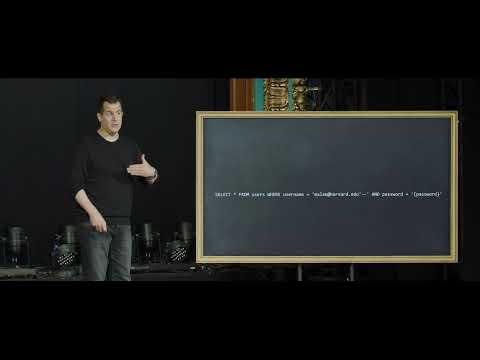
Database Security Risks: SQL Injection Attacks
- SQL injection occurs when malicious input manipulates SQL queries.
- Example: Inputting `' OR '1'='1` in a username field can bypass authentication.
- Solution: Use parameterized queries (placeholders like '?') and never trust user input.
1:25:00
Scaling Databases and Conclusion
- Relational databases with SQL can scale to millions or billions of rows.
- Features like indexes and efficient query languages are key to performance.
- Proper data modeling and security practices are essential for robust applications.
Summary, takeaways, and chapters were generated by AI from the video's transcript and may contain errors. The video belongs to its creator, CS50.