CS 238 Week 8 Lecture
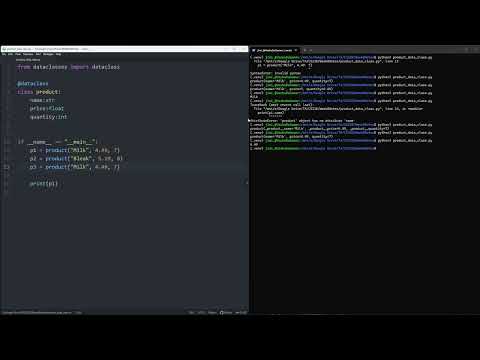 Watch on YouTube →
Overview
James Andro-Vasko introduces Python data classes as a way to reduce boilerplate, demonstrating generated initialization, readable object representations, field-based equality, and conversion with `dataclasses.asdict()`. He then shows how Python’s built-in `unittest` framework can test a clock class with `TestCase` and `assertEqual`, including a modulo-60 setter test that exposes a bug when the modulo operation is omitted.
Key takeaways
- Python’s `@dataclass` can generate an initializer and a useful object representation, reducing repetitive code for classes primarily used to store data.
- Positional constructor arguments follow the order of declared data-class fields, so keyword arguments can help avoid assigning values to the wrong fields.
- Data-class equality compares field values, so separate objects with matching fields can be equal, while a mismatch in even one field makes them unequal.
- `dataclasses.asdict()` converts a data-class instance into a dictionary that can be iterated through with `.items()`.
- Python’s built-in `unittest` framework supports focused tests by placing checks in `TestCase` methods and comparing actual values with `assertEqual`.
- A setter test for minutes can verify wraparound behavior: 77 minutes should become 17 when the implementation applies modulo 60.
Chapters
0:00
Python Data Classes Generate Product Initialization and Representations
- Applying `@dataclass` to a `Product` class generates methods that would otherwise require repetitive boilerplate.
- Positional arguments map to fields in declaration order; the example creates a product with a name, price, and quantity.
- Printing a product object displays its field names and values through the generated representation, and additional methods such as `get_price()` can still be defined.
6:00
Compare Product Objects and Convert Fields with `dataclasses.asdict()`
- Generated equality compares corresponding fields: two products are equal only when their names, prices, and quantities all match.
- Changing one field, such as a product’s price, makes the objects unequal even if the other fields are identical.
- `dataclasses.asdict(product)` returns a dictionary of the object’s fields, which can be traversed with `.items()` to process key-value pairs.
12:04
Test Clock Initialization and Setters with Python `unittest`
- The clock example imports the clock class and Python’s built-in `unittest` module; test classes inherit from `unittest.TestCase`.
- Initialization tests use `assertEqual` to check expected clock values, while setter tests check that setting minutes to 77 produces 17 after modulo 60.
- Running the test module with verbose output reports passing tests and identifies mismatches; removing the modulo operation makes the test fail with 77 instead of 17.
Summary, takeaways, and chapters were generated by AI from the video's transcript and may contain errors. The video belongs to its creator, James Andro-Vasko.