CS 238 Week 6 Lecture
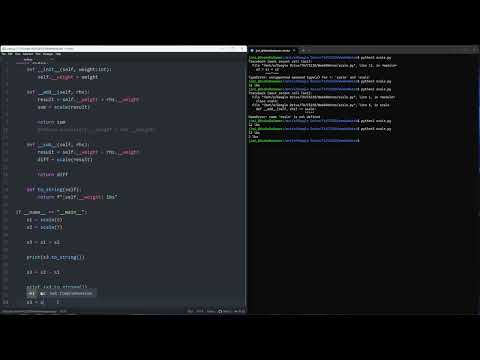 Watch on YouTube →
Overview
James Andro-Vasko explains how Python operator overloading lets a custom `Scale` class use `+`, `-`, `*`, and `/` to combine its weight values. He emphasizes returning a new `Scale` object rather than mutating either operand, demonstrates the corresponding special methods, and cautions that overloaded operators should only be used when their meaning is intuitive.
Key takeaways
- In Python, `S1 + S2` invokes `S1.__add__(S2)`: the left operand becomes `self`, and the right operand is passed as the other argument.
- An arithmetic special method should generally return a new object when the operation is expected not to mutate its operands; for `Scale` weights 5 and 7, addition returns a new object with weight 12.
- The `Scale` arithmetic methods follow a reusable pattern: read operand fields, calculate the result, construct a new `Scale`, and return it.
- Python maps `-`, `*`, and `/` to `__sub__`, `__mul__`, and `__truediv__`; `//` requires the distinct `__floordiv__` method.
- Operator overloading is most useful when the operation has an obvious domain meaning, as with fractions or complex numbers, and can confuse users when applied to types such as products or hazardous items.
Chapters
0:00
Operator Overloading and the Non-Mutation Principle
- Built-in numeric types support operators such as `+`, `*`, and `/`; operator overloading gives custom types similar behavior.
- For `x = 5`, `y = 8`, and `z = x + y`, the result is a new value, 13, while `x` and `y` remain unchanged.
- The same non-mutation principle should guide arithmetic on custom `Scale` objects.
3:00
Adding Scale Objects with Python’s `__add__`
- Adding `S1` with weight 5 and `S2` with weight 7 should produce a new `Scale` with weight 12.
- Python maps `S1 + S2` to `S1.__add__(S2)`: the left operand is `self`, and the right operand is the other parameter.
- The addition method reads both weights, constructs and returns a new `Scale`, and leaves `S1` and `S2` unchanged.
- The result returned from `__add__` is assigned to `S3` and can be displayed through the class’s `to_string` method.
10:00
Implementing Scale Subtraction, Multiplication, and Division
- Subtraction uses `__sub__`; for `S2 - S1`, weights 7 and 5 produce a new `Scale` with weight 2.
- Multiplication uses `__mul__`; multiplying weights 5 and 7 produces a new `Scale` with weight 35.
- True division uses `__truediv__`; dividing weight 7 by 5 produces a decimal-valued result.
- Each arithmetic method follows the same pattern: compute from `self.weight` and the right operand’s weight, construct a result object, and return it.
15:00
True Division, Floor Division, and Choosing Operators Carefully
- Python’s `/` operator corresponds to `__truediv__`, while `//` corresponds to the separate `__floordiv__` method.
- The assignment discussed requires addition, subtraction, multiplication, and true division; floor division is optional and outside its scope.
- Overloading is intuitive for types such as fractions and complex numbers, where arithmetic has established meanings.
- A `Product`, perishable, or hazardous-item class may not have a clear meaning for `+`, so named methods can be less confusing.
Summary, takeaways, and chapters were generated by AI from the video's transcript and may contain errors. The video belongs to its creator, James Andro-Vasko.