Conservation of electric charge | AP Physics | Khan Academy
 Watch on YouTube →
Overview
Khan Academy explains the principle of conservation of electric charge, stating that the total charge within an isolated system remains constant. This is demonstrated through the triboelectric effect (rubbing insulators like fur and a balloon) and electrostatic induction (charging a neutral conductor without direct contact). The concepts are further illustrated using an electroscope, a device that detects charge through the deflection of a metallic needle due to charge repulsion.
Key takeaways
- Conservation of electric charge dictates that the net charge of an isolated system remains constant, meaning charge is neither created nor destroyed, only transferred or redistributed.
- The triboelectric effect explains how rubbing two different insulating materials together can transfer electrons, leading to one material becoming positively charged and the other negatively charged.
- Electric polarization allows a charged object to attract neutral insulators by causing a temporary separation of positive and negative charges within the insulator's atoms.
- An electroscope utilizes the principle of charge repulsion in conductors to detect the presence of electric charge on an object.
- Electrostatic induction demonstrates that a charged object can induce a charge separation in a neutral conductor, leading to observable effects like needle deflection in an electroscope, even without direct contact.
- Grounding provides a path for excess charge to flow to or from the Earth, effectively neutralizing a conductor by allowing charge to dissipate into or be drawn from the vast reservoir of the Earth.
Chapters
0:00
Introduction to Conservation of Charge and Triboelectric Effect
- Conservation of charge is a fundamental principle, similar to conservation of energy and momentum.
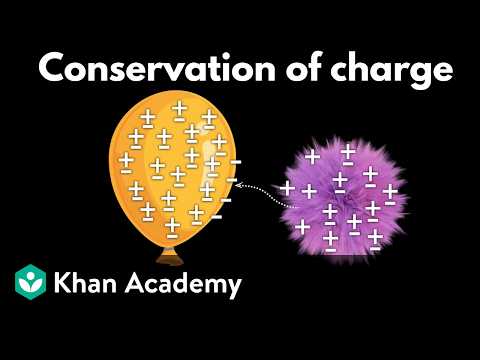
- Rubbing insulators (e.g., fur and a balloon) causes electron transfer, resulting in one object gaining a net negative charge and the other a net positive charge (triboelectric effect).
- The total charge within an isolated system (the fur and balloon) remains constant, even though charge is redistributed.
6:33
Electric Polarization and Attraction of Neutral Objects
- Charged objects can attract neutral insulators through electric polarization, where charge distributions within atoms shift.
- When a charged balloon approaches neutral paper bits, the positive charges in the paper are attracted, and negative charges are repelled, leading to a net attraction.
- This phenomenon is called electric polarization, where the poles of atoms separate, causing a net attraction to the charged object.
9:59
Conductors, Electroscope, and Electrostatic Induction
- Conductors allow charges to move easily, unlike insulators where charges are largely fixed.
- An electroscope, a device with a rotatable metallic needle, detects charge by showing deflection when a charged object is brought near or touches its metallic tip.
- Touching a charged rod to an electroscope transfers charge, causing the needle to deflect due to mutual repulsion of like charges spread throughout the conductor.
- Electrostatic induction occurs when a charged object brought near a neutral conductor causes charge separation within the conductor, leading to attraction or repulsion without direct contact.
Summary, takeaways, and chapters were generated by AI from the video's transcript and may contain errors. The video belongs to its creator, Khan Academy.