Connecting equivalent forms of rational functions | AP®︎/College Precalculus | Khan Academy
 Watch on YouTube →
Overview
Khan Academy demonstrates how different algebraic forms of a rational function reveal distinct properties. The standard polynomial form is ideal for identifying horizontal asymptotes and y-intercepts, while the factored form is crucial for pinpointing holes, vertical asymptotes, and x-intercepts. This highlights the importance of transforming between forms to gain a comprehensive understanding of a function's behavior.
Key takeaways
- The standard polynomial form of a rational function (P(x)/Q(x)) is most useful for determining horizontal asymptotes by comparing the degrees of P(x) and Q(x).
- Setting x=0 in the standard polynomial form of a rational function directly yields the y-intercept.
- Factoring both the numerator and denominator of a rational function is essential for identifying holes and vertical asymptotes.
- A hole exists at x=a if (x-a) is a common factor in both the numerator and denominator.
- Vertical asymptotes occur at values of x where the denominator is zero, but the numerator is non-zero, after canceling common factors.
- X-intercepts are found at values of x where the numerator is zero, but the denominator is non-zero, after canceling common factors.
Chapters
0:00
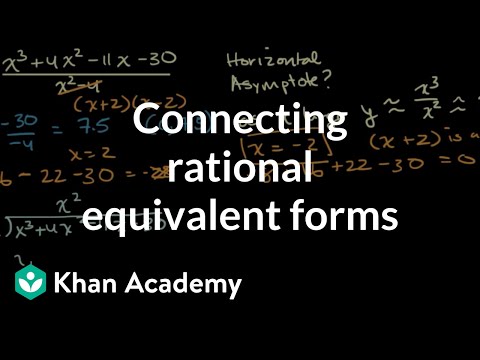
Analyzing Rational Functions in Standard Polynomial Form
- The standard form (expanded polynomials) is best for determining horizontal asymptotes by comparing the highest degree terms.
- For the given function, the degree of the numerator (3) is greater than the denominator (2), indicating no horizontal asymptote.
- The standard form also simplifies finding the y-intercept by setting x=0, yielding -30/-4 or 7.5.
4:57
Factoring Rational Functions to Find Holes and Vertical Asymptotes
- Factoring the denominator (x² - 4) into (x+2)(x-2) is straightforward.
- Testing potential zeros of the denominator in the numerator reveals that x=-2 makes the numerator zero, indicating a hole.
- Algebraic long division of (x+2) into the numerator (x³ + 4x² - 11x - 30) yields (x² + 2x - 15).
Summary, takeaways, and chapters were generated by AI from the video's transcript and may contain errors. The video belongs to its creator, Khan Academy.