CMU Introduction To Deep Learning 11-785, Fall 2026: Lecture 0
 Watch on YouTube →
Overview
Head TA Bradley Warren introduces CMU’s Introduction to Deep Learning (11-485/685/785), led by Dr. Bhiksha Raj, as an implementation-heavy course covering neural networks from MLPs and CNNs through transformers and large language models. He explains the prerequisites, tools, quizzes, coding assignments, and project tracks, then emphasizes regular participation, early experimentation, and academic integrity as key to succeeding in the demanding course.
Key takeaways
- CMU’s 11-485/685/785 course expects substantial hands-on work in Python and PyTorch, with JAX available for students pursuing TPU-based implementations.
- Students can miss two of the 14 quizzes because only their best 12 count, but each quiz allows three attempts and draws on both lectures and slides.
- Homework Part 2 is designed to reward starting early: its initial starter-code submission is worth 10 of 100 points, before later model-performance cutoffs.
- The course assigns every student a study group and TA mentor, and supports learning through recitations, hackathons, boot camps, office hours, and Piazza.
- Discussion and peer learning are allowed, but quizzes must be taken individually and submitting copied code or identical neural-network architectures risks an academic-integrity violation.
Chapters
0:00
Course Team, Prerequisites, and Deep Learning Topics
- Head TA Bradley Warren introduces the course, led by Dr. Bhiksha Raj, with about 30 TAs offering remote and in-person support.
- Students should have Python experience plus calculus and linear algebra; vector calculus and software engineering experience are helpful.
- Topics range from multilayer perceptrons, CNNs, RNNs, and Boltzmann machines to VAEs, GANs, graph neural networks, transformers, and LLMs.
- The course emphasizes implementation and experimentation, primarily using Python and PyTorch, with JAX as an option for TPU work.
5:00
Lectures, Weekly Quizzes, Homeworks, and Project Tracks
- Lectures are recorded, but Pittsburgh students are encouraged to attend in person; attendance counts toward the grade, and full-speed, complete Zoom viewing is required for credit.
- There are 14 weekly quizzes, with the best 12 counted; each has 10 multiple-choice questions and three attempts, and quizzes generally run Friday to Sunday.
- Four main homeworks combine a from-scratch implementation in Part 1 with a larger real-data or Kaggle competition in Part 2.
- Project requirements differ by course number: 785 students design original projects, 685 students complete guided projects, and 485 students do not have a course project.
11:00
Study Groups, Piazza Support, and Project Mentoring
- Every student is assigned a study group and TA mentor; groups are encouraged to discuss homework, papers, classwork, and quizzes and to meet regularly.
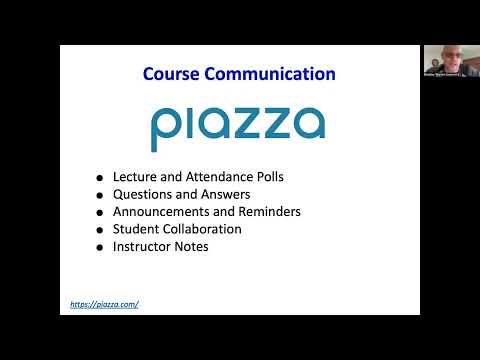
- Piazza is the main communication channel, while office hours, recitations, hackathons, and boot camps provide hands-on help with tools such as AWS, Google Cloud Platform, and Kaggle.
- Project teams have TA mentors; 785 teams generally have three to four students, while 685 teams have two to three, and students may also seek an external mentor.
- Warren urges students to contact mentors early when they fall behind rather than waiting until the end of the semester.
18:00
Homework Strategy, Grading Rules, and Academic Integrity
- Homework Part 1 develops a student-built neural-network toolkit; auto-grading makes compliance with library restrictions and assignment instructions important.
- Part 2 requires an early starter-code submission worth 10 of 100 points, followed by performance cutoffs; students are encouraged to run architectural ablations and compare results.
- Assessment includes attendance, quizzes, homeworks, and—outside 11-485—a team or guided project; the lecture describes attendance as a small but potentially grade-deciding component.
- Collaboration and study-group discussion are encouraged, but quizzes must be completed alone; copying homework architectures or code from GitHub can trigger an academic-integrity violation.
Summary, takeaways, and chapters were generated by AI from the video's transcript and may contain errors. The video belongs to its creator, Carnegie Mellon University Deep Learning.