Citric Acid Cycle (Krebs Cycle), BIO105 Introductory Biology, David Champlin, USM
 Watch on YouTube →
Overview
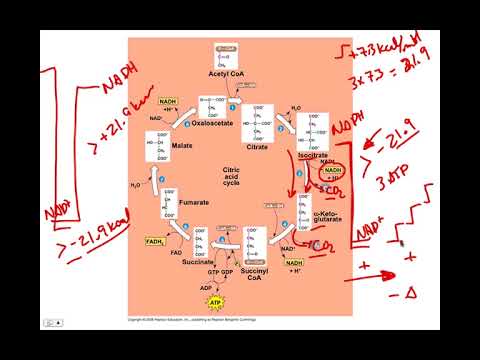
David Champlin explains the citric acid (Krebs) cycle as eight enzyme-catalyzed reactions in the mitochondrial matrix, where oxidation releases carbon dioxide and captures usable energy in NADH, FADH2, and a small amount of ATP or GTP. He emphasizes energy coupling: large downhill free-energy changes drive energy-carrier production, while oxidative phosphorylation later uses those carriers to make most cellular ATP.
Key takeaways
- The citric acid cycle runs through eight enzyme-catalyzed reactions in the mitochondrial matrix and releases carbon dioxide as carbon compounds are oxidized.
- Large decreases in free energy can be coupled to forming NADH, FADH2, or GTP; smaller downhill reactions may instead help set up later energy-yielding steps.
- Champlin uses a simplified energy calculation of 7.3 kcal/mol per ATP and 21.9 kcal/mol for three ATP to illustrate why energy release must exceed the cost of synthesis.
- Substrate-level phosphorylation produces a limited amount of ATP directly through enzyme-coupled reactions, including formation of GTP that can be converted to ATP.
- NADH and FADH2 carry energy from glycolysis and the citric acid cycle to oxidative phosphorylation, where the majority of cellular ATP is made.
Chapters
0:00
Eight Enzyme-Catalyzed Reactions in the Mitochondrial Matrix
- The citric acid cycle consists of eight chemical reactions, each catalyzed by a specific protein enzyme in the mitochondrial matrix.
- Champlin focuses on reaction principles rather than memorizing enzyme names, substrate structures, or every intermediate.
- As carbon compounds are oxidized, carbon dioxide is released and some of the free-energy decrease is captured in energy carriers.
4:30
How Free-Energy Drops Drive NADH, FADH2, and ATP Production
- The isocitrate-to-alpha-ketoglutarate reaction releases CO2 and captures energy in NADH.
- Using the lecture's simplified accounting, ATP synthesis requires about 7.3 kcal/mol, so three ATP represent about 21.9 kcal/mol; the coupled energy release must exceed that amount for the overall process to remain spontaneous.
- Succinate oxidation to fumarate captures energy in FADH2; the lecture assigns FADH2 a yield of two ATP in oxidative phosphorylation.
- A smaller energy-yielding step produces GTP, which can be converted to ATP, while other reactions prepare intermediates for later energy capture.
6:27
Substrate-Level Phosphorylation and Oxidative Phosphorylation
- The cycle and glycolysis make a small amount of ATP directly through substrate-level phosphorylation, in which an enzyme transfers energy from a reaction to ATP production.
- In one example, the enzyme couples a sugar-related reaction to ADP binding through changes in the protein's shape.
- Most ATP is produced during oxidative phosphorylation, which uses NADH and FADH2 generated during glycolysis and the citric acid cycle.
Summary, takeaways, and chapters were generated by AI from the video's transcript and may contain errors. The video belongs to its creator, The New Evolution for Everyone.