Chain rule (Calc 1; Lecture 1-11; Fall 26)
 Watch on YouTube →
Overview
Beard Meets Calculus reviews essential algebra, power-rule rewriting, and trigonometric derivatives before developing the chain rule as the method for differentiating composed functions. Worked applications include motion direction from velocity signs, a tangent line to a trigonometric function, nested chain-rule and product-rule calculations, and transferring function values and slopes from a known tangent line.
Key takeaways
- For a composition f(g(x)), the chain rule is f′(g(x))g′(x): differentiate the outside, substitute the unchanged inside, and multiply by the inside derivative.
- Rewriting (2x³ − 5)/x as 2x² − 5x⁻¹ turns its derivative into a straightforward power-rule calculation: 4x + 5x⁻².
- For s(t) = t + 2sin(t), velocity is 1 + 2cos(t); on 0 to 2π, the particle moves left between 2π/3 and 4π/3 and is stationary at those endpoints.
- A tangent line at x = a provides both f(a), its point on the graph, and f′(a), its slope—enough information to find tangent lines to compositions and powers of f.
- Nested derivatives should be handled one layer at a time; expressions such as sec(5y) contribute a single inner factor of 5, and careful parentheses preserve the scope of product-rule terms.
Chapters
0:00
Quickfire Review: Algebra, Linear Systems, and Rewriting Derivatives
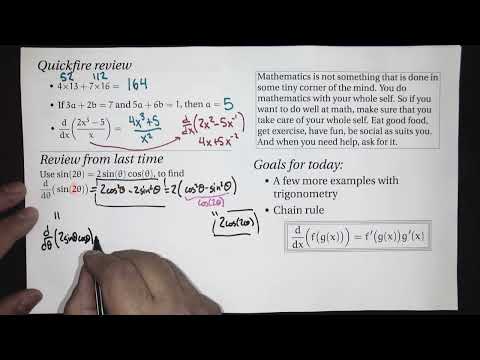
- Checks arithmetic with 4 × 13 + 7 × 16 = 164 and solving a two-equation, two-unknown system by elimination or substitution.
- Rewrites (2x³ − 5)/x as 2x² − 5x⁻¹, making the power rule yield 4x + 5x⁻² without using the quotient rule.
- Encourages choosing a legal, comfortable method and simplifying expressions before differentiating.
4:00
Differentiating sin(2θ) with the Product Rule and Double-Angle Identity
- Uses sin(2θ) = 2 sin θ cos θ to apply the product rule, obtaining 2cos²θ − 2sin²θ.
- Recognizes cos²θ − sin²θ as cos(2θ), so the derivative can also be written as 2cos(2θ).
- Shows how the chain rule later gives the same result more directly: cos(2θ) × 2.
7:30
Whole-Person Exam Preparation and the Chain Rule’s Role
- Recommends rest, nutritious food, exercise, and social connection rather than several late-night study sessions in a row.
- Introduces the chain rule as a central derivative rule for compositions such as f(g(x)).
- Models composition as sequential function machines: x enters g, then g(x) enters f to produce f(g(x)).
11:30
Using Velocity Signs to Classify Motion on 0 ≤ t ≤ 2π
- For position s(t) = t + 2sin(t), differentiates to get velocity s′(t) = 1 + 2cos(t).
- Finds stationary times by solving 1 + 2cos(t) = 0, giving t = 2π/3 and 4π/3 on the specified interval.
- Tests signs between critical times: velocity is positive on (0, 2π/3) and (4π/3, 2π), and negative on (2π/3, 4π/3).
- Concludes that positive velocity means motion right, negative velocity means motion left, and zero velocity means stationary.
20:00
Tangent Line to 6 tan(x) − 2 sec(x) at x = π/4
- Evaluates the function at π/4 using tan(π/4) = 1 and sec(π/4) = √2 to obtain f(π/4) = 4.
- Uses (tan x)′ = sec²x and (sec x)′ = sec x tan x to calculate f′(π/4) = 10.
- Writes the tangent line in point-slope form as y = 4 + 10(x − π/4), noting it need not be expanded unless requested.
25:00
Why the Chain Rule Multiplies the Outside and Inside Derivatives
- Explains that composing two locally linear functions produces a locally linear approximation to the composition.
- Uses tangent-line approximations near x = a and z = g(a); cancellation in the substitution leads to the slope f′(g(a))g′(a).
- States the practical procedure: differentiate the outside function, keep the inside expression, then multiply by the inside derivative.
- Applies the procedure to sin(2θ), giving cos(2θ) · 2 = 2cos(2θ).
30:40
Chain Rule Practice with Exponentials and Trigonometric Compositions
- Differentiates e^(17x) as 17e^(17x), identifying 17x as the inside and e^x as the outside function.
- Differentiates (e^x)^17 using the power rule followed by the chain rule; the result simplifies to 17e^(17x).
- Clarifies that differentiating a constant such as π⁵ gives zero because the chain rule includes the derivative of the constant inside.
- Differentiates sin(t²) + e^(tan t) term by term to obtain 2t cos(t²) + e^(tan t)sec²(t).
37:00
Nested Chain Rules and the Product Rule in a Layered Expression
- Works through a nested expression involving cos((4y^(3/2) + 1)e^(sec(5y))), starting with the outer cosine derivative.
- Applies the product rule to the inner product and the chain rule to e^(sec(5y)).
- Differentiates sec(5y) as sec(5y)tan(5y) × 5; the inner derivative contributes one factor of 5.
- Emphasizes working one layer at a time and keeping parentheses around the entire inner derivative so factors apply correctly.
43:00
Building New Tangent Lines from f(2) = 2 and f′(2) = 4
- Interprets the given tangent line y = 4x − 6 at x = 2 as the information f(2) = 2 and f′(2) = 4.
- For g(x) = f(x² − x), calculates g(2) = 2 and g′(2) = f′(2) · 3 = 12, giving y = 2 + 12(x − 2).
- For g(x) = [f(x)]², calculates g(2) = 4 and g′(2) = 2f(2)f′(2) = 16, giving y = 4 + 16(x − 2).
- Introduces f(f(x)) as another composition problem, but the transcript ends before its tangent line is worked out.
Summary, takeaways, and chapters were generated by AI from the video's transcript and may contain errors. The video belongs to its creator, Beard Meets Calculus.