Ch 16 Overview, BIO105 Introductory Biology, David Champlin, USM
 Watch on YouTube →
Overview
David Champlin introduces Chapter 16 by linking DNA structure to gene expression, DNA replication during S phase, and the DNA-analysis applications covered in Chapter 20. He explains how complementary base pairing, hydrophobic base stacking, and antiparallel strand orientation shape DNA, then previews how RNA polymerase uses a DNA template and why DNA synthesis proceeds 5′ to 3′.
Key takeaways
- DNA’s base-pairing rules—A with T and G with C—allow one strand’s sequence to guide the production of a complementary strand.
- Hydrogen bonds connect paired bases, while hydrophobic stacking of the bases inside the helix adds structural stability.
- RNA polymerase separates DNA locally and reads one strand as a template to make RNA during gene expression.
- DNA strands are antiparallel: one runs 5′ to 3′ while its partner runs 3′ to 5′.
- DNA synthesis proceeds 5′ to 3′, a directional constraint that is important to understanding DNA replication.
- Because DNA is the primary heritable molecule across life, DNA-analysis methods can be applied to diverse subjects such as corn, humans, snakes, and viruses.
Chapters
0:00
Chapter 16 Connects DNA Structure to Replication and DNA Research
- Champlin frames Chapter 16 as a closer look at DNA structure and its role in gene expression and replication during S phase.
- James Watson and Francis Crick’s 1953 DNA model introduces the structural discoveries that underpin the chapter.
- Chapter 20 extends the topic to experimental methods that use DNA’s properties to study organisms including corn, humans, snakes, and viruses.
2:14
Complementary Bases and Hydrophobic Stacking Stabilize the DNA Double Helix
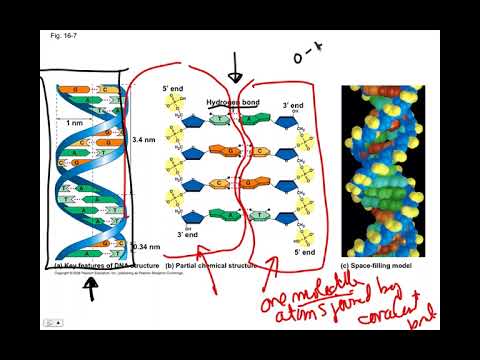
- DNA consists of two strands whose bases pair across the helix: adenine (A) with thymine (T), and guanine (G) with cytosine (C).
- Hydrogen bonds join paired bases; although individually weak, many pairings collectively help hold the double-stranded structure together.
- The bases are planar and somewhat hydrophobic, so stacking them inside the helix shields them from the surrounding water and stabilizes DNA’s structure.
6:45
DNA Unzipping, RNA Templates, and 5′-to-3′ Strand Orientation
- During gene expression, RNA polymerase locally separates DNA strands and uses one strand as a template to assemble a complementary RNA sequence.
- Each DNA strand has a sugar-phosphate backbone and nucleotide bases; the two strands run in opposite directions, a feature called antiparallel orientation.
- DNA-copying enzymes synthesize new strands in the 5′-to-3′ direction, a constraint that shapes the replication details explored next in Chapter 16.
- Champlin previews Chapter 20’s DNA-analysis figures and examples of biological discoveries made using DNA-based techniques.
Summary, takeaways, and chapters were generated by AI from the video's transcript and may contain errors. The video belongs to its creator, The New Evolution for Everyone.