Ch 10 Overview, BIO105 Introductory Biology, David Champlin, USM
 Watch on YouTube →
Overview
David Champlin introduces eukaryotic photosynthesis as the light-powered process that fixes atmospheric carbon dioxide into energy-rich sugars, complementing cellular respiration in plants. He connects chloroplast structure and the endosymbiotic theory to the two stages of photosynthesis: light reactions in thylakoid membranes make ATP and NADPH, which power sugar synthesis in the Calvin cycle in the stroma.
Key takeaways
- Photosynthesis stores light energy in sugars by fixing atmospheric carbon dioxide, while cellular respiration releases usable energy from sugars.
- Plant leaves contain both chloroplasts and mitochondria: chloroplasts produce sugars, and mitochondria use sugars to generate ATP.
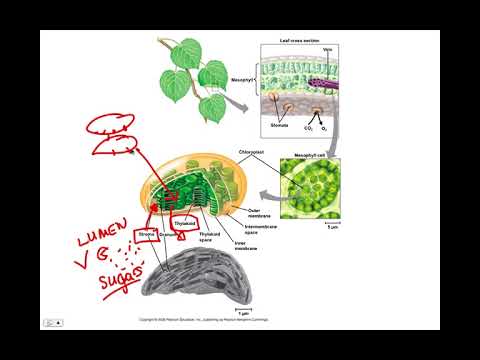
- The chloroplast stroma is the site of Calvin-cycle sugar synthesis, whereas the thylakoid membrane houses chlorophyll and the light-reaction machinery.
- Light reactions supply ATP and NADPH to the Calvin cycle, linking energy capture to carbon fixation.
- Thylakoid electron transport builds an ion gradient that ATP synthase harnesses, a mechanism shared with the mitochondrial inner membrane.
- Stomata and their guard cells regulate leaf gas exchange, allowing carbon dioxide to enter and photosynthetic oxygen to leave.
Chapters
0:00
Chloroplasts, Endosymbiosis, and Photosynthesis in Eukaryotes
- Chapter 10 focuses on photosynthesis in eukaryotes, especially plants, rather than photosynthetic prokaryotes such as cyanobacteria.
- Chloroplasts have a double membrane, a feature consistent with the endosymbiotic theory that an ancestral eukaryotic cell engulfed a photosynthetic bacterium.
- Plants use chloroplasts to produce sugars, while mitochondria in plant cells—including leaf cells—use sugars in cellular respiration to make ATP.
5:00
Carbon Fixation, Light Energy, and Leaf Gas Exchange
- Photosynthesis drives an endergonic reaction: carbon dioxide is fixed into carbon-containing molecules and ultimately sugars, using energy from light.
- Water is split during photosynthesis, releasing oxygen as a byproduct; this process contributes to the oxygen in Earth's atmosphere.
- Carbon dioxide enters leaves through stomata, pores bordered by guard cells, and diffuses through leaf spaces toward chloroplasts; oxygen exits through the same pores.
- The chloroplast stroma contains enzymes for sugar synthesis, while chlorophyll and other light-absorbing pigments are embedded in thylakoid membranes.
9:00
Light Reactions and the Calvin Cycle in Chloroplasts
- Photosynthesis has two linked stages: light reactions in the thylakoid membrane and the Calvin cycle in the stroma.
- Light reactions capture light energy to produce ATP and NADPH, energy intermediates that power the Calvin cycle's sugar-producing reactions.
- An electron transport chain pumps ions across the thylakoid membrane, creating a chemiosmotic gradient that ATP synthase uses to produce ATP.
- The thylakoid membrane's electron transport chain and ATP synthase parallel processes in the mitochondrial inner membrane during cellular respiration.
Summary, takeaways, and chapters were generated by AI from the video's transcript and may contain errors. The video belongs to its creator, The New Evolution for Everyone.