Cell Cycle, BIO105 Introductory Biology, David Champlin, USM
 Watch on YouTube →
Overview
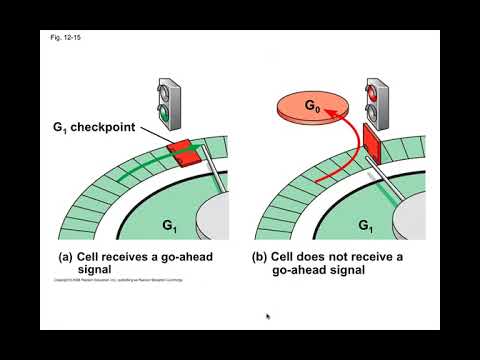
David Champlin explains the eukaryotic cell cycle, distinguishing the G1-to-S Start control point—where platelet-derived growth factor (PDGF) can stimulate skin-cell division during wound healing—from the G2 and M checkpoints that verify internal conditions. He focuses on the G2-to-M switch: cyclin-dependent kinase 1 (CDK1) combines with cyclin to form mitosis-promoting factor (MPF), while inhibitory phosphates and DNA-damage signaling regulate whether mitosis can begin.
Key takeaways
- PDGF released by platelets during wound healing can stimulate skin-cell cycling at the G1-to-S Start control point, which is distinct from the G2 and M checkpoints.
- S phase copies DNA, while G1 and G2 support cell growth and activity; the G2 checkpoint prevents mitosis if replication is incomplete or DNA is damaged.
- CDK1 requires G2-accumulated cyclin and removal of inhibitory phosphates to form active MPF and initiate mitosis.
- Cdc25 activates CDK1 by removing inhibitory phosphates, whereas Wee1 and Myt1 add phosphates that keep CDK1 inactive.
- DNA damage activates Chk1, which inhibits Cdc25; 14-3-3 can further restrict Cdc25 by keeping it outside the nucleus.
- Conserved cell-cycle regulatory proteins across eukaryotes allow research in simpler organisms to inform understanding of human cell biology and health.
Chapters
0:00
Cell-Cycle Phases, PDGF, and the G1-to-S Start Control Point
- Champlin identifies the G1-to-S transition as the Start control point, where PDGF signaling can stimulate skin-cell division during wound healing.
- He compares the repeating cell cycle to a washing-machine cycle, with regulatory proteins acting like switches that control progression.
- Interphase comprises G1, S, and G2; DNA replication occurs in S phase, while cells grow and perform most of their functions during the gap phases.
- Microscopy reveals mitosis as a comparatively brief stage after the longer interphase; embryonic cells can divide rapidly when interphase is shortened.
8:30
G2 and M Checkpoints: Verifying DNA Before Cell Division
- Champlin distinguishes the externally responsive G1-to-S Start control point from checkpoints that assess conditions inside the cell.
- The G2 checkpoint confirms DNA replication is complete and checks for DNA damage before the cell enters mitosis.
- The M-phase checkpoint verifies that chromosomes are properly separated during division.
- Passing a control point or checkpoint means the cell proceeds into the next phase, making checkpoint failures consequential for cell division.
12:30
How Cyclin, CDK1, and Phosphates Switch On Mitosis
- CDK1 is present throughout the cycle, but it becomes mitosis-promoting factor (MPF) when bound to cyclin, which accumulates during G2.
- Inhibitory phosphates keep CDK1 inactive; Cdc25 phosphatase removes them, activating MPF to phosphorylate target proteins and trigger mitosis.
- Champlin’s handout traces the sequence backward from cell division and identifies Cdc2 as an older name for CDK1.
- Wee1 and Myt1 kinases add inhibitory phosphates to CDK1, helping keep it inactive during interphase.
17:00
DNA Damage Activates Chk1 to Block the G2-to-M Transition
- DNA damage, including damage from ultraviolet radiation, activates the Chk1 kinase pathway and delays mitosis so repair can occur.
- Active Chk1 phosphorylates and inhibits Cdc25, preventing Cdc25 from removing CDK1’s inhibitory phosphates and activating MPF.
- The protein 14-3-3 helps retain inhibited Cdc25 outside the nucleus, adding another layer of separation from CDK1.
- Champlin emphasizes that cell-cycle regulatory proteins have conserved counterparts across eukaryotes, including plants and animals, making the pathway relevant to human health.
Summary, takeaways, and chapters were generated by AI from the video's transcript and may contain errors. The video belongs to its creator, The New Evolution for Everyone.