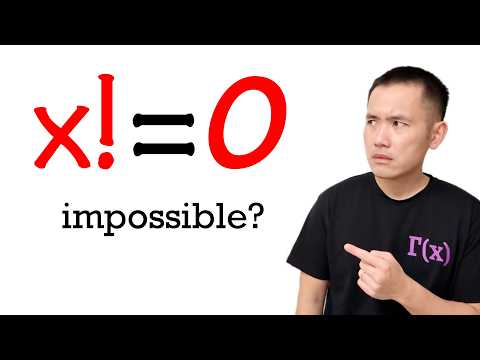
Can factorial ever be 0?
 Watch on YouTube →
Overview
blackpenredpen asks whether any value of x can make x! equal 0, noting that ordinary factorial multiplication applies only to positive integers and that 0! is defined as 1. Extending factorials with the integral ∫₀∞ tˣe⁻ᵗ dt = Γ(x+1), blackpenredpen checks the graph but cautions that a graph alone cannot rule out answers under other mathematical extensions or definitions.
Key takeaways
- The product formula n(n−1)…1 applies to positive whole numbers; 0! is separately defined as 1 rather than obtained by plugging zero into that product.
- The recurrence pattern 3! = 6, 2! = 2, 1! = 1 supports 0! = 1 by successively dividing by 3, 2, and 1.
- The standard integral extension x! = ∫₀∞ tˣe⁻ᵗ dt equals Γ(x+1); at x = 0, it evaluates to 1.
- The integral extension allows non-integer inputs, including 1/2 and −3/2, so factorial notation can go beyond whole-number products.
- A graph that does not intersect the x-axis is not by itself a proof that an equation has no solutions: x² + 1 has no real roots but has complex roots ±i.
- Claims about whether factorial can equal zero depend on which extension and number system are being considered; blackpenredpen leaves room for nonstandard definitions.
Chapters
0:00
Why Ordinary Factorial Multiplication Does Not Apply at Zero
- The usual product n(n−1)(n−2)…1 defines factorial for positive whole numbers, not for n = 0.
- For 3!, 2!, and 1!, the values are 6, 2, and 1; continuing the pattern by division gives 0! = 1.
- The same pattern reaches an undefined division by zero at (−1)!, illustrating why the ordinary product does not extend directly to negative integers.
2:08
Extending Factorial with the Gamma-Function Integral
- blackpenredpen presents x! as ∫₀∞ tˣe⁻ᵗ dt, identifying it as the Pi-function extension and as Γ(x+1).
- Substituting x = 0 gives ∫₀∞ e⁻ᵗ dt = 1, consistent with 0! = 1.
- The integral extension also accommodates non-integer inputs such as x = 1/2 and x = −3/2.
5:30
Why a Graph Cannot Settle Whether Factorial Reaches Zero
- The plotted factorial extension does not cross the x-axis, but blackpenredpen says that visual evidence alone is insufficient to prove no solution exists.
- The example x² + 1 = 0 has no real roots but has complex roots x = ±i, showing that answers can depend on the number system.
- blackpenredpen’s conclusion is cautious: no zero is apparent under the standard extension, but a different, specially defined extension could change what counts as an answer.
Summary, takeaways, and chapters were generated by AI from the video's transcript and may contain errors. The video belongs to its creator, blackpenredpen.