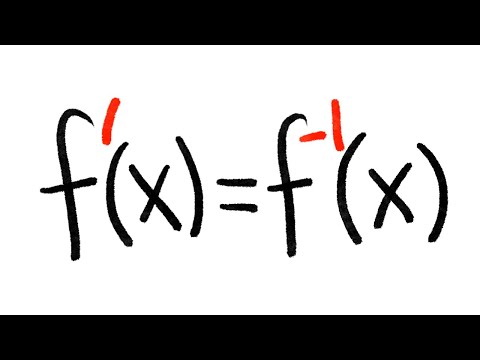
Can f'(x)=f^-1(x)?
 Watch on YouTube →
Overview
blackpenredpen tests power functions as candidates for f'(x)=f⁻¹(x), then finds a solution by setting f(x)=axᵇ and matching the inverse and derivative. Matching exponents gives b²−b−1=0; choosing the golden ratio φ and matching coefficients yields f(x)=φ(x/φ)^φ, which satisfies the equation for positive x.
Key takeaways
- For a trial function f(x)=axᵇ, the inverse is a^(-1/b)x^(1/b), while the derivative is abx^(b−1); matching their exponents forces 1/b=b−1.
- Solving b²−b−1=0 gives the positive exponent b=φ=(1+√5)/2, whose identity 1/φ=φ−1 is used again to match coefficients.
- The coefficient condition a^(-1/b)=ab simplifies to a=φ^(-1/φ)=φ^(1−φ) when b=φ.
- The resulting function f(x)=φ(x/φ)^φ is a concrete positive-domain solution to f'(x)=f⁻¹(x).
- The initial guess f(x)=xᵇ fails because matching its coefficients would force b=1, which makes the derivative's exponent 0 while the inverse's exponent is 1.
Chapters
0:00
Testing a Power Function Without a Coefficient
- blackpenredpen begins with the functional equation f'(x)=f⁻¹(x) and proposes trying a power function f(x)=xᵇ.
- For this guess, f⁻¹(x)=x^(1/b), while f'(x)=b x^(b−1), using the power rule.
- Matching coefficients would require b=1, but then the exponents are 1 and 0, so the coefficient-free guess fails.
2:29
Adding a Coefficient and Deriving the Golden-Ratio Exponent
- With f(x)=axᵇ and a≠0, the inverse is a^(-1/b)x^(1/b), and the derivative is abx^(b−1).
- Equating exponents gives 1/b=b−1, or b²−b−1=0; the positive root is the golden ratio φ=(1+√5)/2.
- Equating coefficients gives a^(-1/b)=ab; using 1/b+1=b reduces this to a^(−b)=b, so a=b^(-1/b).
- A Brilliant sponsorship segment runs between the initial power-function test and the coefficient-based derivation.
5:57
Writing the Golden-Ratio Solution in Final Form
- For b=φ, the identity −1/φ=1−φ rewrites a=φ^(-1/φ) as a=φ^(1−φ).
- Substituting into f(x)=axᵇ gives f(x)=φ^(1−φ)x^φ=φ(x/φ)^φ.
- The resulting power function has the same derivative and inverse on positive x; blackpenredpen presents the method as a power-function search, not a proof that no other forms exist.
- The closing invites viewers to test other candidates, including exponential, sine, and cosine functions.
Summary, takeaways, and chapters were generated by AI from the video's transcript and may contain errors. The video belongs to its creator, blackpenredpen.