Can 0^x=2? (solution by a viewer)
 Watch on YouTube →
Overview
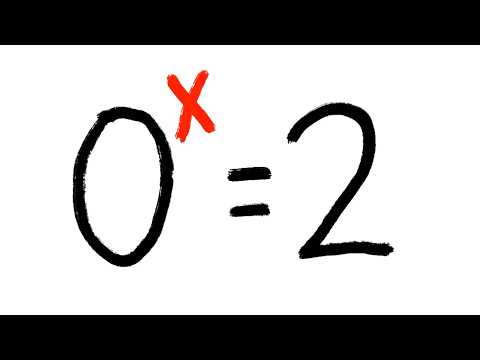
blackpenredpen presents a viewer’s attempted solution to 0^x = 2 using dual numbers, where a nonzero nilpotent ε satisfies ε² = 0. The derivation uses the valid identity e^(cε) = 1 + cε, but then applies logarithms and divides by ε², which is zero and noninvertible; blackpenredpen explicitly questions whether the resulting x = −(ε ln 2)/2 is legitimate.
Key takeaways
- A dual number has the form a + bε, where ε is nonzero but nilpotent: ε² = 0.
- The power-series identity e^(cε) = 1 + cε follows because all terms involving ε² or higher powers vanish.
- The representation a + bε = a·e^((b/a)ε) requires a to be invertible, so it cannot be applied with a = ε² = 0.
- Nilpotent ε has no multiplicative inverse, making division by ε and expressions such as 1/ε invalid in ordinary dual-number arithmetic.
- The displayed value x = −(ε ln 2)/2 is a formal outcome of invalid steps, not a valid solution to 0^x = 2.
Chapters
0:00
The 0^x = 2 Puzzle and Nilpotent Dual Numbers
- blackpenredpen frames 0^x = 2 as a puzzle and introduces dual numbers instead of complex solutions.
- The dual-number unit ε is defined as nonzero while satisfying ε² = 0.
- The analogy uses Z₄: the nonzero element 2 has square 0 modulo 4.
2:20
Deriving the Dual-Number Exponential Form
- Using the exponential power series and ε² = 0, blackpenredpen obtains e^(cε) = 1 + cε.
- For a nonzero scalar a, the derivation rewrites a + bε as a·e^((b/a)ε).
- The exponential identity is valid in the dual numbers, but the later application requires a to be invertible.
5:20
The Proposed Logarithm and Its Validity Problems
- The derivation sets ε = ε² + ε and applies the exponential form with a = ε² = 0, despite that form requiring a nonzero, invertible a.
- It takes logarithms of expressions involving ε² and divides by ε², operations that are not defined in the dual-number algebra.
- Formal manipulations produce ln ε = −1/ε and then x = −(ε ln 2)/2, but blackpenredpen ends by questioning the logarithm rules and the result’s legitimacy.
Summary, takeaways, and chapters were generated by AI from the video's transcript and may contain errors. The video belongs to its creator, blackpenredpen.