Calvin cycle, BIO105 Introductory Biology, David Champlin, USM
 Watch on YouTube →
Overview
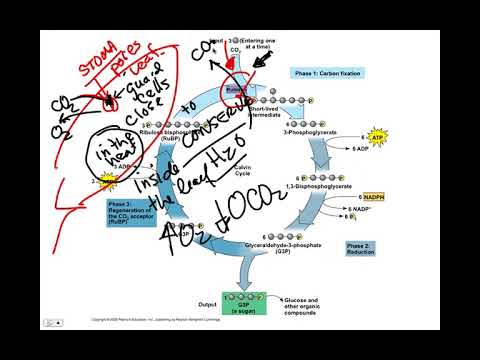
David Champlin explains how the Calvin cycle uses ATP and NADPH from the light reactions to fix CO₂ and synthesize energy-rich, three-carbon sugars, with Rubisco catalyzing carbon fixation in the chloroplast stroma. He then connects heat-driven photorespiration in C3 plants to the distinct spatial and temporal adaptations of C4 and CAM plants.
Key takeaways
- The Calvin cycle uses ATP and NADPH from the light reactions to drive carbon-fixing reactions and produce three-carbon sugars that supply material for glucose and other compounds.
- ATP hydrolysis releases about 7.3 kilocalories per mole; coupling that energy-releasing reaction to sugar synthesis makes the combined process energetically favorable.
- When heat prompts stomata to close, reduced water loss comes at a cost: lower internal CO₂ and higher O₂ can cause Rubisco to drive photorespiration, releasing CO₂ and wasting energy.
- C4 plants reduce photorespiration through spatial separation: mesophyll cells initially fix CO₂, which is then made available to Rubisco in another part of the leaf.
- CAM plants reduce photorespiration through temporal separation: they fix CO₂ at night, store it in organic acids, and release it during the day when stomata are closed.
Chapters
0:00
Calvin Cycle Energetics: ATP, NADPH, and Three-Carbon Sugar
- The Calvin cycle, named for research by Melvin Calvin and colleagues at Berkeley in the 1940s and 1950s, takes place in the chloroplast stroma.
- ATP and NADPH made by the light reactions drive the cycle’s chemical synthesis, even though the cycle was historically called the “dark reaction.”
- Champlin emphasizes energy coupling: ATP hydrolysis releases about 7.3 kilocalories per mole, helping drive endergonic steps so the overall coupled reaction is energetically favorable.
- The cycle produces a three-carbon sugar that can contribute to glucose and other molecules; its multistep, cyclic chemistry does not need to be memorized for this course.
6:38
Rubisco, Stomatal Closure, and Photorespiration in C3 Plants
- Rubisco fixes carbon by incorporating atmospheric CO₂; photosynthesis turns gaseous carbon into organic matter, as illustrated by the carbon making up a tree.
- Leaf stomata allow CO₂ to enter and oxygen to leave, but guard cells close the pores in hot conditions to reduce water loss.
- When stomata close, CO₂ falls and O₂ rises inside the leaf; Rubisco can then use O₂ and release CO₂ rather than fixing carbon, causing photorespiration and wasting energy.
- Champlin identifies this as a limitation for C3 plants, including many trees in cooler northern climates, when hot summer conditions promote photorespiration.
11:18
How C4 and CAM Plants Limit Photorespiration
- C4 plants, including many grasses, initially fix CO₂ with enzymes other than Rubisco in mesophyll cells, then deliver concentrated carbon to Rubisco in a separate location.
- This spatial separation helps C4 plants maintain carbon fixation in hot, dry environments where stomata may close.
- CAM plants, including cacti and succulents, initially fix CO₂ at night and store it in organic acids.
- During the hot daytime, CAM plants release stored CO₂ inside the leaf, keeping local CO₂ available to Rubisco and reducing photorespiration.
Summary, takeaways, and chapters were generated by AI from the video's transcript and may contain errors. The video belongs to its creator, The New Evolution for Everyone.