Calculus 1000-Limit at Infinity (Sec 007, October 1, 2026)
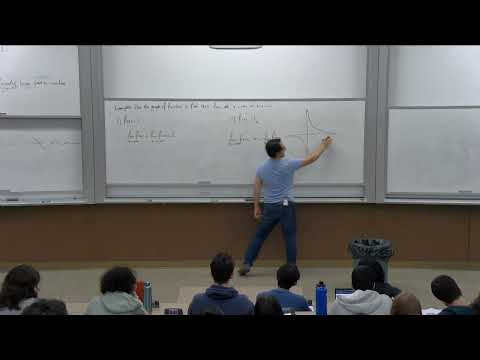 Watch on YouTube →
Overview
Asghar Ghorbanpour introduces limits as x approaches positive or negative infinity, using graphs of constant, reciprocal, exponential, and arctangent functions to identify end behavior and horizontal asymptotes. He shows how the substitution x = 1/t converts infinite limits to one-sided limits at zero, then applies limit laws and dominant-term factoring to evaluate examples and explain why forms such as ∞/∞ require further work.
Key takeaways
- A limit at infinity describes function values for sufficiently large positive or negative x; infinity is not a number or a point where the function is evaluated.
- The substitution x = 1/t converts x → +∞ into t → 0⁺ and x → −∞ into t → 0⁻, letting standard one-sided limit techniques handle infinite limits.
- A finite end limit L makes y = L a horizontal asymptote; a function can have at most two such asymptotes, one for each direction of infinity.
- Reciprocal powers 1/xʳ tend to 0 for r > 0 when defined, while arctan(x) approaches ±π/2 and eˣ approaches 0 at negative infinity.
- Forms ∞ − ∞, 0·∞, and ∞/∞ are indeterminate rather than results; they must be resolved by examining the functions’ relative behavior.
- For polynomial quotients, divide by the denominator’s highest power of x; for exponential quotients with matching dominant growth, factor and cancel the largest exponential term.
Chapters
0:00
Intuitive Meaning of Limits as x Approaches ±∞
- A finite limit L at positive infinity means f(x) gets arbitrarily close to L for sufficiently large positive x.
- For a limit at negative infinity, x must be sufficiently large in magnitude and negative; infinity itself is not a real-number input.
- The graph-based intuition allows the function to approach L from above, below, or while oscillating closer to L.
5:10
Graphing 1/x, eˣ, and arctan(x) at Both Ends
- The constant function f(x) = 2 has limit 2 at both positive and negative infinity.
- For 1/x, the limit is 0 as x approaches either infinity, wherever the function is defined; more generally, 1/xʳ tends to 0 for positive r when defined.
- The exponential eˣ tends to 0 as x → −∞ and grows without bound as x → +∞; arctan(x) tends to −π/2 and π/2, respectively.
- For exponential functions, bˣ tends to infinity as x → +∞ when b > 1, while it tends to 0 when 0 < b < 1.
14:20
Horizontal Asymptotes from End Limits
- The line y = L is a horizontal asymptote if either the limit as x → +∞ or the limit as x → −∞ equals L.
- The graph examples give y = 0 as a horizontal asymptote for 1/x and eˣ, and y = π/2 and y = −π/2 as asymptotes for arctan(x).
- A function can have at most two horizontal asymptotes—one determined by each direction of infinity.
17:40
Convert Infinite Limits with the Substitution x = 1/t
- For x → +∞, setting x = 1/t changes the limit into a one-sided limit as t → 0⁺.
- For x → −∞, the same substitution changes the limit into a one-sided limit as t → 0⁻.
- The substitution makes infinite limits accessible to familiar techniques for ordinary one-sided limits, including limit laws.
21:30
Rational Limit Example: (2x + 1)/(3x − 1)
- For x → +∞, substituting x = 1/t turns (2x + 1)/(3x − 1) into (2/t + 1)/(3/t − 1).
- Combining terms over t and canceling the common factor gives (2 + t)/(3 − t), with t → 0⁺.
- Direct substitution now yields 2/3, so y = 2/3 is the function’s horizontal asymptote at positive infinity.
25:30
A Squeeze-Theorem Limit Transferred to Infinity
- The example x·sin(1/x) as x → −∞ becomes sin(t)/t after setting x = 1/t and letting t → 0⁻.
- The standard limit sin(t)/t = 1, established using the squeeze theorem, gives the original infinite limit as 1.
- Because the two-sided limit sin(t)/t exists, its left-hand limit at t = 0 has the same value.
33:30
Applying Limit Laws to Exponential and Arctangent Examples
- Limit laws and the squeeze theorem also apply at infinity after limits are expressed as one-sided limits.
- For (eˣ + 3)/(eˣ − 1) as x → −∞, eˣ → 0, so the quotient approaches 3/(−1) = −3.
- For 3⁻ˣ + 2 arctan(x) as x → +∞, the exponential term tends to 0 and the arctangent term tends to π, giving a total limit of π.
40:00
Why Infinity Arithmetic Produces Indeterminate Forms
- Infinity is not a number, so it cannot be substituted into ordinary arithmetic or limit laws as though it were a real value.
- The forms ∞ − ∞, 0·∞, and ∞/∞ are indeterminate: their outcomes depend on the functions involved.
- By contrast, adding two quantities that both grow without bound gives an unbounded result; subtraction and division require more analysis.
43:00
Polynomial Quotients: Factor the Highest Power of x
- For (x² + x + 1)/(x³ + 3x² − 1) as x → +∞, the numerator and denominator both grow, creating an ∞/∞ form.
- Divide numerator and denominator by x³, the highest power in the denominator, to express the quotient using terms such as 1/x and 1/x².
- As x → +∞, those reciprocal terms tend to 0; the numerator approaches 0 while the normalized denominator approaches 1, so the quotient tends to 0.
47:40
Exponential Quotients: Factor the Dominant Term eˣ
- In (eˣ + 1)/(eˣ + 4) as x → +∞, both numerator and denominator grow without bound, again producing an ∞/∞ form.
- Factoring eˣ from both expressions and canceling gives (1 + e⁻ˣ)/(1 + 4e⁻ˣ).
- Since e⁻ˣ → 0 as x → +∞, the quotient tends to 1; the general strategy is to factor and cancel the dominant term.
Summary, takeaways, and chapters were generated by AI from the video's transcript and may contain errors. The video belongs to its creator, Asghar Ghorbanpour.