Calc 1 -- Practice Preparation Quiz (Fall 2026)
 Watch on YouTube →
Overview
Beard Meets Calculus works through a 10-question Calc 1 preparation quiz, demonstrating methods for linear equations, algebraic simplification, function composition, graph transformations, logarithms, and unit-circle values. The walkthrough emphasizes checking answers, reading instructions carefully, choosing efficient strategies, and prioritizing problems strategically because the quiz requires 80% rather than perfection.
Key takeaways
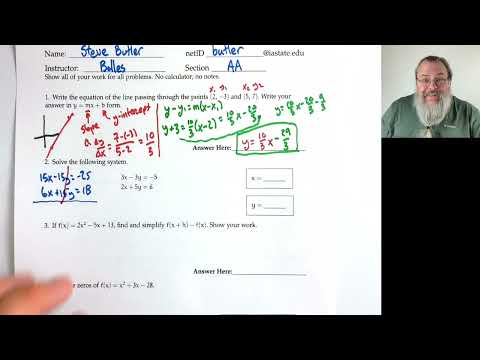
- For the line through (2, -3) and (5, 7), the slope is 10/3 and the requested slope-intercept equation is y = (10/3)x - 29/3.
- Elimination solves 3x - 3y = -5 and 2x + 5y = 6 as (-1/3, 4/3); substituting the result into the original equations is an effective error check.
- For f(x) = 2x² - 5x + 13, expanding f(x + h) - f(x) and canceling terms without h gives 4xh + 2h² - 5h.
- A reliable way to identify a transformed cubic is to combine transformation rules with graph points: y = -(x - 2)³ + 4 passes through (0, 12) and (1, 5).
- To solve e^(-2x) - 9 = 0 exactly, isolate the exponential before taking ln; the result is x = -ln 3.
- The quiz review encourages strategic pacing: the target is 80%, and difficult unit-circle matching can be postponed while faster problems are completed.
Chapters
0:00
Quiz Setup: Names, Sections, and Scannable Answers
- Enter a full name, Net ID, recitation section, and recitation instructor before starting.
- Write legibly in a dark color because completed quizzes are scanned.
- The practice quiz contains 10 questions, and the review prioritizes understanding over speed.
2:10
Find a Line Through (2, -3) and (5, 7)
- Calculate slope as change in y over change in x: (7 - (-3))/(5 - 2) = 10/3.
- Use point-slope form with (2, -3), then rearrange into the requested y = mx + b form.
- The resulting line is y = (10/3)x - 29/3; substituting (5, 7) checks the result.
5:48
Solve a Two-Equation System by Elimination
- For 3x - 3y = -5 and 2x + 5y = 6, multiply the equations by 5 and 3 to eliminate y.
- Adding the scaled equations gives 21x = -7, so x = -1/3.
- Eliminate x in a second pass to find y = 4/3, then substitute the pair into the original equations to verify.
12:35
Expand and Simplify f(x + h) - f(x)
- For f(x) = 2x² - 5x + 13, replace every x with (x + h) when evaluating f(x + h).
- Expand 2(x + h)² - 5(x + h) + 13 and subtract the entire expression for f(x), using parentheses to preserve signs.
- Terms without h cancel, leaving 4xh + 2h² - 5h.
16:53
Factor x² + 3x - 28 to Find Its Zeros
- Set the quadratic equal to zero and find numbers whose product is -28 and whose sum is 3.
- Factor as (x + 7)(x - 4) and apply the zero-product property.
- The zeros are x = -7 and x = 4; substituting either value into the quadratic confirms it.
21:42
Combine Rational Terms Over x² - 9
- Factor the denominator x² - 9 as (x + 3)(x - 3) to identify the common denominator.
- Rewrite the expression using x² - 9 as the shared denominator, multiplying the first term by x² - 9 and the final term by x - 3.
- Distribute the subtraction carefully; the cubic terms cancel and the simplified result is (3x² - 5x + 1)/(x² - 9).
28:01
Simplify Exponents and Leave Only Positive Powers
- Move a factor with a negative exponent across the fraction bar to make its exponent positive.
- Combine powers with the same base by adding exponents in the numerator and subtracting denominator exponents.
- The simplified expression is a⁶b⁶, with no negative exponents remaining.
30:31
Evaluate a Piecewise Composition from the Inside Out
- For f(g(3)), first select the branch of g that applies to 3; since 3 > 2, use g(x) = -3x + 1.
- Compute g(3) = -8, then select the branch of f that applies to -8.
- Evaluating that branch gives f(-8) = 40, illustrating why composition requires choosing a piecewise rule at each layer.
33:17
Identify a Reflected, Shifted Cubic by Its Graph
- Recognize the graph as a cubic transformed by a reflection and horizontal and vertical shifts.
- The curve is reflected across the x-axis, shifted right 2 and up 4, giving y = -(x - 2)³ + 4.
- When transformation rules are unclear, test visible graph points: the curve includes (0, 12) and (1, 5), which identify the matching equation.
41:34
Solve e^(-2x) - 9 = 0 with Natural Logarithms
- Isolate the exponential first: e^(-2x) = 9; logarithms do not separate an exponent from addition or subtraction.
- Apply the natural logarithm to obtain -2x = ln 9, then divide by -2.
- The exact solution is x = -(1/2)ln 9, equivalently x = -ln 3.
45:23
Use the Unit Circle for Exact Values and Quiz Strategy
- Recall first-quadrant unit-circle values to find cos(π/3) = 1/2 and tan(π/6) = √3/3.
- Relate angles in other quadrants to reference angles and apply the correct sign: sin(3π/4) = √2/2 and cos(7π/6) = -√3/2.
- Beard Meets Calculus recommends saving the unit-circle matching problem for later if it is slowing progress, since the quiz requires 80% rather than a perfect score.
- Finish by practicing the quiz independently and checking work when time permits.
Summary, takeaways, and chapters were generated by AI from the video's transcript and may contain errors. The video belongs to its creator, Beard Meets Calculus.