Calc 1 -- Practice for Quiz 6 (Fall 2026)
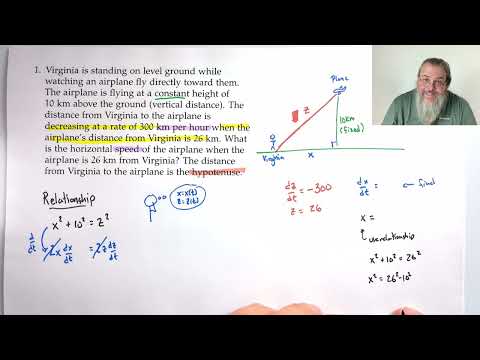 Watch on YouTube →
Overview
Calc I practice works through 10 quiz-style problems on related rates, tangent-line linearization, critical points, and absolute extrema. The solutions emphasize translating words into equations, differentiating with respect to time when quantities vary, checking domains and units, and comparing function values at every candidate point.
Key takeaways
- In related-rates problems, model changing quantities as functions of time and differentiate the relationship with respect to t; for the airplane, x² + 10² = z² leads to a horizontal speed of 325 km/h.
- A rate described as decreasing is negative: the airplane’s dz/dt is -300 km/h, while its speed is reported as the positive magnitude 325 km/h.
- Linearization uses L(x) = f(a) + f′(a)(x - a); selecting a nearby input that is easy to evaluate, such as 625 for estimating the fourth root of 600, makes the calculation practical.
- Critical points require checking where the derivative is zero and where it is undefined while confirming the original function is defined; denominator zeros outside the function’s domain are not critical points.
- For a cone with height 12 ft and base radius 4 ft, similar triangles give h = 3r; combining this with the cone-volume formula simplifies the model to V = πr³.
- To find absolute extrema on a closed interval, evaluate the original function at both endpoints and all interior critical points; for 2s³ + 9s² on [-4, 1], the absolute minimum is 0 at 0 and the maximum is 27 at -3.
Chapters
0:00
Recognizing the Airplane Problem as Related Rates
- Multiple rates—distance changing and horizontal speed—signal a related-rates problem.
- The word “hypotenuse” identifies a right triangle, with horizontal distance x, fixed height 10 km, and Virginia-to-plane distance z.
- “Decreasing at 300 km/h” means dz/dt = -300 km/h, while the target is dx/dt when z = 26 km.
6:19
Finding the Airplane’s Horizontal Speed
- Apply the Pythagorean relationship x² + 10² = z², then differentiate with respect to time to obtain x(dx/dt) = z(dz/dt).
- At z = 26 km, the horizontal distance is x = √(26² - 10²) = 24 km.
- Substitution gives dx/dt = -325 km/h; the negative sign indicates motion toward Virginia, while speed is 325 km/h.
15:08
Linearizing Secant at π/6
- Linearization is the tangent-line formula L(x) = f(a) + f′(a)(x - a), with a = π/6.
- For f(x) = sec x, the unit circle gives sec(π/6) = 2/√3 and tan(π/6) = 1/√3.
- Since f′(x) = sec x tan x, the tangent slope is 2/3 and L(x) = 2/√3 + (2/3)(x - π/6).
19:53
Differentiating the Logarithmic Approximation Problem
- For f(x) = ln(1 + 4x - 4x²) - 25/(x + 4), build the approximation at x = 1 using f(1) + f′(1)(x - 1).
- The chain rule gives the logarithm’s derivative as (4 - 8x)/(1 + 4x - 4x²); differentiating the rational term contributes 25/(x + 4)².
- Evaluation gives f(1) = -5 and f′(1) = -3, so L(x) = -5 - 3(x - 1).
24:54
Using the Tangent Line to Estimate f(1.2)
- Near x = 1, approximate f(x) with L(x), so f(1.2) ≈ L(1.2).
- Substitution into L(x) = -5 - 3(x - 1) gives -5 - 3(0.2) = -5.6.
- The estimate is negative; its sign follows from the computed function value and slope.
26:47
Choosing a Nearby Base Point for the Fourth Root of 600
- Rewrite the target as f(600) for f(x) = x^(1/4), then select a nearby input with an easy fourth root.
- Since 625 = 5⁴, use a = 625 as the tangent-line base point.
- The linearization is L(x) = f(625) + f′(625)(x - 625), with f(625) = 5.
31:05
Estimating the Fourth Root with Linearization
- For f(x) = x^(1/4), f′(x) = 1/(4x^(3/4)); at 625 this equals 1/500.
- Evaluate L(600) = 5 + (1/500)(600 - 625) = 4.95.
- The estimate uses a tangent line at a nearby perfect fourth power rather than calculating the root exactly.
35:16
Critical Points of an Exponential Quotient
- For f(x) = e^(3x)/(3x² - 1), apply the quotient rule and factor the derivative as 3e^(3x)(3x² - 2x - 1)/(3x² - 1)².
- The exponential factor never vanishes; factoring the quadratic gives (3x + 1)(x - 1).
- The derivative is zero at x = -1/3 and x = 1; denominator zeros are excluded because the original function is undefined there.
41:19
Critical Points of tan²θ + 4 sec θ
- Differentiation and factoring give t′(θ) = 2 tan θ sec θ(sec θ + 2).
- Within the defined parts of 0 to 2π, tan θ = 0 at 0 and π, while sec θ = -2 yields cos θ = -1/2 at 2π/3 and 4π/3.
- Secant cannot equal zero, and θ = π/2 and 3π/2 are excluded because the function is undefined there.
48:23
Factoring the Derivative for an Exponential-Polynomial Function
- For f(t) = (2t - 7)e^(2t) - 8t(t - 6), use the product rule on the exponential term and expand the quadratic term.
- After collecting factors, f′(t) = 4(t - 3)(e^(2t) - 4).
- Both factors are continuous, so there are no derivative-undefined candidates; critical points come from setting either factor to zero.
54:20
Solving the Exponential Critical-Point Equation
- The factor t - 3 gives the critical point t = 3.
- Solving e^(2t) = 4 with natural logarithms gives 2t = ln 4 and t = ln 2.
- The two critical points are t = 3 and t = ln 2.
1:01:57
Calculating the Water-Surface Radius Rate
- Differentiate V = πr³ with respect to time to get dV/dt = 3πr²(dr/dt).
- At a water depth of 3 ft, h = 3r implies r = 1 ft.
- Using dV/dt = 15π gives dr/dt = 5 ft/min.
1:04:27
Implicit-Curve Rates: Finding dy/dt
- For 3xy³ + yx³ = 2x² + 2y, treat both x and y as functions of time because the question gives dx/dt and asks for dy/dt.
- Differentiate each product with the product rule, then substitute x = 1, y = 1, and dx/dt = 1/3.
- The resulting equation reduces to 8(dy/dt) = -2/3, so dy/dt = -1/12 units per second.
1:11:18
Building the Candidate List for Absolute Extrema
- For h(s) = 2s³ + 9s² on the closed interval [-4, 1], check endpoints and points where h′ is zero or undefined.
- The derivative is h′(s) = 6s(s + 3), so the interior critical points are s = 0 and s = -3.
- The complete candidate list is -4, -3, 0, and 1; all lie within the interval.
1:15:33
Comparing Candidate Values and Identifying the Extrema
- Evaluate the original function at the candidate points: h(-4) = 16, h(-3) = 27, h(0) = 0, and h(1) = 11.
- The smallest value is 0 at s = 0, giving the absolute minimum; the largest is 27 at s = -3, giving the absolute maximum.
- The closing review emphasizes practicing the reasoning behind the steps, not only memorizing procedures.
Summary, takeaways, and chapters were generated by AI from the video's transcript and may contain errors. The video belongs to its creator, Beard Meets Calculus.