Calc 1 -- Practice for Quiz 5 (Fall 2026)
 Watch on YouTube →
Overview
Beard Meets Calculus works through 10 Calc 1 Quiz 5 practice problems covering implicit differentiation, logarithmic differentiation, inverse-function derivatives, arc tangent rules, second derivatives, and vertical tangents. The solutions emphasize recognizing problem cues, evaluating early, preserving implicit relationships, and using algebraic simplification to obtain results such as tangent lines y = -x/2 + 3/2, critical values x = -1 and 1/4, four vertical-tangent points, and (g^{-1})'(59) = -1/34.
Key takeaways
- Implicit differentiation treats y as a function of x, applies the chain rule to every y-expression, and is the natural method when an equation cannot be solved cleanly for y.
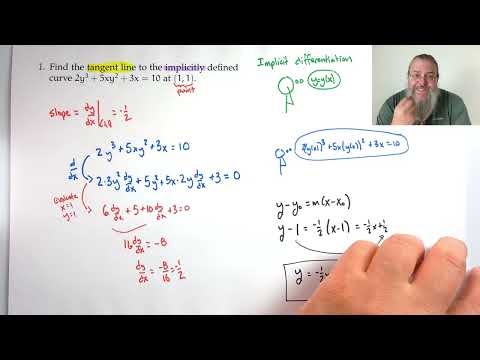
- For 2y^3 + 5xy^2 + 3x = 10 at (1,1), implicit differentiation gives dy/dx = -1/2, producing the tangent line y = -x/2 + 3/2.
- Logarithmic differentiation is most effective when products, quotients, and variable exponents appear together; for y = 12x(x^2 - 7)/(x + 4)^{1/3}, it yields y'(4) = 47.
- A second implicit derivative should usually be obtained by differentiating the first implicit equation again before solving for y'; for 2x + 3e^y = x^2 + y at (3,0), the result is y'' = -5.
- Inverse-function tangent geometry swaps coordinates and reciprocates nonzero slopes, while the derivative formula (g^{-1})'(a) = 1/g'(g^{-1}(a)) requires finding the original input first.
- Vertical tangents can be found by setting dx/dy = 0; for 2y^3 - 9y^2 = x^2 - 8x - 20, this produces exactly four points: (-2,0), (10,0), (1,3), and (7,3).
Chapters
0:00
Practice Strategy and Recognizing Calculus Problem Cues
- Beard Meets Calculus recommends attempting each problem independently before checking the solution.
- Frustration is framed as a productive part of learning because calculus is learned primarily through doing problems.
- Key wording such as "implicitly defined," "vertical tangent," and "slope of the tangent line" identifies the required technique.
2:00
Problem 1: Implicit Tangent Line for 2y^3 + 5xy^2 + 3x = 10
- The curve cannot conveniently be solved for y, so y is treated as a function of x during implicit differentiation.
- Differentiation uses the chain rule on 2y^3 and the product rule on 5xy^2.
- At (1,1), the derivative equation becomes 16(dy/dx) + 8 = 0, giving slope -1/2.
- The tangent line is y - 1 = -(1/2)(x - 1), or y = -x/2 + 3/2.
8:20
Problem 2: Choosing Logarithmic Differentiation for Variable Exponents
- The expression contains x in both bases and exponents, making ordinary product, quotient, and power rules inconvenient.
- Logarithmic differentiation rewrites products as sums, quotients as differences, and powers as coefficients.
- The core identity used is f'(x) = f(x) d/dx[ln f(x)].
- Beard Meets Calculus stresses that most of the work is careful algebraic rewriting before taking the derivative.
13:00
Problem 2: Differentiating the Log-Expanded Expression
- The logarithm of the complicated function is separated into terms for numerator factors and denominator factors.
- Expressions such as ln(e^{3x}) simplify to 3x, while powers such as x^2 + 1 move in front of logarithms.
- The derivative applies the product rule to (x^2 + 1)ln(2 + cos x), the logarithmic derivative 1/x, and d/dx[ln(tan x)] = sec^2(x)/tan(x).
- The resulting unsimplified expression is accepted because no further simplification was requested.
18:40
Problem 3: Derivative Rules for ln x and arctan x
- For h(x) = 2ln(1 + 4x^2) + 3 arctan(2x), the target is to find all x where h''(x) = 0.
- The chain-rule forms are d/dx[ln f(x)] = f'(x)/f(x) and d/dx[arctan f(x)] = f'(x)/(1 + f(x)^2).
- The first derivative is 16x/(1 + 4x^2) + 6/(1 + 4x^2), which combines to (16x + 6)/(1 + 4x^2).
- Simplifying before taking the second derivative reduces the calculation to one quotient-rule problem.
23:20
Problem 3: Solving h''(x) = 0 with the Quotient Rule
- Differentiating (16x + 6)/(1 + 4x^2) gives [(16)(1 + 4x^2) - (16x + 6)(8x)]/(1 + 4x^2)^2.
- Because 1 + 4x^2 is always positive for real x, only the numerator must equal zero.
- Expansion and factoring reduce the equation to 4x^2 + 3x - 1 = (4x - 1)(x + 1) = 0.
- The solutions are x = 1/4 and x = -1; the quadratic formula provides an alternative verification.
29:20
Problem 4: Setting Up a Second Implicit Derivative
- For 2x + 3e^y = x^2 + y at (3,0), solving explicitly for y is impractical because y appears both inside and outside the exponential.
- The first implicit derivative is 2 + 3e^y y' = 2x + y'.
- To obtain y'', Beard Meets Calculus differentiates this equation again instead of solving for y' first.
- Treating both y and y' as functions of x makes the second differentiation systematic.
34:00
Problem 4: Evaluating y' and y'' at (3,0)
- Substituting x = 3 and y = 0 into the first-derivative equation gives 2 + 3y' = 6 + y', so y' = 2.
- The second derivative equation uses the product rule on 3e^y y', producing 3e^y(y')^2 + 3e^y y'' = 2 + y''.
- At (3,0) with y' = 2, the equation becomes 12 + 3y'' = 2 + y''.
- Solving gives y'' = -5.
39:50
Problem 5: Tangent Lines to Inverse Functions
- The line y = (2/7)x + 37/7 is tangent to f at the point where x = f^{-1}(3), meaning f(x) = 3 there.
- Substituting y = 3 into the tangent line gives x = 9, so the point on f is (9,3).
- The inverse swaps coordinates, making the corresponding point (3,9), and reciprocal slopes change 2/7 to 7/2.
- The tangent line to f^{-1} is y - 9 = (7/2)(x - 3), or y = (7/2)x - 3/2.
47:00
Problem 5: Swapping x and y for the Inverse Tangent Line
- A geometric alternative is to reflect the original tangent line across y = x by swapping x and y.
- Starting from y = (2/7)x + 37/7 gives x = (2/7)y + 37/7 for the inverse tangent line.
- Solving for y produces y = (7/2)x - 3/2, matching the point-and-reciprocal-slope method.
- The reflection argument is local: the original tangent line determines the inverse tangent only at the corresponding point.
50:00
Problem 6: Why dx/dy = 0 Indicates a Vertical Tangent
- For 2y^3 - 9y^2 = x^2 - 8x - 20, a vertical tangent occurs where dx/dy = 0.
- Because differentiation is with respect to y, x is treated as a function of y rather than y as a function of x.
- Differentiation gives 6y^2 - 18y = (2x - 8)(dx/dy).
- Setting dx/dy = 0 reduces the condition to 6y(y - 3) = 0, so y = 0 or y = 3.
54:50
Problem 6: Finding All Four Vertical-Tangent Points
- For y = 0, substitution into the original curve gives x^2 - 8x - 20 = 0 = (x - 10)(x + 2), producing (-2,0) and (10,0).
- For y = 3, substitution gives x^2 - 8x + 7 = 0 = (x - 1)(x - 7), producing (1,3) and (7,3).
- The complete set of vertical-tangent points is (-2,0), (10,0), (1,3), and (7,3).
- The problem demonstrates switching perspectives between y as a function of x and x as a function of y.
59:00
Problem 7: Implicit Differentiation with arctan
- For arctan(x + y^2) = 3e^{x + 2y} + xy + 5 at (-4,2), the tangent slope is dy/dx evaluated at that point.
- The left side uses the chain rule: [1/(1 + (x + y^2)^2)](1 + 2yy').
- The right side differentiates 3e^{x + 2y} as 3e^{x + 2y}(1 + 2y') and xy as y + xy'.
- Implicit differentiation is required because y occurs in several nonlinear positions.
1:04:00
Problem 7: Evaluating the arctan Implicit Derivative
- At (-4,2), x + y^2 = 0 and x + 2y = 0, so the exponential and arctangent denominators simplify substantially.
- The evaluated equation becomes 1 + 4y' = 3 + 6y' + 2 - 4y'.
- Solving gives y' = 2.
- Using point-slope form at (-4,2), the tangent line is y - 2 = 2(x + 4), or y = 2x + 10.
1:07:00
Problem 8: Logarithmic Differentiation of a Product and Quotient
- For y = 12x(x^2 - 7)/(x + 4)^{1/3}, logarithmic differentiation avoids combining product, quotient, and chain rules directly.
- The logarithm expands into ln 12 + ln x + ln(x^2 - 7) - (1/3)ln(x + 4).
- Differentiating gives y' = y[1/x + 2x/(x^2 - 7) - 1/(3(x + 4))].
- The method turns a complicated derivative into one function copy followed by a short sum of logarithmic derivatives.
1:12:30
Problem 8: Evaluating the Logarithmic Derivative at x = 4
- At x = 4, the original function evaluates to 12(4)(9)/(8^{1/3}) = 144/2 = 72.
- The bracketed derivative factor becomes 1/4 + 4/9 - 1/24.
- Multiplying by 72 gives 18 + 32 - 3 = 47.
- Therefore, dy/dx at x = 4 is 47.
1:16:10
Problem 9: Solving for B from a Tangent Slope
- For y = arctan(ln(Bx)), the slope at x = e^2 is specified as 1/(17e^2).
- The chain rule gives y' = 1/[1 + (ln(Bx))^2] multiplied by 1/x.
- Substitution of x = e^2 and reciprocal manipulation produce 1 + [ln(Be^2)]^2 = 17, so ln(Be^2) = ±4.
- Exponentiating yields B = e^2 or B = e^{-6}; these are the two possible constants consistent with the slope condition.
1:22:40
Problem 10: Restricting a Parabola to Define an Inverse
- For g(x) = 5x^2 - 14x + 11, the domain (-∞, 7/5] selects the left branch of the upward-opening parabola.
- The restriction is necessary because the full parabola is not one-to-one and therefore cannot have an inverse function.
- The inverse derivative formula is (g^{-1})'(x) = 1/g'(g^{-1}(x)).
- To evaluate at x = 59, first find the restricted-domain input satisfying g(x) = 59.
1:28:10
Problem 10: Computing (g^{-1})'(59) and Final Review
- Solving 5x^2 - 14x + 11 = 59 gives 5x^2 - 14x - 48 = (5x + 10)(x - 24/5) = 0.
- The domain x ≤ 7/5 selects x = -2, so g^{-1}(59) = -2.
- Since g'(x) = 10x - 14, g'(-2) = -34 and (g^{-1})'(59) = -1/34.
- The review closes by reinforcing implicit differentiation, logarithmic differentiation, arctangent derivatives, inverse functions, algebraic factoring, and persistence.
Summary, takeaways, and chapters were generated by AI from the video's transcript and may contain errors. The video belongs to its creator, Beard Meets Calculus.