Calc 1 -- Practice for Quiz 4 (Fall 2026)
 Watch on YouTube →
Overview
Beard Meets Calculus works through 10 Calc I quiz-practice problems on motion, derivative rules, tangent lines, piecewise differentiability, and reading derivatives from graphs. The solutions emphasize translating wording into calculus operations and using the chain rule, while one worked answer has a sign error: Problem 4 evaluates to -21, not the stated 21.
Key takeaways
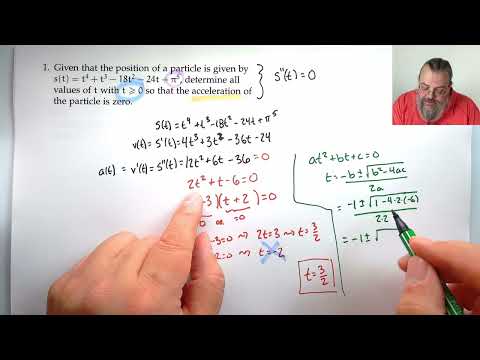
- A position function’s acceleration is its second derivative; for s(t) = t^4 + t^3 - 18t² - 24t + π⁵, setting s''(t) = 0 and applying t ≥ 0 leaves t = 3/2.
- Simplifying between derivative steps can substantially reduce work: cos θ/(1 + sin θ) has first derivative -1/(1 + sin θ), which makes its second derivative straightforward.
- For f(x) = g(x³ - 5x), the chain rule gives f'(2) = g'(-2) × 7 = -21; preserving the negative sign is essential.
- When a particle continues with its current motion after a force stops, the model uses the tangent line at that instant; the tangent to y = 20 + e^x - 4x at x = 0 reaches y = 0 at x = 7.
- A piecewise function is differentiable at its join only when both its one-sided function values and one-sided derivatives agree; here those conditions yield a = 5/3 and b = -2/3.
- Graph-based composition derivatives require two separate readings: for f(f(x)) at x = 4, f(4) = 5.5, f'(4) = 1/2, and f'(5.5) = -4, producing -2.
Chapters
0:00
Practice Strategy: Attempt Each Quiz Problem Before Viewing Solutions
- Beard Meets Calculus encourages attempting each problem independently before following the worked solution.
- The set contains 10 practice problems intended to build readiness for a Calc I quiz.
0:26
Problem 1: Translate Zero Acceleration into a Second-Derivative Equation
- The position function is s(t) = t^4 + t^3 - 18t^2 - 24t + π^5; π^5 is a constant, so its derivative is zero.
- Acceleration is s''(t), so the task is to solve s''(t) = 0 while respecting the restriction t ≥ 0.
4:28
Problem 1: Factor the Acceleration Quadratic and Apply the Time Restriction
- Differentiating twice gives s''(t) = 12t^2 + 6t - 36, or 6(2t^2 + t - 6).
- Factoring gives (2t - 3)(t + 2) = 0, with roots 3/2 and -2; only t = 3/2 satisfies t ≥ 0.
7:27
Problem 1: Confirm the Roots with the Quadratic Formula
- For 2t^2 + t - 6 = 0, the quadratic formula produces (-1 ± 7)/4, or t = 3/2 and t = -2.
- The domain restriction still excludes -2; the solution then moves to a diver’s position-and-velocity problem.
9:32
Problem 2: Find a Diver’s Velocity and Acceleration at One Second
- For s(t) = -16t^2 + 15t + 30 feet, velocity is s'(t) = -32t + 15 feet per second.
- At t = 1, velocity is -17 ft/s; the second derivative is constant acceleration, -32 ft/s².
14:47
Problem 3: Differentiate a Trigonometric Quotient and Simplify
- For cos(θ)/(1 + sin θ), the quotient rule gives a first derivative that simplifies using sin²θ + cos²θ = 1.
- Factoring the numerator and canceling a common factor reduces the first derivative to -1/(1 + sin θ), making the next derivative easier.
21:02
Problem 3: Differentiate the Simplified Expression Again
- Rewrite -1/(1 + sin θ) as -(1 + sin θ)^-1 and apply the chain rule.
- The second derivative is cos θ/(1 + sin θ)^2; simplifying before the second differentiation avoids a longer quotient-rule calculation.
23:45
Problem 4: Use the Chain Rule with a Given Derivative Value
- For f(x) = g(x^3 - 5x), the chain rule gives f'(x) = g'(x^3 - 5x)(3x² - 5).
- At x = 2, the inputs are g'(-2) = -3 and 3(2²) - 5 = 7, so f'(2) = -3 × 7 = -21; the transcript’s stated answer of 21 has a sign error.
27:34
Problem 5: Find the Tangent Slope of a Square-Root Function at π
- The slope of the tangent line to y = √(x + cos x) at x = π is y'(π), so the square root is rewritten as (x + cos x)^(1/2).
- The chain rule gives y' = (1 - sin x)/(2√(x + cos x)); using sin π = 0 and cos π = -1 yields 1/(2√(π - 1)).
32:34
Problem 6: Model Newton’s First Law with a Tangent Line
- For y = 20 + e^x - 4x, the point at x = 0 is (0, 21) and the slope is y'(0) = 1 - 4 = -3.
- The tangent line y = 21 - 3x represents the particle’s continued motion; setting y = 0 gives the ground-impact point (7, 0).
39:24
Problem 7: Compute the Fourth Derivative of x cos x
- Repeated product-rule applications give g'(x) = cos x - x sin x, g''(x) = -2 sin x - x cos x, and g'''(x) = -3 cos x + x sin x.
- The fourth derivative is g⁽⁴⁾(x) = 4 sin x + x cos x; at π/3 this equals 2√3 + π/6.
47:30
Problem 8: Use Tangent-Line Data in a Chain-Rule Calculation
- The graph’s tangent line at x = 3 gives f(3) = 2 and f'(3) = -1/2 from its rise-over-run slope.
- For g(x) = tan((π/3)f(x)), the chain rule gives g'(3) = sec²(2π/3)(π/3)(-1/2) = -2π/3.
54:25
Problem 9: Choose Piecewise Parameters for Differentiability at Zero
- For left branch 5 tan x + sec(2x) and right branch ae^(3x) + b, continuity at zero requires a + b = 1.
- Matching one-sided derivatives gives 5 = 3a, so a = 5/3 and b = -2/3; both function values and slopes must match.
1:05:45
Problem 10: Read f(4) and f'(4) from the Graph
- The graph shows f(4) = 5.5 on a straight segment and f'(4) = 1/2 from a rise of 1 over a run of 2.
- For the derivative of [f(x)]², the chain rule gives 2f(4)f'(4) = 2(5.5)(1/2) = 11/2.
1:09:39
Problem 10: Evaluate the Derivative of the Composition f(f(x))
- The chain rule gives d/dx[f(f(x))] = f'(f(x))f'(x), so at x = 4 the needed graph values are f(4) = 5.5 and f'(4) = 1/2.
- The graph’s slope on the segment containing 5.5 is f'(5.5) = -4, giving f'(5.5)(1/2) = -2; the closing review highlights tangent lines, graph reading, trigonometric derivatives, and the chain rule.
Summary, takeaways, and chapters were generated by AI from the video's transcript and may contain errors. The video belongs to its creator, Beard Meets Calculus.