Calc 1 -- Practice for Quiz 3 (Fall 2026)
 Watch on YouTube →
Overview
Beard Meets Calculus works through 10 Calc 1 quiz-practice problems covering quotient and product rules, limit-definition derivatives, second derivatives, tangent lines, and differentiability of piecewise functions. The solutions emphasize choosing simpler algebraic forms, translating geometric conditions into equations, and checking signs and results; final examples include tangent lines to a parabola and the limit-defined derivative of x²/(x+4).
Key takeaways
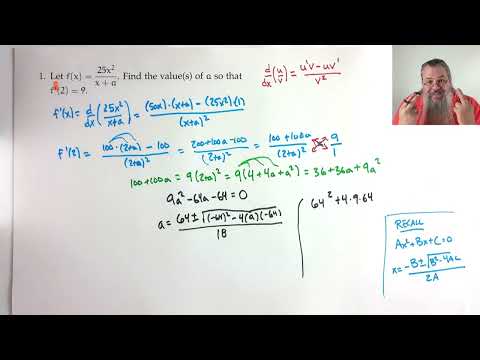
- For f(x)=25x²/(x+a), the condition f′(2)=9 leads to a quadratic with two solutions, a=8 and a=−8/9; both must be reported.
- A tangent line at x=2 gives only f(2) and f′(2), not the entire function; applying the product rule to x²f(x) yields the general answer y=28x−44.
- A piecewise function is differentiable at its boundary only when both its one-sided function limits and one-sided derivative limits agree; for the example at x=3, this gives b=−9 and c=6.
- Perpendicular tangent lines require negative-reciprocal slopes: the curve x³−6x²+20 has slope −12 at x=2, producing the point (2,4) against the line x−12y=7.
- For y=x²−5x+9, tangent lines through the origin occur where f(a)−af′(a)=0; the resulting lines are y=x and y=−11x.
- The limit definition for x²/(x+4) requires combining fractions and canceling h before taking the limit, giving f′(x)=(x²+8x)/(x+4)².
Chapters
0:00
Problem 1: Find a from a Quotient-Rule Derivative
- For f(x)=25x²/(x+a), use the quotient rule rather than the limit definition because no method is specified.
- Substituting x=2 into f′(x) and setting f′(2)=9 produces 9a²−64a−64=0.
- The quadratic formula gives both valid values, a=8 and a=−8/9.
12:29
Problem 2: Use a Given Tangent Line to Find New Tangent Data
- The line y=4x−5 tangent to f at x=2 supplies f(2)=3 and f′(2)=4.
- For g(x)=x²f(x), the product rule gives g(2)=12 and g′(2)=28.
- The tangent line at x=2 is y=12+28(x−2), or y=28x−44.
18:30
Why Substituting a Tangent Line for f Can Lose Credit
- Replacing f(x) with 4x−5 happens to reproduce g(2)=12 and g′(2)=28 in this example.
- That substitution assumes f is the tangent line everywhere, although the given information only fixes its value and slope at x=2.
- Using the product rule with f(2) and f′(2) correctly handles every function with the stated tangent line.
21:30
Problem 3: Differentiate √(6x+11) from the Limit Definition
- Start from g′(x)=lim as h→0 of [g(x+h)−g(x)]/h and carefully substitute x+h wherever x appears.
- Multiply by the conjugate to turn the difference of square roots into a difference of squares.
- After canceling h, evaluate the remaining limit to obtain g′(x)=3/√(6x+11).
31:00
Problem 4: Recover f(−1) and f′(−1) from Quotient Data
- For h(x)=f(x)/(2x³), the quotient rule and h′(−1)=7 give f′(−1)+3f(−1)=−14.
- Combine that equation with the given 3f′(−1)−f(−1)=8 to form a two-equation system.
- Solving and checking the original relation gives f(−1)=−5 and f′(−1)=1.
40:02
Problem 5: Enforce Continuity at a Piecewise Boundary
- For the piecewise function with x²+bx+c below 3 and 6−c√(3x) above 3, the potential issue is the join at x=3.
- Matching the one-sided function limits gives 9+3b+c=6−3c, or 3b+4c=−3.
- Continuity is necessary, but differentiability also requires the two sides’ slopes to agree.
44:27
Problem 5: Match One-Sided Derivatives to Ensure Differentiability
- The derivative on the lower branch is 2x+b, whose limit at 3 is 6+b.
- The derivative of 6−c√(3x) approaches −c/2 as x approaches 3 from above.
- Set 6+b=−c/2 to get 2b+c=−12; solving with 3b+4c=−3 yields b=−9 and c=6.
50:23
Problem 6: Find a Curve Point with a Perpendicular Tangent
- Rewrite x−12y=7 as y=x/12−7/12, so a perpendicular tangent must have slope −12.
- For y=x³−6x²+20, set y′=3x²−12x equal to −12; the resulting equation is (x−2)²=0.
- At x=2, the curve gives y=4, so the requested point is (2,4).
56:22
Problem 7: Simplify Before Taking a Second Derivative
- Rewrite f(x)=(x³+a)/x as x²+ax⁻¹ to avoid taking repeated quotient-rule derivatives.
- The second derivative is f″(x)=2+2ax⁻³.
- Using f″(2)=4 gives 2+a/4=4, so a=8.
1:01:34
Problem 8: Use the Tangent-Line Intercept to Locate Contact Points
- Lines of the form y=kx all have y-intercept zero, so a tangent at x=a must satisfy f(a)−af′(a)=0.
- For f(x)=x²−5x+9, the condition simplifies to 9−a²=0.
- The possible tangency locations are a=3 and a=−3.
1:06:56
Problem 8: Convert Tangency Locations into the Two Lines
- The slope at a=3 is f′(3)=1, giving the tangent line y=x.
- The slope at a=−3 is f′(−3)=−11, giving the tangent line y=−11x.
- Both lines pass through the origin, as required by the form y=kx.
1:08:55
Problem 9: Make the Curves Intersect at (2,2)
- At x=2, the curve y=(2/e²)eˣ has value 2.
- For the other curve y=ax³+bx, requiring the same point gives 8a+2b=2.
- Dividing by 2 reduces the intersection condition to 4a+b=1.
1:11:00
Problem 9: Impose Perpendicular Tangent Slopes
- At x=2, the exponential curve has slope 2, while ax³+bx has slope 12a+b.
- Perpendicular slopes are negative reciprocals, so 12a+b=−1/2.
- Solving with 4a+b=1 gives a=−3/16 and b=7/4.
1:15:27
Problem 10: Set Up the Limit Definition for x²/(x+4)
- Begin with f′(x)=lim as h→0 of [f(x+h)−f(x)]/h for f(x)=x²/(x+4).
- Substitute x+h into both occurrences of x in f(x+h), keeping parentheses around the full numerator and denominator.
- Combine the two fractions using the common denominator (x+h+4)(x+4).
1:17:28
Problem 10: Expand the Difference Quotient Carefully
- Expand (x+h)²(x+4) as x³+4x²+2x²h+8xh+xh²+4h².
- Distribute the subtraction across x²(x+h+4), preserving the negative signs.
- The h-free terms x³ and 4x² cancel, leaving a numerator whose remaining terms all contain h.
1:21:36
Problem 10: Cancel h and Verify with the Quotient Rule
- Factor h from the numerator and cancel it against the h in the difference quotient before taking the limit.
- Setting h=0 yields f′(x)=(x²+8x)/(x+4)².
- A quotient-rule check, with numerator derivative 2x and denominator derivative 1, produces the same result.
1:26:08
Wrap-Up: Practice, Simplify, and Check Your Work
- The worked problems show why derivative rules are more efficient than the limit definition for routine derivatives.
- Rewriting expressions, as with (x³+a)/x, can turn a difficult quotient-rule task into straightforward power-rule work.
- Beard Meets Calculus recommends slowing down and checking algebra when signs or numbers begin to look unexpectedly complicated.
Summary, takeaways, and chapters were generated by AI from the video's transcript and may contain errors. The video belongs to its creator, Beard Meets Calculus.