Calc 1 -- Practice for Quiz 2 (Fall 2026)
 Watch on YouTube →
Overview
Beard Meets Calculus works through 10 Calc 1 quiz-practice problems on continuity, limits, asymptotes, discontinuities, tangent lines, and the derivative definition. The solutions emphasize one-sided limits at piecewise-function boundaries, algebraic techniques such as factoring and conjugates, dominant-term analysis at infinity, and careful sign handling; the corrected results include a removable-continuity value of -8 at x = -4 and a limit of 6√3 for the fourth-root expression.
Key takeaways
- A removable discontinuity at x = -4 in (x² - 16)/(x + 4) is repaired by defining f(-4) = -8, the limit of the simplified expression x - 4.
- For a piecewise function to be continuous at a boundary, its defined value and the one-sided limits must agree; the examples yield a = -8 at x = 3 and A = 3, B = -2 at the joins x = -1 and x = 2.
- At positive infinity, dividing by the fastest-growing term turns an indeterminate quotient into a comparison of leading coefficients; for the fourth-root example, the correct limit is 6√3.
- For g(x) = (2e²ˣ - 7eˣ - 15)/(e²ˣ - 6eˣ + 5), factoring after z = eˣ reveals horizontal asymptotes y = -3 and y = 2, a vertical asymptote x = 0, and a removable hole at x = ln 5.
- Squaring a function can change discontinuity types: a jump may remain a jump, become removable, or disappear when one-sided values square to the same number.
- The derivative definition for √(3x + 1) at x = 5 yields 3/8 after multiplying by the conjugate and canceling h; the same conjugate method rationalizes the radical limit at negative infinity, where √(x²) = |x| requires sign care.
Chapters
0:00
Removable Discontinuity at x = -4
- For f(x) = (x² - 16)/(x + 4), substituting x = -4 gives 0/0, so factor the numerator as (x - 4)(x + 4).
- For x ≠ -4, cancellation gives f(x) = x - 4; the limit as x approaches -4 is -8.
- Defining f(-4) = -8 makes the function continuous; the transcript's spoken value of 8 is an arithmetic error.
5:42
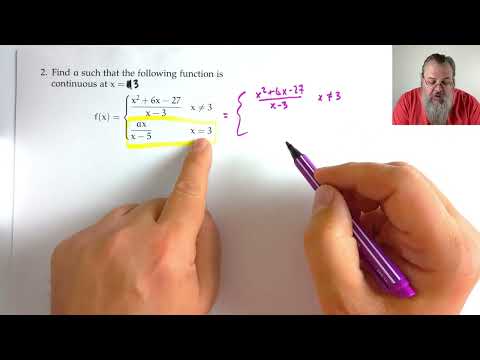
Choose a for Continuity at x = 3
- The piece for x ≠ 3 is (x² + 6x - 27)/(x - 3), which factors to x + 9 near x = 3.
- The limit at 3 is 12, while the defined value is 3a/(3 - 5) = -3a/2.
- Setting -3a/2 = 12 gives a = -8.
12:15
Match Three Polynomial Pieces at x = -1 and x = 2
- For the piecewise function with pieces 7 + 2x, ax² + bx, and 14 - 3x, only the joining points x = -1 and x = 2 require checks.
- At x = -1, matching one-sided limits gives 5 = a - b.
- At x = 2, matching limits gives 4a + 2b = 8, or 2a + b = 4.
19:31
Set Up the Fourth-Root Limit at Positive Infinity
- The limit has numerator 18x³ + 7√x + 36 and denominator ⁴√(9x¹² + 7x² + 122).
- Both numerator and denominator grow without bound, so the ∞/∞ form requires comparing dominant growth rather than direct substitution.
- The numerator's leading term is 18x³; dividing numerator and denominator by x³ exposes the limiting contributions.
24:16
Normalize Dominant Terms and Evaluate the Limit
- After dividing by x³, the numerator tends to 18 because √x/x³ and 36/x³ tend to zero.
- Inside the fourth root, dividing by x¹² leaves 9 plus terms that vanish, so the denominator tends to ⁴√9 = √3.
- The limit is 18/√3 = 6√3; the transcript's final simplification to 6 is incorrect.
32:50
Find Horizontal Asymptotes of the Exponential Rational Function
- For g(x) = (2e²ˣ - 7eˣ - 15)/(e²ˣ - 6eˣ + 5), evaluate limits as x approaches both infinities.
- As x → -∞, eˣ and e²ˣ tend to zero, leaving -15/5 = -3 and horizontal asymptote y = -3.
- As x → +∞, e²ˣ dominates; dividing through by e²ˣ leaves a limit of 2 and horizontal asymptote y = 2.
39:09
Factor with z = eˣ to Identify the Vertical Asymptote
- Set z = eˣ to rewrite the rational expression as (2z² - 7z - 15)/(z² - 6z + 5).
- Factoring gives ((2z + 3)(z - 5))/((z - 1)(z - 5)); canceling shows a hole at z = 5, or x = ln 5.
- The remaining denominator vanishes at z = 1, which corresponds to the vertical asymptote x = 0.
49:32
Track Candidate Discontinuities After Squaring a Graph
- For g(x) = [f(x)]², continuity is preserved wherever f is continuous, so only the five marked discontinuities on the graph need checking.
- At x = -3, the one-sided values of f approach 3 and 1, so their squares approach 9 and 1; g retains a jump.
- One-sided limits and the function value must all be compared: squaring can change a discontinuity's classification.
55:44
Classify the Remaining Discontinuities of the Squared Graph
- At x = -2, both sides and the function value square to 4, so the original removable hole becomes continuous.
- At x = 0, the one-sided values 1 and -1 both square to 1, matching g(0); the original jump becomes continuous.
- At x = 1 and x = 3, the two-sided limits agree but differ from g's value, leaving removable discontinuities; the final classification is a jump at -3 and removable points at 1 and 3.
1:00:00
Prepare the Radical Limit at Negative Infinity
- Evaluate √(x² - 8x + 117) + x as x → -∞, where the radical and x have opposite large magnitudes.
- Direct substitution suggests an ∞ − ∞ indeterminate form, so multiply by the conjugate √(x² - 8x + 117) − x.
- The difference of squares simplifies the numerator to -8x + 117.
1:03:27
Use the Conjugate to Reveal a Quotient
- After rationalizing, the expression is (-8x + 117)/(√(x² - 8x + 117) - x).
- Divide numerator and denominator by x to compare the terms that grow linearly.
- Because x approaches negative infinity, √(x²) = |x| = -x; overlooking this sign would produce the wrong limit.
1:09:00
Handle the Absolute-Value Sign and Finish the Radical Limit
- Rewriting the radical after division by x introduces the negative sign required by √(x²)/x = -1 for x < 0.
- Terms such as 117/x and 117/x² vanish, leaving a numerator of -8 and a denominator of -2.
- The limit is 4.
1:11:31
Reduce Piecewise Continuity to the Boundary at x = 0
- The function uses 3 - 5x + 2x² on the left of zero and sin(bx)/(x + 4) on the right.
- Each formula is continuous within its interval; continuity on the full domain depends on matching behavior at x = 0.
- The left-hand limit and defined value are both 3.
1:15:24
Apply the Sine Limit to Determine b
- The right-hand limit of sin(bx)/(x(x + 4)) has a 0/0 form, signaling the standard limit sin(u)/u → 1 as u → 0.
- Rewrite the expression as [sin(bx)/(bx)] · [b/(x + 4)]; the right-hand limit is b/4.
- Matching b/4 to the left-hand value 3 gives b = 12.
1:19:48
Read Function Value and Derivative from a Tangent Line
- A tangent line at x = 2 passes through (2, 7), so the function value is g(2) = 7.
- The same tangent line passes through (5, 1), so its slope is (7 - 1)/(2 - 5) = -2.
- Because the tangent-line slope equals the derivative at the tangency point, g′(2) = -2.
1:23:50
Set Up the Derivative Definition for √(3x + 1)
- To find the derivative of f(x) = √(3x + 1) at x = 5, use lim(h→0)[f(5 + h) - f(5)]/h.
- Substitution into the rule gives [√(16 + 3h) - 4]/h; parentheses keep the 5 + h input grouped correctly.
- Direct substitution produces 0/0, so algebra is needed before evaluating the limit.
1:29:00
Rationalize and Cancel in the Difference Quotient
- Multiply by the conjugate √(16 + 3h) + 4 to eliminate the radical difference in the numerator.
- The numerator becomes (16 + 3h) - 16 = 3h; cancel h to get 3/(√(16 + 3h) + 4).
- Taking h → 0 gives f′(5) = 3/(4 + 4) = 3/8.
1:33:44
Review the Core Quiz Techniques and Practice Advice
- The worked set covers continuity, one-sided limits, asymptotes, radical limits, tangent-line information, and the limit definition of a derivative.
- Recurring techniques include factoring to remove 0/0, normalizing by dominant terms, substituting z = eˣ, and multiplying by a conjugate.
- Beard Meets Calculus recommends practicing derivative-definition problems, especially substitution of x + h and algebraic cancellation.
Summary, takeaways, and chapters were generated by AI from the video's transcript and may contain errors. The video belongs to its creator, Beard Meets Calculus.