Calc 1 -- Practice for Quiz 1 (Fall 2026)
 Watch on YouTube →
Overview
Beard Meets Calculus works through 10 Calc 1 quiz-practice problems on average rates of change, algebraic and trigonometric limits, one-sided limits, piecewise functions, and compositions. The solutions emphasize checking direct substitution first, then using identities, conjugates, factoring, interval combinations, and one-sided analysis to resolve indeterminate forms or discontinuities.
Key takeaways
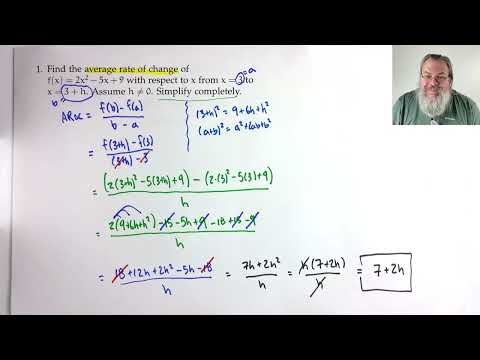
- For f(x) = 2x² − 5x + 9, the average rate of change from 3 to 3 + h simplifies to 7 + 2h after factoring h from the difference quotient.
- The limit (sec θ − 1)/(4 tan² θ) equals 1/8 after rewriting in sine and cosine, using sin² θ = (1 − cos θ)(1 + cos θ), and canceling 1 − cos θ.
- A 0/0 limit with a square root can often be resolved by multiplying by the conjugate; here that method turns the limit at x = 5 into 2/5.
- One-sided limits determine whether a two-sided limit exists: at x = 3 the sum of two jumping functions has limits −4 and 4, while their product has matching limits of 3.
- For nested limits, track the inner expression's value and direction before selecting a piecewise branch; this yields lim as x → 2 of f(f(x)) = 8.
- An absolute value near a one-sided endpoint requires checking the sign of its interior; for the limit as y → −4⁺, the interior is negative and the resulting limit is −3/5.
Chapters
0:00
Average Rate of Change from x = 3 to x = 3 + h
- Use the average-rate-of-change formula [f(b) − f(a)]/(b − a) for f(x) = 2x² − 5x + 9.
- Set a = 3 and b = 3 + h, so the denominator simplifies to h; retain parentheses when substituting 3 + h into f.
- Expand the numerator and combine terms to obtain 7h + 2h², then factor and cancel h (given h ≠ 0).
4:22
Finish the Difference Quotient and Simplify to 7 + 2h
- Expanding 2(3 + h)² produces 18 + 12h + 2h²; the −5(3 + h) term contributes −15 − 5h.
- The constant terms cancel against f(3), leaving (7h + 2h²)/h.
- Factoring out and canceling h gives the fully simplified average rate of change, 7 + 2h.
8:36
Trigonometric Limit: Rewrite Secant and Tangent Using Sine and Cosine
- For lim as θ → 0 of (sec θ − 1)/(4 tan² θ), direct substitution gives 0/0, so more work is required.
- Use sec θ = 1/cos θ and tan θ = sin θ/cos θ, then multiply numerator and denominator by cos² θ.
- The expression becomes (1 − cos θ)cos θ/[4 sin² θ], exposing the trig identity sin² θ = 1 − cos² θ.
18:09
Factor the Trigonometric Identity and Evaluate the Limit
- Replace sin² θ with (1 − cos θ)(1 + cos θ), using the difference-of-squares factorization.
- Cancel the common factor 1 − cos θ to get cos θ/[4(1 + cos θ)].
- Substitute θ = 0 into the simplified expression: 1/[4(1 + 1)] = 1/8.
24:00
Conjugates Remove the Square Root in a Limit at x = 5
- For lim as x → 5 of [x − √(6x − 5)]/(x − 5), substitution gives 0/0.
- Multiply by the conjugate x + √(6x − 5) in both numerator and denominator, preserving the expression while simplifying the numerator.
- The numerator becomes x² − (6x − 5) = x² − 6x + 5, which factors as (x − 5)(x − 1).
28:06
Cancel the Shared Factor and Evaluate the Radical Limit
- After factoring, cancel x − 5 against the denominator, while keeping the remaining denominator x + √(6x − 5).
- The equivalent expression away from x = 5 is (x − 1)/[x + √(6x − 5)].
- Substituting x = 5 gives 4/10 = 2/5; the cancellation resolves the indeterminate form.
33:43
Combine Rational Terms to Resolve a 0/0 Limit at x = 1
- For lim as x → 1 of [1/(2 − x) − 1/x]/(x − 1), direct substitution gives 0/0.
- Use the common denominator x(2 − x): the numerator becomes [x − (2 − x)]/[x(2 − x)] = 2(x − 1)/[x(2 − x)].
- Cancel x − 1 against the outer denominator to reduce the limit to 2/[x(2 − x)].
40:09
Read Average Rate of Change from a Graph Using Slope
- The graph gives f(1) = 2, and the requested average rate of change over [1, b] is 1/2.
- Interpret the average rate of change as the slope of a secant line through (1, 2); a rise of 1 for a run of 2 traces the candidate intersections.
- Choose b = 5, where the graph gives f(5) = 4; verification yields (4 − 2)/(5 − 1) = 1/2.
44:32
Translate Three Given Rates into Function-Value Differences
- An average rate of −2 on [0, 4] gives [f(4) − f(0)]/4 = −2, so f(4) − f(0) = −8.
- A rate of 1 on [2, 4] gives [f(4) − f(2)]/2 = 1, so f(4) − f(2) = 2.
- A rate of 9 on [2, 7] gives [f(7) − f(2)]/5 = 9, so f(7) − f(2) = 45.
49:23
Combine Interval Changes to Find the Rate on [0, 7]
- To form f(7) − f(0), combine [f(7) − f(2)] − [f(4) − f(2)] + [f(4) − f(0)]; the intermediate f(2) and f(4) terms cancel.
- Substitute the known differences: 45 − 2 + (−8) = 35, so f(7) − f(0) = 35.
- Divide by the interval length 7 to get an average rate of change of 35/7 = 5.
53:55
Compare One-Sided Limits of a Sum at a Jump Discontinuity
- At x = 3, the graph gives left-hand limits f(x) → −1 and g(x) → −3, so f(x) + g(x) → −4 from the left.
- From the right, f(x) → 3 and g(x) → 1, so the sum approaches 4.
- Because −4 and 4 disagree, the two-sided limit of f(x) + g(x) at 3 does not exist.
56:37
A Product Can Have a Limit Even When Its Factors Jump
- At x = 3 from the left, f(x) → −1 and g(x) → −3, so their product approaches 3.
- From the right, f(x) → 3 and g(x) → 1, so the product also approaches 3.
- The matching one-sided product limits show that lim as x → 3 of f(x)g(x) exists and equals 3, despite jumps in both functions.
1:03:33
Track the Inner Expression in a Piecewise-Function Limit
- For g(x) = 2x − 6 when x < 4, g(4) = 7, and g(x) = x + 3 when x > 4, evaluate lim as x → 0 of g(4 − x²).
- Since x² > 0 for real x ≠ 0, the inner expression 4 − x² approaches 4 from below, even when x approaches 0 from either side.
- Use the branch 2y − 6 for y → 4⁻; substituting 4 gives 8 − 6 = 2.
1:11:40
Handle an Absolute-Value Limit with a One-Sided Sign Check
- For lim as y → −4⁺ of |y² + 5y + 4|/(y² + 3y − 4), direct substitution gives 0/0.
- Factor the polynomials as |(y + 4)(y + 1)|/[(y + 4)(y − 1)]. Just above −4, y + 4 is positive and y + 1 is negative, so the expression inside the absolute value is negative.
- Replace the absolute value with −(y + 4)(y + 1), cancel y + 4, and substitute −4 to obtain −(−3)/(−5) = −3/5.
1:17:00
Square a Piecewise Function and Compare Its One-Sided Limits
- For f(x) = −2x when x < 2 and f(x) = x + 3 when x ≥ 2, the left-hand values approach −4 and the right-hand values approach 5.
- Squaring gives left-hand limit (−4)² = 16 and right-hand limit 5² = 25.
- Because the one-sided limits differ, lim as x → 2 of [f(x)]² does not exist.
1:21:25
Evaluate Nested and Shifted Piecewise-Function Limits
- For f(f(x)) as x → 2⁻, the inner value −2x approaches −4 from above; the outer branch −2y gives 8.
- As x → 2⁺, the inner value x + 3 approaches 5 from above; the outer branch y + 3 also gives 8, so lim as x → 2 of f(f(x)) = 8.
- For f(x + 2) as x → 2, the input to f approaches 4, where the branch y + 3 applies; the limit is 4 + 3 = 7.
Summary, takeaways, and chapters were generated by AI from the video's transcript and may contain errors. The video belongs to its creator, Beard Meets Calculus.