But what is cross-entropy? | Compression is Intelligence Part 2
 Watch on YouTube →
Overview
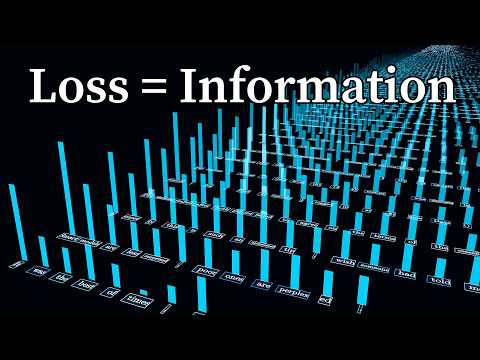
3Blue1Brown explains cross-entropy, a core concept in information theory and machine learning, by connecting it to file compression and language model training. The video demonstrates how cross-entropy quantifies the inefficiency of using a compression scheme optimized for one probability distribution (Q) when applied to another (P), mirroring how language models are trained to minimize the difference between their predicted token distributions and the true data distribution. This principle is applied to language tree discovery via file compression and forms the basis for training modern language models, with distillation offering a richer training signal by comparing model distributions.
Key takeaways
- Cross-entropy quantifies the inefficiency of using a compression scheme optimized for distribution Q when applied to data from distribution P.
- Language model training minimizes cross-entropy loss, effectively forcing the model's predicted token distribution to match the true data distribution.
- The choice of negative log as the loss function in LLM training is mathematically motivated to ensure minimization occurs when the model's predictions align with data statistics.
- Distillation uses cross-entropy to train smaller models by comparing their output distributions to those of larger teacher models, providing a richer learning signal.
- KL divergence, a related concept, measures the 'wasted' bits when using a suboptimal code and acts as an asymmetric distance between probability distributions.
Chapters
- A 2002 paper showed how general file compression (like gzip) can reveal linguistic structure between documents.
- By appending document B to A and compressing, the resulting file size difference indicates B's similarity to A.
- This co-compression metric can cluster documents by language and even recover language lineage trees.
- This technique is a pure example of compression theory applied to machine learning tasks.
- Cross-entropy is the underlying concept behind the compression-based language analysis.
- It's also a core component in training modern language models, hinting at a connection between compression and LLM training.
- The video will cover the fundamentals of cross-entropy, its relation to compression, and its application in pre-training and distilling language models.
- The goal is to reframe LLM training not as next-token prediction, but as compression.
- Messages are treated as sequences of symbols sampled from a probability distribution.
- The optimal encoding for a symbol uses a number of bits equal to the negative log base 2 of its probability.
- This is Shannon's definition of information content; fractional bits are meaningful for optimal codes.
- The total information content of a message is the sum of its symbols' information contents.
- Cross-entropy measures the average bits per symbol when using an encoding optimized for distribution Q, but applied to data from distribution P.
- The formula for cross-entropy is the sum of P(i) * (-log2(Q(i))) for all symbols i.
- Visualized as bars where width is P(i) and height is -log2(Q(i)).
- Cross-entropy is minimized when Q = P, and its minimum value equals the entropy of P.
- The language tree example uses co-compression to measure document similarity, approximating cross-entropy.
- It quantifies how well a compression scheme optimized for one context performs in another.
- This principle extends to measuring how different patterns in one setting are from another.
- In LLMs, it quantifies the difference between the model's understanding and the true language patterns in training data.
- Language models predict probability distributions over tokens.
- The loss function quantifies prediction quality; cross-entropy loss is commonly used.
- It's calculated as the average negative log-likelihood of the true next tokens, effectively the average information per token from the model's perspective.
- Minimizing cross-entropy loss forces the model's output distribution (Q) to match the training data's distribution (P).
Summary, takeaways, and chapters were generated by AI from the video's transcript and may contain errors. The video belongs to its creator, 3Blue1Brown.