But what is a Laplace Transform?
 Watch on YouTube →
Overview
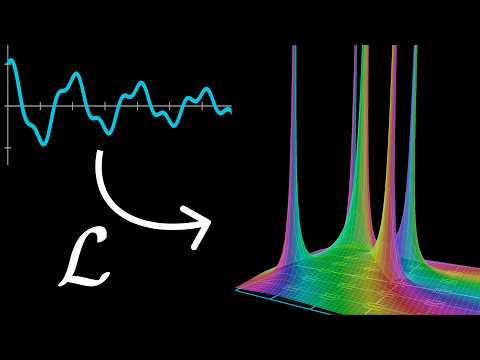
3Blue1Brown visualizes the Laplace transform as a machine that dissects functions into their constituent exponential pieces, revealing these components as 'poles' in the transformed function's s-plane. The video explains how the integral definition of the Laplace transform, particularly its analytic continuation, allows for the analysis of functions beyond their initial domain of convergence, demonstrating this with examples like the cosine function and the driven harmonic oscillator.
Key takeaways
- The Laplace transform converts differential equations into algebraic equations by mapping functions to the s-plane, where exponential components appear as poles.
- Poles in the transformed function F(s) directly correspond to the exponents 's' of the exponential components e^(st) in the original function f(t).
- The integral defining the Laplace transform may only converge over a portion of the s-plane, but analytic continuation allows for a unique extension of the function across the entire plane.
- The Laplace transform of an exponential function e^(at) is 1/(s-a), characterized by a pole at s=a.
- The linearity of the Laplace transform allows it to handle sums of functions by summing their individual transforms.
- When s is purely imaginary (s = iω), the Laplace transform is closely related to the Fourier transform, probing how well a function aligns with oscillations.
Chapters
0:00
Introduction to the Laplace Transform and its Purpose
- The Laplace transform is a powerful tool for studying differential equations, often used without deep understanding of its mechanism.
- The goal is to visualize how functions decompose into exponential pieces (e^(st)) and understand the role of 's' in the complex plane.
- Exponential functions are fundamental because derivatives of e^(st) are simply s * e^(st), simplifying differential equations into algebra.
2:10
Exponential Functions and Function Decomposition
- Exponential functions e^(st) are key, where 's' can be a complex number, allowing for rotation and magnitude changes over time.
- Many functions, like cosine(t), can be expressed as sums of complex exponentials (e^(it) and e^(-it)).
- More complex systems, like driven harmonic oscillators, decompose into multiple exponential pieces.
8:29
The s-Plane and the Laplace Transform Definition
- The s-plane represents all possible values of 's', with each point encoding an entire exponential function e^(st).
- The Laplace transform takes a function f(t) and outputs a new function F(s) of a complex variable 's'.
- The definition involves multiplying f(t) by e^(-st) and integrating from t=0 to infinity: F(s) = ∫[0, ∞] f(t)e^(-st) dt.
18:36
Visualizing the Integral: Area, Averages, and Complex Planes
- Integrating e^(-st) for real 's' can be visualized as area under a curve, which equals 1/s.
- For complex 's', the integral represents a spiraling sum of average values of e^(-st) over unit time intervals.
- The magnitude of this spiraling sum is plotted over the s-plane, revealing larger values near s=0 and smaller values with higher imaginary parts (more oscillation).
29:16
Convergence, Analytic Continuation, and Poles
- The integral for e^(-st) converges only when the real part of 's' is positive; it diverges for negative real parts.
- Analytic continuation extends the function's definition beyond its convergence domain, uniquely preserving its 'niceness' (differentiability).
- Poles are points in the s-plane where the transformed function blows up, indicating the presence of specific exponential components in the original function.
Summary, takeaways, and chapters were generated by AI from the video's transcript and may contain errors. The video belongs to its creator, 3Blue1Brown.