But how do AI images and videos actually work? | Guest video by Welch Labs
 Watch on YouTube →
Overview
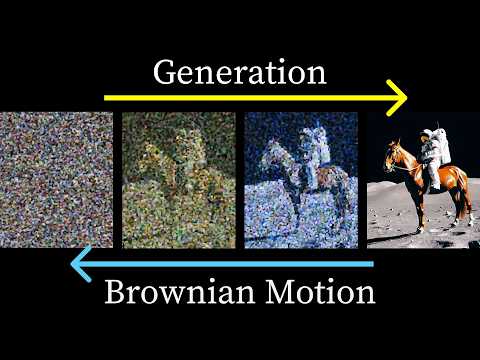
Stephen Welsh explains diffusion models for AI image and video generation, detailing how they work by reversing a process of adding noise to data, akin to running Brownian motion backward. He covers OpenAI's CLIP for creating a shared text-image embedding space, the DDPM algorithm's surprising need for noise during generation, and the development of DDIM and classifier-free guidance to improve generation speed and prompt adherence, culminating in models like DALL-E 2 and Stable Diffusion.
Key takeaways
- Diffusion models generate images/videos by reversing a process of adding noise, akin to running Brownian motion backward in high-dimensional space.
- OpenAI's CLIP creates a shared embedding space where text and image concepts are geometrically aligned, enabling semantic manipulation.
- Adding random noise during the generation phase of DDPM is crucial for producing sharp, diverse images, preventing collapse to the dataset's average.
- DDIM offers a deterministic, faster alternative to DDPM for image generation by solving an equivalent ordinary differential equation.
- Classifier-free guidance, by leveraging the difference between conditioned and unconditioned diffusion model outputs, dramatically improves prompt adherence and detail in generated content.
- Modern AI image/video generation relies on combining text encoders (like CLIP) with diffusion models, guided by techniques like classifier-free guidance, to translate language prompts into visual media.
Chapters
0:00
Introduction to Diffusion Models and WAN 2.1
- AI image/video generation relies on diffusion, a process analogous to reversed Brownian motion in high dimensions.
- WAN 2.1, an open-source model, generates videos from text prompts, starting with random noise.
- The generation process involves a transformer iteratively refining noise into structured video over multiple steps.
3:46
CLIP: Bridging Text and Images
- OpenAI's CLIP (2021) uses two models (text and vision) trained on 400 million image-caption pairs.
- It learns a shared high-dimensional embedding space where similar concepts (e.g., an image of a cat and its caption) are represented by vectors pointing in similar directions.
- Cosine similarity measures the angle between vectors, enabling CLIP to understand relationships like 'hat' by subtracting image vectors.
13:40
DDPM: The Diffusion Process and Noise Addition
- Denoising Diffusion Probabilistic Models (DDPM) generate images by reversing a noise-addition process.
- A key finding is that adding random noise *during* generation, not just training, is crucial for high-quality results.
- DDPM models are trained to predict the total noise added to an image, effectively learning a score function pointing towards the data distribution.
19:15
Visualizing Diffusion: Time-Varying Vector Fields
- Diffusion models learn a time-varying vector field, where each point (image) is guided back to the data distribution.
- Simplifying images to 2D points on a spiral illustrates how adding noise is a random walk, and reversing it means learning to navigate back.
- Conditioning the model on time (t) allows it to learn coarse fields for high noise levels and fine structures for low noise levels.
28:58
The Role of Noise in Generation Quality
- Adding random noise during DDPM generation prevents generated points from collapsing to the mean of the distribution, avoiding blurry results.
- The noise ensures the model samples from a distribution that approximates the true data manifold, preserving diversity.
- Without noise, generated images converge to the average, resulting in a blurry mess rather than distinct images.
36:53
DDIM: Deterministic Image Generation
- DDIM (Denoising Diffusion Implicit Models) uses an ordinary differential equation derived from DDPM's stochastic process.
- This allows high-quality image generation deterministically, without adding random noise at each step, and in fewer steps.
- DDIM requires no changes to model training but significantly speeds up generation, producing the same final distribution as DDPM.
Summary, takeaways, and chapters were generated by AI from the video's transcript and may contain errors. The video belongs to its creator, 3Blue1Brown.