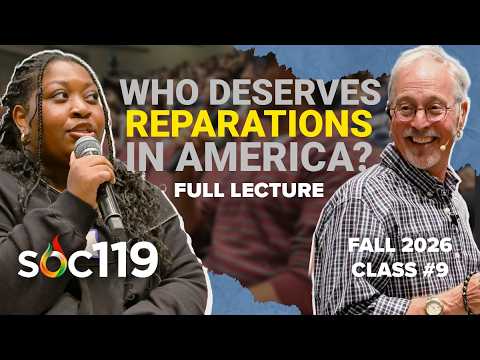
Black Americans Don’t Need Reparations?! | Just Acknowledge American History | 26FA Class #9 Lecture
 Watch on YouTube →
Overview
SOC 119 uses compound interest and historical wealth comparisons to explain how slavery, Jim Crow, and unequal access to postwar benefits left Black Americans with a major accumulated disadvantage. A class discussion weighs cash reparations, fairness, DEI, and symbolic acknowledgment; its central proposal is that learning and openly recognizing the history may be a necessary first step, even without agreement on a remedy.
Key takeaways
- SOC 119’s compound-interest analogy makes time central to the reparations argument: decades of restricted access to assets can compound into disadvantages that persist after legal barriers are removed.
- The lecture cites a stark postwar example of unequal wealth-building access: 100 of 67,000 New York metropolitan-area World War II veteran mortgages went to veterans of color, despite Black veterans comprising about 12% of the veteran population.
- The lecture’s 1960 figures—$295 versus $7,600 in median household wealth and poverty rates of 55% versus 18%—are presented as outcomes shaped by slavery, Jim Crow, and unequal opportunity, not simply individual choices.
- The staircase and boxing analogies distinguish formally equal competition today from equal starting conditions: removing a barrier does not restore the time, assets, or opportunities lost while it was in place.
- The class leaves open whether acknowledgment alone is sufficient, but treats teaching the historical record and taking its material consequences seriously as possible first steps toward addressing reparations.
- Intergenerational inequality involves knowledge and connections as well as wealth; families with established resources can pass on guidance and access that families excluded from opportunity may not have had to transmit.
Chapters
0:00
Class Introductions and the Compound-Interest Analogy
- SOC 119 opens a class on reparations with introductions from Tyler, Kara, Zahria, and Sid.
- Tyler explains compound interest as money earning returns that are reinvested over time.
- A $500 monthly investment at 7% grows much more over 40 years than over 10, illustrating why an early start matters.
4:35
Enslaved People as a Large Share of U.S. Wealth
- The lecture estimates that in 1860, enslaved people represented about $3.5 billion of $16.1 billion in U.S. wealth.
- That figure treats the market value of roughly 4 million enslaved people as property within the national wealth total.
- After emancipation, the lecture says Black Americans were about 14% of the population but held only around 0.5% of U.S. wealth in 1865.
7:05
The Postwar Question: Why Did Emancipation Not Close the Gap?
- SOC 119 asks why formal emancipation did not lead Black Americans to comparable group-level wealth or opportunity.
- Students recall the Great Migration, Jim Crow, segregation, and unequal access to education and jobs.
- Students describe high-school coverage of Reconstruction as brief, often followed by a jump to the 1920s, 1930s, or World War II.
10:05
Racialized Chattel Slavery and Reconstruction’s Limits
- The lecture distinguishes Western chattel slavery by its inheritance and racialization: people were enslaved because of ancestry and skin color.
- Zahria describes Reconstruction as federal military oversight intended to protect newly freed Black Americans from white retaliation.
- SOC 119 asks whether Reconstruction rebuilt the South on egalitarian terms, noting that legal changes did not automatically alter white attitudes or power.
15:25
Jim Crow, Segregation, and the Barriers After Emancipation
- Jim Crow signs and the doctrine of “separate but equal” illustrate continuing racial exclusion after slavery ended.
- The class discusses how Black Americans faced restrictions on jobs, land ownership, changing employers, and other routes to economic independence.
- SOC 119 connects those barriers to the risk of losing the time and financial head start that makes compound growth possible.
18:45
The GI Bill Era and Unequal Access to Mortgages
- SOC 119 describes post–World War II housing and employment programs as tools used to restart the U.S. economy.
- In the New York metropolitan area, the lecture cites 67,000 mortgages for World War II veterans, with only 100 going to veterans of color.
- Because 12% of the veterans were Black, the example illustrates how unequal access to homeownership could limit wealth accumulation across generations.
23:20
1960 Wealth and Poverty Gaps Through Compound Interest
- The lecture gives a 1960 median household wealth comparison of $295 for Black households and $7,600 for white households.
- It also cites poverty rates of 55% for Black Americans and 18% for white Americans in 1960.
- SOC 119 uses the earlier compound-interest example to argue that wealth gaps reflect both where families start and how long they have access to growth.
30:35
Present-Day Wealth Disparities and the Reparations Question
- SOC 119 presents a contemporary median-wealth comparison and asks what society should do about the disparity.
- The discussion rejects the claim that the gap simply reflects individual effort, pointing back to slavery, Jim Crow, and unequal access to assets.
- Students frame the dilemma as how to address inherited disadvantages without pretending that any policy can make every outcome perfectly equal.
34:00
Fairness, Catch-Up Time, and the Staircase Demonstration
- SOC 119 uses a staircase demonstration with Noah to show how removing barriers does not erase the distance already created by past exclusion.
- Kara notes that catching up may take time, while Sid questions who would pay for reparations and which Black Americans would qualify.
- Zahria argues that waiting hundreds of years for disparities to disappear would leave historical unfairness unaddressed in the meantime.
41:35
Why Reparations Are Difficult to Discuss
- Students identify practical questions about reparations, including who pays, who receives assistance, how much, and when inequality counts as addressed.
- Sid proposes acknowledgment as one possible form of reparations, while noting that symbolic recognition alone may not change material inequality.
- Zahria says a central frustration is that people can see disparities yet dismiss their historical causes with appeals to individual effort.
47:50
DEI, Quotas, and Aggregate Racial Inequality
- A student raises concerns that race-conscious hiring quotas could lower a candidate pool’s quality; SOC 119 redirects the discussion to unequal starting conditions.
- SOC 119 distinguishes individual circumstances from aggregate group disparities, using Zahria and himself to represent Black and white Americans broadly.
- Zahria compares the issue to a boxing match in which one fighter’s hand is tied for several rounds before being freed, challenging the idea that equal rules now erase earlier harm.
55:10
Student Reflections, Immigration, and the Role of Culture
- Tyler says the wealth difference and the scale of historical disadvantage are larger than he expected; Kara says the history makes the present gap clearer.
- Students discuss whether post-1965 culture affects disparities and compare Black Americans’ experiences with immigrant groups.
- SOC 119 says immigration involves selection effects and argues that economic circumstances shape culture, while another student notes that Civil Rights Act-era changes benefited immigrants and other groups too.
1:02:40
Intergenerational Knowledge and Acknowledgment as a First Step
- A student explains that families with wealth and opportunity can pass down career knowledge and connections, such as a doctor helping a child enter medical school.
- SOC 119 emphasizes that inherited disadvantage includes lost resources, information, and understanding, not only money.
- The class closes without a settled policy solution, with students considering acknowledgment, historical education, and continued reflection as initial steps.
Summary, takeaways, and chapters were generated by AI from the video's transcript and may contain errors. The video belongs to its creator, SOC 119.