BIOL 105 Lecture 20 10/12/26
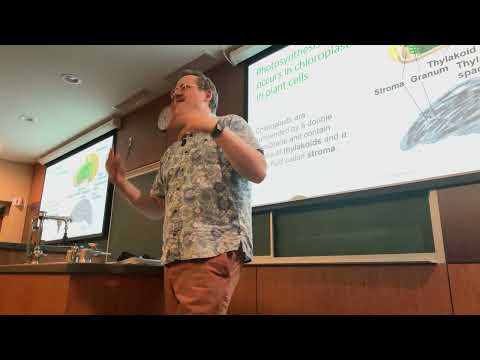 Watch on YouTube →
Overview
Jonathan Montgomery introduces photosynthesis through chloroplast structure, gas exchange, pigment absorption, and the relationship between light reactions and the Calvin cycle. He explains how light-driven electron transport produces ATP and NADPH, which power carbon dioxide fixation into sugars, and previews the photosynthesis pigment lab alongside upcoming exam and lab-midterm requirements.
Key takeaways
- Stomata enable passive carbon dioxide uptake but also permit water loss: guard-cell turgor opens the pores, and diffusion continues until concentration gradients diminish.
- Photosynthetic oxygen originates from water oxidation, while carbon dioxide is reduced and incorporated into sugars during the Calvin cycle.
- Chlorophyll’s absorption of wavelengths other than green explains why many leaves look green; absorption spectra and action spectra respectively show pigment uptake and photosynthetic response across wavelengths.
- The light reactions generate both ATP and NADPH because sugar construction requires chemical energy and reducing power, not ATP alone.
- Sugar is a more stable, transportable long-term energy store than ATP, allowing plants to maintain metabolism when light is unavailable.
- The Z scheme links two light-driven electron boosts with electron transport and chemiosmosis: water supplies electrons, ATP is produced, and NADP⁺ is reduced to NADPH.
Chapters
0:00
Exam 2 Schedule and Online Lab Midterm Requirements
- Exam 2 is scheduled for the following Monday and covers energetics and metabolism material since Exam 1; it is not cumulative.
- The study guide is in the Week 9 module, and the exam retains the same format and Scantron setup as before.
- The 50-point online lab midterm is open Thursday through Sunday, allows two hours and any resources, and accepts no late submissions.
- Using a lab notebook during the midterm is practice for the 100-point, in-person lab final, where the notebook will be the only permitted resource.
4:50
Chloroplast Compartments and the Photosynthesis Lab
- Eukaryotic photosynthesis occurs in chloroplasts, which have outer and inner envelope membranes plus thylakoid membranes.
- Thylakoid membranes enclose the thylakoid space and sit within the stroma, the chloroplast’s internal fluid.
- Like mitochondrial membranes, thylakoid membranes host electron transport, proton pumping, and ATP synthase-driven chemiosmosis.
- The upcoming lab uses freeze-dried spinach to extract pigments and measure their absorption across light wavelengths.
7:35
Stomata Balance Carbon Dioxide Uptake with Water Loss
- Stomata are pores commonly found on the underside, or abaxial surface, of leaves; guard cells open them when they become turgid.
- Opening stomata lets carbon dioxide diffuse into leaves down its concentration gradient without energy expenditure.
- Water vapor also diffuses out through open stomata, making transpiration a major route of plant water loss.
- Diffusion into the leaf slows as internal and external carbon dioxide concentrations approach equilibrium.
12:15
Photosynthesis Redox Reactions and Water Oxidation
- Redox reactions transfer electrons: the electron donor is oxidized and acts as the reducing agent, while the electron recipient is reduced.
- Photosynthesis is endergonic and anabolic: it uses energy to build larger, higher-energy molecules by reducing carbon dioxide.
- Water is oxidized to supply electrons; sunlight provides the energy needed to remove its stable electrons and raise their energy.
- The oxygen released during photosynthesis comes from water oxidation in the light reactions.
16:09
Visible Light Wavelengths and Photosynthetic Pigment Color
- Visible light spans approximately 380–750 nanometers; shorter wavelengths carry more energy than longer wavelengths.
- Violet and ultraviolet radiation are higher-energy than red and infrared radiation; ultraviolet exposure can damage DNA.
- Plant tissue commonly appears green because chlorophylls absorb other wavelengths more strongly while green light is reflected or transmitted.
- Pigment composition changes plant color: carotenoid-rich tissue can appear orange, while other pigments can produce red coloration.
19:51
Chlorophyll Spectra, Autumn Color, and the Pigment Lab
- An absorption spectrum plots wavelength against absorbance; chlorophyll A, chlorophyll B, and carotenoids absorb different parts of the spectrum.
- In autumn, plants degrade and recycle chlorophyll as leaves lose photosynthetic capacity and the plant prepares for dormancy, revealing remaining pigments.
- The lab uses a 96-well plate reader to measure pigment absorption spectra and identify extracted pigments, including beta-carotene.
- An action spectrum shows how strongly different wavelengths drive photosynthesis, connecting pigment absorption to photosynthetic activity.
28:25
Light Reactions and the Calvin Cycle Build Sugars
- Photosynthesis has two linked stages: light-driven reactions in the thylakoid membrane and the Calvin cycle, which does not absorb light directly.
- Light reactions produce ATP and NADPH; the Calvin cycle uses both to build sugars by incorporating carbon dioxide.
- NADPH carries high-energy electrons that provide reducing power, while ATP supplies chemical energy for Calvin cycle reactions.
- The process stores solar energy in organic molecules rather than ending with ATP production alone.
32:18
Why Plants Store Energy as Sugar Instead of ATP
- ATP supplies immediate cellular energy but is more reactive and less suitable for long-term storage than sugar.
- Sugars are more stable and easier to transport; plants can store excess sugar in forms such as starch.
- Stored carbohydrate supports ATP production when light is unavailable, including at night or when shading limits photosynthesis.
- Light reactions oxidize water, while the Calvin cycle uses carbon dioxide to assemble sugars.
37:32
Photosystems and the Z Scheme Generate ATP and NADPH
- Photosystems are protein-and-pigment complexes embedded in thylakoid membranes that use light to raise electron energy.
- Electrons from water move through an electron transport chain; their energy drives proton pumping and ATP production by chemiosmosis.
- A second photosystem re-energizes the electrons, which are then transferred to NADP⁺ to form NADPH rather than entering another ATP-producing chain.
- The Z scheme summarizes the electron energy path—low to high, down through transport, then high again—and the production of ATP plus NADPH for carbon fixation.
Summary, takeaways, and chapters were generated by AI from the video's transcript and may contain errors. The video belongs to its creator, Jonathan Montgomery.