BIOL 105 Lecture 19 10/9/26
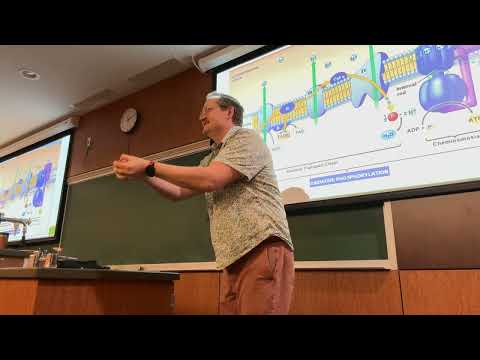 Watch on YouTube →
Overview
Cellular respiration captures energy from glucose mainly through oxidative phosphorylation: electrons from NADH and FADH₂ power proton pumping, and the proton motive force drives ATP synthase; roughly 28 of a maximum 32 ATP per glucose come from this stage. The lecture explains how oxygen enables electron flow, how fermentation regenerates NAD⁺ when oxygen is absent, and how fats and proteins can also feed respiration. It then introduces photosynthesis as a related membrane-based process, outlining chloroplast compartments and how chlorophyll uses light to raise electrons to higher energy levels.
Key takeaways
- The electron transport chain does not make most ATP directly: it uses electron energy to build a proton motive force, which ATP synthase then harnesses through chemiosmosis.
- Oxygen sustains aerobic ATP production by accepting electrons at the end of the mitochondrial electron transport chain; without it, electron flow and proton pumping stop.
- Fermentation enables glycolysis to continue without oxygen by oxidizing NADH back to NAD⁺, with lactate or ethanol as products rather than the main goal.
- The lecture estimates that oxidative phosphorylation produces about 28 of a maximum 32 ATP per glucose, making it the largest ATP-producing stage.
- DNP can undermine ATP production without blocking electron transfer: by making a membrane permeable to protons, it dissipates the gradient that ATP synthase needs.
- Photosynthesis shares the proton-gradient and ATP-synthase logic of respiration, but uses light to raise electrons from water to higher energy levels.
Chapters
- The online lab midterm opens Thursday of the following week and closes Sunday at 9:00 PM.
- The lab midterm is worth 50 points, allows one attempt, and has a two-hour time limit.
- Exam 2 is scheduled for week nine; its posted study guide emphasizes cellular respiration and photosynthesis.
- Cellular respiration proceeds through glycolysis, pyruvate oxidation and the citric acid cycle, then oxidative phosphorylation.
- By the end of stage two, glucose has been broken down and its carbon released as carbon dioxide.
- Most remaining energy is held by reduced electron carriers, NADH and FADH₂, which supply electrons to stage three.
- The electron transport chain in the inner mitochondrial membrane uses energy from electron transfers to pump protons across the membrane.
- Protons cannot cross the hydrophobic phospholipid bilayer freely, so pumping them creates a concentration gradient called the proton motive force.
- Oxygen is the terminal electron acceptor; it takes electrons at the end of the chain and, with hydrogen ions, forms water.
- Without oxygen, electron carriers cannot pass along electrons, the chain backs up, and proton pumping stops.
- Chemiosmosis occurs as protons flow down their gradient through ATP synthase, which uses that movement to produce ATP.
- The electron transport chain generates the proton motive force; ATP synthase uses it, making these distinct but connected parts of oxidative phosphorylation.
- NADH supplies electrons earlier in the chain than FADH₂, allowing more proton pumping and greater ATP yield per NADH.
- The proton gradient acts like a battery: it stores energy across the inner mitochondrial membrane until protons flow through ATP synthase.
- A maximum yield of about 32 ATP per glucose is presented, with approximately 28 produced by oxidative phosphorylation.
- Cyanide and carbon monoxide can block electron transport, preventing the proton gradient and ATP production.
- DNP acts differently: it makes the membrane permeable to protons, dissipating the gradient even if electron transport continues.
- Oxygen deprivation also prevents oxidative phosphorylation because the electron transport chain loses its terminal electron acceptor.
- Without oxygen, glycolysis can still make a small amount of ATP, but it requires oxidized NAD⁺.
- When the electron transport chain backs up, NADH accumulates and NAD⁺ becomes scarce; fermentation transfers electrons from NADH to pyruvate or a pyruvate-derived compound, regenerating NAD⁺.
- Depending on the organism and enzymes, fermentation produces lactate or ethanol; ethanol fermentation also releases carbon dioxide.
- Fermentation's key role is restoring NAD⁺ so glycolysis can continue, not extracting the additional energy available from pyruvate through aerobic respiration.
- Glucose is an effective fuel, but breakdown products from fats and proteins can enter cellular respiration at different points.
- Glycerol from triglycerides can be converted into a glycolysis intermediate and then toward pyruvate, bypassing some early glycolysis steps.
- Different entry points produce different ATP yields while still allowing fuel molecules to be broken down toward carbon dioxide.
- In photosynthesis, light energy raises electrons from a low-energy state on water; the energized electrons then move through electron transport processes.
- As in mitochondria, electron transport creates a proton gradient that powers ATP synthase through chemiosmosis.
- Respiration breaks down glucose using oxygen to produce carbon dioxide, water, and energy; photosynthesis uses carbon dioxide, water, and light energy to produce glucose and oxygen.
- Photosynthesis and respiration are linked through their exchanged materials, while energy enters the cycle as sunlight and some energy is released as heat.
- A chloroplast has an outer and inner envelope membrane plus a thylakoid membrane, which contains key proteins for light-driven proton-gradient formation and ATP production.
- The stroma surrounds the thylakoids, while the interior of each thylakoid is the thylakoid space; membranes create distinct compartments.
- Thylakoid membranes are stacked into grana, increasing membrane area for photosynthetic machinery.
- Chloroplasts are organelles; chlorophyll is a pigment that absorbs light, and the lecture sets up how that absorbed energy can raise electrons.
Summary, takeaways, and chapters were generated by AI from the video's transcript and may contain errors. The video belongs to its creator, Jonathan Montgomery.