BIOL 105 Lecture 18 10/7/26
 Watch on YouTube →
Overview
Cellular respiration is presented as a controlled, three-stage extraction of energy from glucose: glycolysis and the citric acid cycle transfer most of that energy to NADH and FADH₂, while oxidative phosphorylation uses their electrons to build a proton gradient and produce most ATP. The lecture also explains substrate-level phosphorylation, the roles of oxidation and reduction, and oxygen’s function as the terminal electron acceptor; course logistics include a 50-point online lab midterm designed to prepare students for the lab final.
Key takeaways
- Glycolysis converts one six-carbon glucose into two three-carbon pyruvate molecules, capturing a small amount of ATP while transferring electrons to NADH.
- Pyruvate oxidation and the citric acid cycle release glucose carbon as CO₂ and store much of the remaining energy in NADH and FADH₂.
- Substrate-level phosphorylation makes ATP through direct enzyme-mediated phosphate transfer, whereas oxidative phosphorylation relies on a proton gradient and ATP synthase.
- The electron transport chain uses energy from electrons moving toward increasingly electronegative carriers to pump protons across the mitochondrial inner membrane.
- Oxygen serves as the terminal electron acceptor; combining with electrons and protons produces water and supports maintenance of the proton gradient.
- The online lab midterm is a 50-point, two-hour practice assessment available October 15–18; using the lab notebook alone helps prepare for a final that reuses some questions with changed numbers.
Chapters
0:00
Online Lab Midterm: Dates, Format, and Notebook Preparation
- The 50-point online lab midterm is available October 15–18 and allows two hours; past students typically finish in about an hour.
- Questions use multiple choice and dropdowns, including calculations with closely spaced answer choices; the lab final is primarily short answer.
- Use the lab notebook rather than the internet to practice, since some midterm questions return on the final with changed numbers.
- Printed midterm questions and other paper resources are permitted in the lab notebook; a well-organized three-ring binder makes protocols easier to consult.
5:05
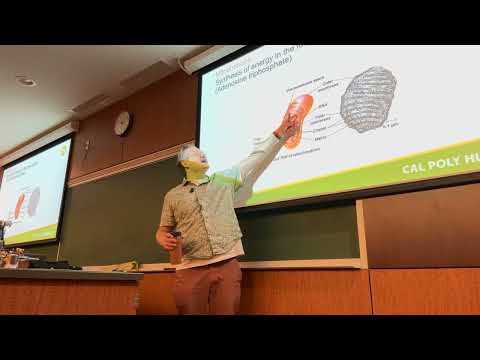
Cellular Respiration Stages and Mitochondrial Compartments
- The lecture models cellular respiration in three stages: glycolysis, pyruvate oxidation plus the citric acid cycle, and oxidative phosphorylation.
- In eukaryotes, glycolysis occurs outside the mitochondrion, while later stages are associated with the mitochondrion’s inner membrane and matrix.
- The inner and outer mitochondrial membranes enclose the intermembrane space and matrix, compartments needed for proton movement.
- Prokaryotes also perform cellular respiration, but they lack mitochondria and do not have organelles specialized for the process.
10:44
Glucose Breakdown Stores Most Energy in NADH and FADH₂
- Glycolysis splits six-carbon glucose into two three-carbon pyruvate molecules, producing a small amount of ATP and NADH.
- Pyruvate oxidation and the citric acid cycle break down the remaining carbon, releasing carbon dioxide and producing more NADH and FADH₂.
- After glucose breakdown, most of its captured energy is in the reduced electron carriers, not yet in ATP.
- Oxidative phosphorylation uses those carriers to make the majority of the ATP generated during respiration.
14:10
Substrate-Level Phosphorylation Transfers Phosphate Directly
- In substrate-level phosphorylation, an enzyme transfers a phosphate group directly from a phosphorylated substrate to ADP, forming ATP.
- Phosphoenolpyruvate is one example: transferring its phosphate to ADP is energetically favorable because the substrate has more available energy than ATP.
- Glycolysis includes an energy-investment phase that adds phosphates to glucose-derived intermediates and a return phase that captures energy as ATP.
- The detailed glycolysis reactions are background here; the key distinction is direct phosphate transfer versus ATP production driven by chemiosmosis.
22:37
NAD⁺ and NADH Carry Electrons Through Redox Reactions
- NAD⁺ is the oxidized form of the electron carrier; accepting electrons during glucose oxidation reduces it to NADH.
- When NADH donates electrons to another molecule, NADH becomes oxidized back to NAD⁺ and acts as a reducing agent.
- The oxidation of glucose and reduction of electron carriers connect glycolysis to the later stages of cellular respiration.
- NADH carries high-energy electrons onward, while pyruvate still contains energy that must be extracted.
25:47
Pyruvate Oxidation and the Citric Acid Cycle Release CO₂
- During pyruvate oxidation, a three-carbon pyruvate loses carbon and electrons, producing NADH and a two-carbon acetyl group attached to coenzyme A.
- Acetyl-CoA enters the citric acid cycle, where carbon is fully oxidized and released as carbon dioxide.
- The cycle produces additional NADH and FADH₂, plus a small amount of ATP through substrate-level phosphorylation.
- The cycle is simplified for this course: its essential takeaways are CO₂ release and energy capture in reduced electron carriers, rather than memorizing every intermediate.
33:27
Citric Acid Cycle: Simplified Model and Broader Connections
- The lecture emphasizes the model-level summary—pyruvate oxidation and the citric acid cycle produce CO₂, NADH, and FADH₂—rather than detailed reaction memorization.
- Oxaloacetate is regenerated in the cycle and reacts with acetyl-CoA to keep the cyclical pathway operating.
- Some cycle intermediates, including malate, can leave the cycle and contribute to sugar regeneration through gluconeogenesis.
- These connections show that metabolic pathways branch and share intermediates, even though BIOL 105 uses a simplified linear account of respiration.
37:44
Electron Transport Chain Builds the Proton Gradient for ATP Synthase
- NADH and FADH₂ donate electrons to carriers in the inner mitochondrial membrane; electrons move toward increasingly electronegative carriers and lower energy states.
- Energy released as electrons move along the electron transport chain powers proton pumping across the inner membrane, building a concentration gradient in the intermembrane space.
- Protons return toward the matrix through ATP synthase, whose rotor-like movement drives ATP production from ADP and inorganic phosphate.
- This coupling of the electron transport chain and chemiosmosis is oxidative phosphorylation; the proton gradient is a temporary store of energy, analogous to water held behind a hydroelectric dam.
44:28
Oxygen Accepts Electrons and Forms Metabolic Water
- Oxygen is the terminal electron acceptor at the end of the electron transport chain because it is highly electronegative.
- After accepting electrons and protons, oxygen forms water, accounting for metabolic water production during respiration.
- Removing protons on the matrix side helps maintain the proton gradient that drives ATP synthase.
- A steeper proton concentration gradient increases the force driving proton diffusion through ATP synthase.
Summary, takeaways, and chapters were generated by AI from the video's transcript and may contain errors. The video belongs to its creator, Jonathan Montgomery.