BIOL 105 Lecture 17 10/5/26
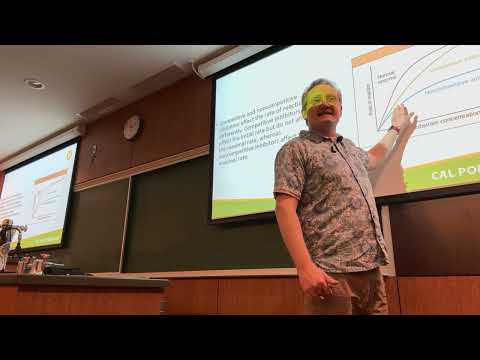 Watch on YouTube →
Overview
Jonathan Montgomery connects enzyme regulation to cellular respiration, explaining how feedback inhibition and competitive or noncompetitive inhibitors control metabolic pathways. He then traces respiration as an exergonic redox process: glucose is oxidized, oxygen is reduced, and mitochondria release energy gradually through an electron transport chain to support ATP production; the lecture concludes with glycolysis, pyruvate oxidation and the citric acid cycle, and oxidative phosphorylation.
Key takeaways
- Feedback inhibition lets a pathway’s end product bind an allosteric site on an earlier enzyme, changing its active site and slowing further product formation.
- Competitive inhibition can be overcome by sufficiently high substrate concentration, whereas noncompetitive inhibition lowers the enzyme system’s maximum reaction rate.
- Glyphosate targets the plant shikimate pathway; Roundup Ready crops use an engineered bacterial enzyme to keep producing essential amino acids despite inhibition of the plant enzyme.
- In redox reactions, the electron bookkeeping is reciprocal: a reducing agent loses an electron and becomes oxidized, while an oxidizing agent gains one and becomes reduced.
- Mitochondrial respiration channels energy from glucose through stepwise electron transfers, using oxygen as the final electron acceptor and capturing part of the released energy in ATP.
- The three broad respiration stages are glycolysis, pyruvate oxidation plus the citric acid cycle, and oxidative phosphorylation; the last stage produces most of the ATP.
Chapters
0:00
Exam Two Reminder and Enzyme Regulation
- The next midterm is in two weeks and covers material since exam one; its format and length remain the same.
- Which enzymes a cell expresses helps determine its metabolism, while inhibition can switch a pathway off more quickly than changing gene expression.
6:03
Enzyme Saturation and Competitive versus Noncompetitive Inhibition
- With enzyme concentration and temperature held constant, increasing substrate raises reaction rate until active sites are saturated and the rate plateaus.
- Competitive inhibitors compete for the active site; sufficiently high substrate concentration can reduce their effect.
- Noncompetitive inhibitors bind elsewhere and alter the active site, lowering the maximum reaction rate even when substrate concentration is high.
- Inhibitor binding is generally temporary in reversible regulation; irreversible binding leaves an enzyme inactivated.
11:27
Glyphosate, the Shikimate Pathway, and Roundup Ready Crops
- Glyphosate, the active ingredient in Roundup, inhibits the shikimate pathway used by many plants to make essential amino acids.
- Roundup Ready crops are engineered with a bacterial version of an enzyme in that pathway, allowing amino-acid production to continue when the plant’s own enzyme is inhibited.
- The example illustrates how genetic engineering can add the capacity to produce a protein or enzyme an organism did not previously make.
15:05
Mitochondrial Compartments and Industrial Enzyme Applications
- Membrane-bound organelles such as mitochondria and chloroplasts organize enzymes and substrates in close proximity, improving pathway efficiency.
- Enzymes from extremophiles can remain functional under the high temperatures or unusual pH conditions found in washing machines.
- Enzymes are used in laundry detergents because they catalyze reactions that break down materials.
18:27
Cofactors and What Enzymes Need to Function
- Cofactors are nonprotein components required for enzyme activity; many associate with an enzyme’s active site.
- Some cofactors are inorganic ions, such as magnesium; organic cofactors are called coenzymes.
- Removing a required cofactor can deactivate an enzyme without denaturing it or using a competitive or noncompetitive inhibitor.
21:32
Cellular Respiration Converts Glucose Energy into ATP
- Cellular respiration breaks down high-energy organic molecules such as glucose into carbon dioxide and water, requires oxygen, and produces ATP.
- Because respiration breaks down molecules and releases energy, it is catabolic and exergonic, with a negative ΔG.
- ATP serves as a portable energy currency for cellular work; the lecture gives about 32 ATP per glucose and roughly 34% energy efficiency as estimates, not memorization targets.
27:11
Redox Basics: Electron Gain, Loss, and Agents
- Reduction is gain of an electron; oxidation is loss of an electron, regardless of whether the molecule started with a neutral charge.
- A reducing agent donates an electron and is itself oxidized; an oxidizing agent accepts an electron and is itself reduced.
- The lecture emphasizes electron movement as the central way to track redox reactions in respiration.
33:43
Glucose Oxidation, Oxygen Reduction, and the Electron Transport Chain
- During respiration, glucose loses electrons and is oxidized as it is broken down toward carbon dioxide; oxygen gains electrons and is reduced.
- Oxygen’s high electronegativity makes it an effective final electron acceptor; when it gains electrons and hydrogen ions, metabolic water forms.
- The electron transport chain releases energy in controlled steps as electrons move from higher to lower energy states, helping drive ATP synthesis rather than releasing energy all at once.
42:24
Mitochondrial Structure and the Three Stages of Respiration
- Mitochondria have an outer membrane, an inner membrane, an intermembrane space, and a matrix; folds of the inner membrane are called cristae.
- Glycolysis splits one six-carbon glucose into two three-carbon pyruvate molecules and takes place in the cytoplasm at the introductory course level.
- Pyruvate oxidation and the citric acid cycle break down the carbon molecules further and release carbon dioxide; oxidative phosphorylation produces most of the ATP using high-energy electrons harvested earlier.
Summary, takeaways, and chapters were generated by AI from the video's transcript and may contain errors. The video belongs to its creator, Jonathan Montgomery.