BIOL 105 Lecture 16 10/2/26
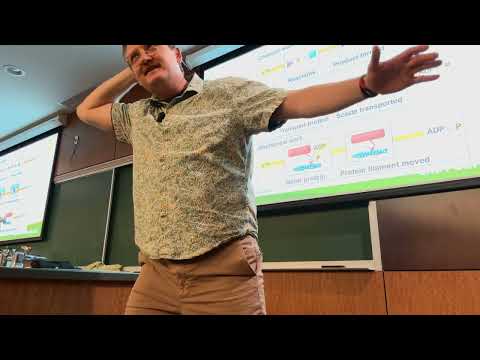 Watch on YouTube →
Overview
Jonathan Montgomery connects ATP hydrolysis to cellular work, then explains how enzymes make reactions proceed faster by lowering activation energy without changing ΔG. He covers active-site catalysis, temperature and pH effects, cofactors and inhibitors, multi-step metabolic pathways, and feedback inhibition, including tryptophan and isoleucine as examples.
Key takeaways
- Enzymes lower activation energy but do not change ΔG; doubling enzyme concentration cannot change a reaction’s ΔG of −20 kcal/mol.
- ATP hydrolysis can drive endergonic cellular work through coupled reactions, often by temporarily phosphorylating a reactant or protein.
- Enzyme activity depends on both molecular encounters and structural integrity: increasing temperature can speed reactions until heat denatures the enzyme.
- Competitive inhibitors block an enzyme’s active site, whereas noncompetitive inhibitors bind elsewhere and alter active-site function.
- Feedback inhibition lets an end product such as tryptophan or isoleucine shut down an earlier pathway step, conserving ATP and leaving shared precursors available for other pathways.
Chapters
0:00
ATP Hydrolysis Couples Energy-Releasing and Energy-Requiring Reactions
- In week six of BIOL 105, Montgomery reviews energetics and notes that Exam 2 is scheduled for October 19, with a study guide posted.
- ATP hydrolysis releases energy when its terminal phosphate is removed; enzymes can couple that reaction to endergonic synthesis such as making glutamine from glutamate and ammonia.
- A phosphorylated intermediate can temporarily store energy on a reactant before the phosphate group is released during product formation.
5:30
ATP Powers Chemical, Transport, and Mechanical Work
- Chemical work uses ATP hydrolysis to drive endergonic reactions, often through temporary phosphorylation of a reactant.
- For transport work, phosphorylation changes a transport protein’s shape and affinity, enabling it to move molecules across the cell membrane.
- For mechanical work, ATP-driven shape changes power motor proteins; cellular respiration replenishes ATP by extracting energy from organic molecules.
11:00
Enzymes Lower Activation Energy Without Changing ΔG
- Exergonic reactions can still require activation energy before reactants reach a transition state and form lower-energy products.
- An enzyme lowers the activation-energy barrier, making a reaction proceed more readily under cellular conditions.
- Enzymes do not change the energy difference between reactants and products: a reaction with ΔG = −20 kcal/mol remains at −20 kcal/mol if the enzyme concentration doubles.
17:00
Active Sites Bind Substrates and Catalyze Specific Reactions
- A substrate binds at an enzyme’s specific active site, forming an enzyme–substrate complex before conversion to product.
- Enzymes can lower activation energy by bringing substrates together, straining bonds, creating a favorable local environment, or forming a temporary covalent bond.
- Products no longer fit the active site as well and are released; the enzyme remains available to catalyze additional reactions.
- A separate enzyme can catalyze the reverse reaction, but an endergonic reverse direction may require coupling to ATP hydrolysis.
23:00
Temperature and Substrate Concentration Change Reaction Rates
- Higher temperature increases molecular motion and the chance that enzyme and substrate particles encounter one another, raising reaction rate up to a limit.
- Adding substrate or enzyme can increase encounter frequency and reaction rate, variables students will investigate in the upcoming enzyme lab.
- Excessive heat can denature an enzyme, changing its structure and reducing or eliminating its function.
27:00
Enzyme Temperature and pH Optima Reflect Their Environments
- Enzymes have environment-specific optima: a thermophilic bacterium’s enzymes can function best at higher temperatures than human enzymes, which operate near body temperature.
- Reaction rate often rises with temperature before dropping sharply as the enzyme denatures; moving away from an enzyme’s optimal pH also reduces activity.
- Extreme temperature, pH, salt concentrations, or chemicals can disrupt protein structure; denaturation means loss of three-dimensional shape and therefore function.
33:00
Cofactors and Inhibitors Regulate Enzyme Activity
- Cofactors are nonprotein helpers, often ions such as magnesium or iron, that some enzymes require; binding or chelating them can stop enzyme activity in laboratory preparations.
- Competitive inhibitors occupy the active site, while noncompetitive inhibitors bind elsewhere and alter the active site’s shape.
- Activators can bind enzymes and increase activity, allowing biological regulation without destroying the enzyme’s structure.
- Many vitamins function as enzyme cofactors, so cells must obtain them even though they are not proteins encoded as enzymes.
37:00
Metabolic Pathways Use Specific Enzymes at Each Step
- A metabolic pathway converts a starting molecule through multiple intermediates, with a specific enzyme catalyzing each step.
- Pathways form complex cycles and branches; a shared intermediate may feed several processes, so its use must be regulated.
- The Krebs cycle and pathways such as gluconeogenesis illustrate that metabolic networks can have multiple inputs and outputs rather than one simple linear direction.
43:00
Feedback Inhibition and Allosteric Control Limit Product Overproduction
- In feedback inhibition, a pathway’s end product inhibits an earlier step, preventing unnecessary production and conserving energy and shared precursor molecules.
- In tryptophan synthesis, accumulated tryptophan can bind enzyme 1 at a site outside its active site, changing the enzyme’s shape and slowing the pathway.
- Isoleucine provides another example of end-product allosteric inhibition: it binds an allosteric site rather than competing for the active site.
- Cells can also regulate pathways over longer timescales by not producing a needed enzyme, though this is slower than inhibiting an enzyme that is already present.
Summary, takeaways, and chapters were generated by AI from the video's transcript and may contain errors. The video belongs to its creator, Jonathan Montgomery.