BIOL 105 Lecture 15 9/30/26
 Watch on YouTube →
Overview
Jonathan Montgomery connects membrane transport to cellular energetics: passive transport moves substances down concentration gradients, while active transport uses energy to move them against gradients or build proton gradients. He then defines metabolism, anabolic and catabolic reactions, entropy, Gibbs free energy (ΔG), and enzymes, showing how ATP hydrolysis can be coupled to energy-requiring processes such as glutamine synthesis.
Key takeaways
- A proton gradient stores energy in a different form from ATP: ATP-powered pumps establish the gradient, and proton flow back across the membrane can help produce ATP.
- Bulk transport solves a different problem from transport proteins: phagocytosis takes in large particles, pinocytosis takes in fluid, and receptor-mediated endocytosis selectively concentrates ligand-bound targets.
- Simple diffusion across the phospholipid bilayer favors small nonpolar molecules; polar molecules and ions typically require transport proteins even when moving down their gradients.
- Anabolic reactions build molecules and generally require energy, whereas catabolic reactions break molecules down and generally release energy; ΔG quantifies the free-energy change.
- Enzymes lower activation energy so reactions can proceed at useful rates, and coupling ATP hydrolysis to an endergonic reaction can make cellular synthesis possible.
Chapters
0:00
Active Transport, Proton Pumps, and Membrane Potential
- Passive transport moves molecules from high to low concentration without an energy input; active transport moves them from low to high concentration and requires energy.
- The sodium-potassium pump is an electrogenic pump: moving ions across a membrane creates voltage that supports rapid nerve signaling.
- Proton pumps move hydrogen ions across membranes that are otherwise impermeable to ions, building concentration and electrical gradients used in mitochondria and chloroplasts.
- ATP-powered proton pumping can acidify compartments such as lysosomes; proton flow back through a pump can also drive ATP production.
6:01
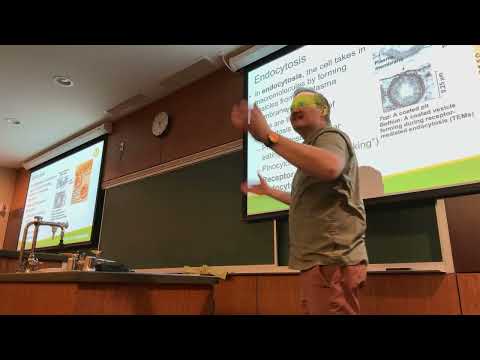
Endocytosis: Phagocytosis, Pinocytosis, and Receptor-Mediated Uptake
- Cells use vesicles or larger vacuoles to move material too large for membrane transport proteins.
- Phagocytosis brings large particles into a cell, while pinocytosis takes in extracellular fluid and its suspended contents.
- Receptor-mediated endocytosis uses surface receptors to bind target ligands, then folds the membrane inward to concentrate those targets in a vesicle.
- Exocytosis provides the opposing bulk-transport route, moving material out of the cell.
10:34
Membrane Transport Flowchart: Diffusion vs. Facilitated Diffusion
- Membrane transport of molecules is organized into passive transport and active transport; active transport moves against a concentration gradient and requires ATP.
- Passive transport includes simple diffusion and facilitated diffusion, with facilitated diffusion using membrane transport proteins but no ATP.
- Small nonpolar molecules cross the phospholipid bilayer by simple diffusion; polar molecules and ions generally need facilitated diffusion to cross passively.
12:56
Metabolism: Anabolic Building and Catabolic Breakdown
- Metabolism is the complete set of chemical reactions in a defined scope, such as a cell, mitochondrion, or whole organism.
- Anabolic reactions build larger molecules from smaller ones and typically require energy; catabolic reactions break molecules down and release energy.
- Montgomery demonstrates the contrast with two monomers joined into a polymer versus stacked erasers knocked over, illustrating energy input for building and energy release during breakdown.
- Cellular respiration breaks down glucose using oxygen, producing carbon dioxide and water while transferring some glucose energy into ATP and releasing some as heat.
21:35
Kinetic and Potential Energy in Organisms and the Biosphere
- Kinetic energy is energy of motion; potential energy is stored energy, such as chemical energy in ATP or gravitational energy in a lifted object.
- Photosynthetic organisms convert solar energy into high-energy organic molecules such as glucose; heterotrophs break down organic molecules to obtain usable energy.
- The biosphere is an open system because solar energy enters and supports energy-consuming anabolic reactions; a closed system has no continuing inputs or outputs.
26:12
Thermodynamics, Heat Loss, and Entropy
- Energy is conserved but changes form; energy transformations in biological systems dissipate some energy as heat.
- Entropy describes disorder, and systems tend toward increased entropy unless energy enters from outside to support organization.
- Montgomery compares ordered napkins with scattered napkins and a tidy dorm room with a disordered one to illustrate that restoring order requires energy.
- Heat can be useful rather than merely waste: ATP breakdown during shivering produces heat that helps warm the body.
33:01
Gibbs Free Energy, ΔG, and Reaction Direction
- Gibbs free energy describes the energy available to perform work, and a reaction's ΔG is the free energy of its products minus that of its reactants.
- A negative ΔG means the reaction releases usable energy; a positive ΔG means energy must be supplied to drive it.
- Anabolic reactions generally build higher-energy products and have positive ΔG, while catabolic reactions generally break down molecules and have negative ΔG.
- The lecture distinguishes ΔG from total energy: cells use free-energy changes to assess whether reactions can power work such as pumping protons or building molecules.
44:46
Enzymes Lower Activation Energy and Couple Reactions
- Enzymes are biological catalysts that help reactions proceed at useful rates; they lower activation energy without changing the overall ΔG.
- Even an energy-releasing reaction may need an initial activation-energy input, as illustrated by the energy needed to ignite a napkin before combustion continues.
- Enzymes can couple an exergonic reaction, such as ATP breakdown, to an endergonic reaction that would otherwise require energy.
47:27
ATP Hydrolysis Powers Glutamine Synthesis
- ATP (adenosine triphosphate) contains adenine, a sugar, and three phosphate groups and serves as a widely used cellular energy currency.
- Removing ATP's terminal phosphate through hydrolysis releases free energy that enzymes can direct toward cellular work.
- The lecture's example couples ATP hydrolysis to the energy-requiring synthesis of glutamine from glutamic acid and ammonia.
Summary, takeaways, and chapters were generated by AI from the video's transcript and may contain errors. The video belongs to its creator, Jonathan Montgomery.