BIO105 Introductory Biology, Wed., Sept., 9th, David Champlin, USM
 Watch on YouTube →
Overview
David Champlin lays out BIO105’s progression from atoms and biological chemistry to cells and metabolism, using reductionism—the study of a cell by examining its parts—as the organizing approach. He previews aquaporin as a recurring example of protein structure and function, then introduces the periodic table, atomic structure, ions, isotopes, electron shells, and how shared electrons form water molecules.
Key takeaways
- BIO105’s first exam sequence moves from atoms and biological chemistry through macromolecules and membranes to cells and metabolism, with chapter 7 on membranes taught before chapter 6 on cells.
- Aquaporin connects several course topics: it is a membrane protein with a water-selective channel, and a mutation that blocks the channel can impair eye lubrication and contribute to glaucoma in mice.
- In the sodium chloride example, sodium loses one electron and chlorine gains it; their resulting +1 and −1 charges make them ions, while their proton counts still identify their elements.
- Isotopes of the same element have the same number of protons but different numbers of neutrons: carbon-12, carbon-13, and carbon-14 have 6, 7, and 8 neutrons, respectively.
- Champlin presents full outer electron shells as the reason noble gases are relatively unreactive and electron sharing as the basis for the bonds in water.
- Students who miss class are expected to study the recording, submit notes by email within one week, and use their notes as a tool for recalling course material.
Chapters
0:00
Attendance, Recordings, and Notes for BIO105
- Students who miss class must take notes from the recording and email photos or a PDF of those notes within one week.
- Attendance is intended to keep students participating; Champlin asks students facing serious illness or caregiving issues to let him know.
- Class recordings may be deleted as the semester progresses, so Champlin encourages students who attend to take notes as a study guide.
4:15
Chapter 2 Reading, Practice Quizzes, and Biology Opportunities
- Students should read chapter 2, record questions while studying, and bring them to class; a 10-point multiple-choice quiz will cover two short videos.
- Champlin frames practice quizzes as preparation for the format of course exams, which cover much more material than the focused quizzes.
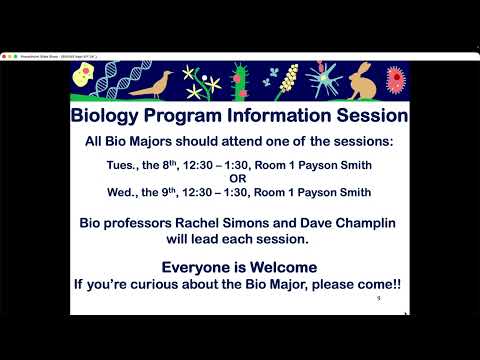
- A biology-program information session with pizza is scheduled for 12:30 in room 1, Pace Smith; students can explore lab, field, and career-path opportunities.
9:44
Open Questions and the Course’s Biology Roadmap
- Students are encouraged to interrupt with questions, including questions about material they find confusing or material beyond the current lesson.
- The course covers roughly the first 20 textbook chapters, generally in sequence, while chapter 1 serves as an overview students can ask about as needed.
- Champlin plans to supplement the textbook with his own explanations, particularly where he considers its treatment of biology or evolution unclear.
13:00
Reductionism: Building from Chemistry to Cells and Metabolism
- Chapters 2–5 introduce biological chemistry and progressively larger molecules; chapter 7 covers cell-membrane molecules before chapter 6’s focused treatment of cells.
- Champlin describes reductionism as taking a cell apart to study its components, down to atoms, rather than assuming the whole is more than the sum of its parts.
- The first exam follows the transition from molecular building blocks to the cell and then to metabolism and energy flow.
16:50
Aquaporin: A Water Channel Built into Cell Membranes
- Aquaporin is a protein embedded in the cell membrane; its donut-shaped channel allows water to pass in either direction without actively pumping it.
- Champlin says typical cells contain tens of thousands of aquaporins, with tear-gland cells relying on them to move water into tears.
- The channel selectively passes water, and specific amino acids lining its pore help determine how water moves through it.
23:20
Cell Membranes, Aquaporin Mutations, and Biological Scale
- Cell membranes surround cells across life and are made of phospholipids; membrane proteins such as aquaporin regulate movement across that boundary.
- A mouse with a mutation affecting aquaporin can develop early glaucoma because water movement needed to keep the eye’s lens wet is disrupted.
- The Boston-scale analogy makes molecular size tangible: if a cell spanned the Boston metro area, water would be basketball-sized and an aquaporin would be about the size of a delivery truck.
32:20
Atoms as the Building Blocks of Biological Molecules
- Chapter 2 starts with atoms as the components of water, phospholipids, and proteins; Champlin compares them to Lego blocks used to construct larger molecules.
- He emphasizes oxygen, carbon, hydrogen, and nitrogen as especially common elements in living organisms, while noting that calcium and sodium also have essential biological roles.
- The periodic table organizes elements by atomic number and recurring chemical properties.
34:40
Atomic Number and the Periodic Table’s Organization
- An element’s atomic number is its number of protons: hydrogen has 1, helium 2, and carbon 6.
- Changing an atom’s proton count changes its element, which is why the atomic number identifies the element rather than merely labeling it.
- The periodic table’s columns group elements with recurring chemical similarities, a pattern chemists began recognizing in the 19th century.
37:00
Why Noble Gases Are Unreactive
- Helium, neon, and argon belong to the noble-gas column and are gases at room temperature that generally do not react readily.
- Champlin gives a laboratory example: manufacturers can replace air in bottles of sensitive powdered chemicals with an inert gas to limit reactions with oxygen.
- He previews the explanation that a full outer electron shell makes these elements less likely to form chemical bonds.
40:10
Protons, Neutrons, and Electrons in an Atom
- Atoms have a nucleus containing positively charged protons and neutral neutrons, with negatively charged electrons around the nucleus.
- Protons determine the element; protons and neutrons account for nearly all atomic mass, while electrons have negligible mass by comparison.
- Champlin sets the biological focus at atoms and these subatomic particles, noting that biology rarely needs to go down to quarks or leptons.
44:00
How Sodium and Chlorine Form Charged Ions
- When sodium chloride dissolves in water, sodium transfers one electron to chlorine, producing sodium with a +1 charge and chloride with a −1 charge.
- A neutral sodium atom has 11 protons and 11 electrons; after losing one electron it has 10 electrons, while chlorine gains one.
- A charged atom is an ion: positive ions are cations and negative ions are anions; electron changes occur in the outermost orbitals.
50:55
Carbon Isotopes and the Role of Electrons in Reactions
- Carbon-12 has 6 protons and 6 neutrons; carbon-13 and carbon-14 retain 6 protons but have 7 and 8 neutrons, respectively.
- Different neutron counts produce isotopes; some isotopes are radioactive and can be used to date biological samples, rocks, and other materials.
- Champlin emphasizes electrons as central to bonding: metabolism rearranges the bonds between atoms in molecules.
55:30
Electron Shells Explain Water’s Covalent Bonds
- Electrons fill shells around the nucleus; in Champlin’s introductory model, the first shell holds 2 electrons and the next shells relevant to common biological elements hold 8.
- Noble gases such as helium and neon are unreactive because their outermost shells are full; oxygen, with 6 outer-shell electrons, can become more stable by sharing electrons.
- In water, oxygen shares electrons with two hydrogen atoms, filling the outer-shell positions described in the lecture and forming a stable molecule.
Summary, takeaways, and chapters were generated by AI from the video's transcript and may contain errors. The video belongs to its creator, The New Evolution for Everyone.