BIO105 Introductory Biology, Wed., Sept., 23rd, David Champlin, USM
 Watch on YouTube →
Overview
In a BIO105 lecture at USM, David Champlin connects osmosis, molecular interactions, pH, and organic chemistry as foundational concepts for later biology topics. He works through a 100 mM sucrose-versus-lactose example to show how splitting sucrose into glucose and fructose raises osmolarity, then reviews protein folding, acid–base behavior, pKa, and the functional groups students should recognize for exams.
Key takeaways
- Splitting 100 mM sucrose into 100 mM glucose and 100 mM fructose produces 200 mOsm of solute particles, creating a gradient that draws water toward the higher-osmolarity side.
- Isotonic, hypertonic, and hypotonic describe the external solution relative to the cell, and the direction of net osmosis follows the difference in total solute concentration.
- Protein structure depends on both covalent bonds within the amino-acid chain and noncovalent interactions that fold the chain and mediate temporary binding to molecules such as insulin receptors.
- At pH 7, hydrogen-ion concentration is 10⁻⁷ M; each decrease of one pH unit increases that concentration tenfold.
- Hydrochloric acid dissociates readily, acetic acid is a weaker proton donor, and ammonia can accept a proton to form ammonium; pKa marks the point where the two forms are equally abundant.
- Students should recognize seven functional groups—hydroxyl, carbonyl, carboxyl, amino, sulfhydryl, phosphate, and methyl—as recurring structural features and likely exam content.
Chapters
0:00
BIO105 Course Plan and Osmosis Quiz Expectations
- David Champlin says the end-of-class quiz focuses on osmosis and includes simple addition rather than calculator-level mathematics.
- The lecture builds from Chapter 3 into Chapter 4, with later material previewed to help connect foundational topics.
- Champlin encourages students to take notes and says students who miss class must send photos of their notes.
3:00
Why Splitting Sucrose Changes Osmolarity
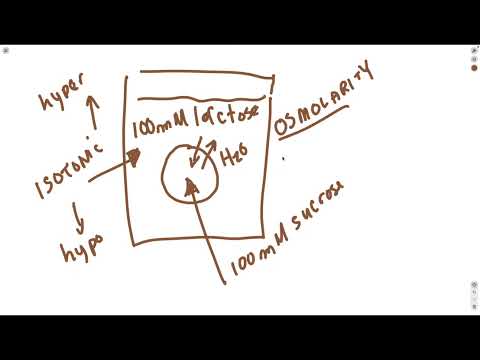
- Champlin models an artificial cell as a phospholipid bilayer bubble in a beaker, with 100 mM lactose outside and 100 mM sucrose inside.
- Sucrose is one disaccharide molecule composed of glucose and fructose joined by a covalent bond.
- Breaking 100 mM sucrose into 100 mM glucose plus 100 mM fructose changes the inside total to 200 mOsm, even though the same component molecules remain.
7:00
Osmotic Gradients, Water Flow, and Stored Potential Energy
- Champlin defines isotonic, hypertonic, and hypotonic by comparing total solute concentration in the external solution with the cell interior.
- With 100 mOsm outside and 200 mOsm inside after sucrose splitting, water moves into the artificial cell faster than it moves out; sufficient water influx would dilute the interior toward equilibrium.
- In a U-shaped tube separated by a membrane, the higher-osmolarity side gains water and rises, illustrating osmotic pressure and a concentration gradient that stores potential energy.
12:00
Collective Properties Explain Osmosis at the Introductory Level
- Champlin identifies osmolarity changes from splitting a solute as a colligative property: the number of dissolved particles matters.
- He describes hydration shells and the distinction between water associated with dissolved material and relatively free water, while noting that the molecular explanation can be difficult to make intuitive.
- The practical prediction emphasized is that water moves toward the side with higher osmolarity; students are not expected to master the deeper physical explanation for this course.
18:00
Quizzes as Low-Stakes Practice for Multiple-Choice Exams
- Champlin says quizzes model exam questions and help students learn the level of detail expected in a multiple-choice course.
- Quizzes focus on a limited assignment, while exams also draw on textbook material and class content; the final exam is cumulative.
- He recommends reviewing completed quizzes because some questions may reappear in modified form on exams.
22:00
Noncovalent Interactions Shape Protein Structure and Binding
- A newly made protein begins as an amino-acid chain, likened to floppy yarn, and folds into a three-dimensional structure through interactions among its amino acids and with water.
- Covalent bonds hold atoms in the chain together, while noncovalent interactions help establish protein shape and function.
- Specific but temporary binding, such as insulin attaching to its receptor, depends on multiple noncovalent interactions; morphine can also bind endorphin receptors.
30:00
Hydrogen Bonds, Molecular Options, and Metabolism
- Champlin reviews hydrogen bonds as dipole–dipole interactions and describes van der Waals forces as a family of interactions ranging from stronger to weaker examples.
- Noncovalent interactions can bring molecules together and provide alternative partners that enable covalent bonds to break and form during metabolism.
- A Snickers bar stores chemical potential energy; digestion releases that energy as its molecules are rearranged into more stable, lower-energy products.
33:00
The pH Scale and Hydrogen-Ion Concentration
- Neutral pH is 7, corresponding to a hydrogen-ion concentration of 10⁻⁷ M.
- Each one-unit decrease in pH represents a tenfold increase in hydrogen-ion concentration, so pH 6 corresponds to 10⁻⁶ M.
- Champlin connects this scale to the relationship pH = −log[H⁺] and explains that acids and bases alter hydrogen-ion levels in water.
37:00
Strong Hydrochloric Acid Versus Ethanol and Vinegar
- Hydrochloric acid dissociates readily in water and donates hydrogen ions, making it a strong acid that can sharply lower pH.
- Ethanol has an alcohol group that interacts with water but generally retains a hydrogen, so Champlin presents it as neither an acid nor a base in this comparison.
- Acetic acid, the acid in vinegar, donates hydrogen less completely than hydrochloric acid because its conjugate form can stabilize charge across two oxygen atoms.
43:00
pKa, Acetic Acid, and Ammonia as a Weak Base
- Champlin defines pKa as the pH at which an acid–base pair is half dissociated, with equal amounts in the protonated and deprotonated forms.
- As pH changes, acetic acid can either donate a hydrogen ion to water or accept one back, illustrating why it behaves as a weak acid rather than fully dissociating.
- Ammonia (NH₃) can accept a hydrogen ion to form ammonium (NH₄⁺); Champlin describes it as a weak base and gives its pKa as about 9.
49:00
Sodium Hydroxide, Acid–Base Strength, and Biological Reactions
- Sodium hydroxide dissociates in water and supplies hydroxide ions, which reduce hydrogen-ion concentration and raise pH; hydrochloric acid has the opposite effect.
- Champlin compares strong bases, weak bases, weak acids, and strong acids through how readily they accept or donate hydrogen ions.
- Acid–base chemistry returns in digestion: acidic stomach conditions help reactions rearrange covalent bonds, including hydrolysis of glycogen, proteins, nucleic acids, and fats.
55:00
Molarity, Chapter 4 Functional Groups, and Quiz Wrap-Up
- Champlin invites questions about molarity, moles, and solution mass before the scheduled osmosis quiz.
- He introduces recurring organic functional groups students should recognize: hydroxyl, carbonyl, carboxyl, amino, sulfhydryl, phosphate, and methyl.
- The functional-group structures are presented as useful exam material, while detailed compound names and examples are lower priority.
- The class ends with quiz instructions: put away phones and calculators, use addition and conceptual reasoning, and return any outstanding earlier quizzes.
Summary, takeaways, and chapters were generated by AI from the video's transcript and may contain errors. The video belongs to its creator, The New Evolution for Everyone.