BIO105 Introductory Biology, Wed., Sept., 16th, David Champlin, USM
 Watch on YouTube →
Overview
David Champlin reviews BIO105 course expectations, then builds a framework for how atoms form molecules and how molecular properties shape biological processes. He connects covalent-bond polarity and noncovalent interactions—including ionic attractions and hydrogen bonds—to water’s behavior, membrane permeability, protein folding, insulin-receptor binding, pH, and solubility.
Key takeaways
- In the course’s introductory bonding model, hydrogen forms one covalent bond, oxygen two, nitrogen three, and carbon four; these patterns help interpret structures such as glucose.
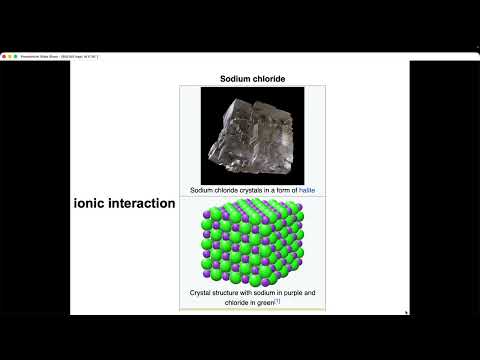
- Electronegativity differences determine whether covalent electrons are shared evenly: O–H bonds are polar, while sodium chloride represents ionic attraction rather than covalent sharing.
- Cell membranes are not sealed against water: phospholipid tails move and leave occasional gaps, while aquaporins enable faster water transport.
- Noncovalent interactions let proteins such as insulin bind receptors through complementary shape and chemistry without forming permanent covalent bonds.
- Hydrogen bonds and other attractions explain how water supports surface tension, dissolves polar or charged substances, and helps stabilize protein structures.
- Hydration shells form around dissolved particles; temperature changes water’s ability to keep substances such as sugar in solution.
Chapters
0:00
BIO105 Assignments, Attendance, and the Aquaporin Quiz
- Champlin says students who miss class should email photos of their notes within a week; repeated absences are governed by the syllabus policy.
- Chapter 3 covers water chemistry, with notes due the following Monday; students can scan handwritten notes into a PDF with a phone app.
- A 10-point quiz at the end of class focuses on the Aquaporin video; an osmosis quiz is planned for the following week.
4:00
Why Handwritten or Drawn Notes Can Support STEM Learning
- Champlin recommends making physical, personally meaningful notes because drawing and spatial organization can help students learn STEM concepts.
- An iPad is acceptable if students actively draw or arrange material and already learn effectively that way; typed AI-generated notes do not meet the intended practice.
- Students are encouraged to explain when an assignment does not make sense so its purpose can be discussed.
8:00
Covalent Molecules, Valence Electrons, and Electronegativity
- The course defines a molecule as two or more atoms joined by covalent bonds; a double-stranded DNA helix consists of two strands that can be unzipped and copied.
- Only outer-shell valence electrons participate in the introductory model of covalent bonding; inner-shell electrons are not involved.
- Electronegativity generally increases from left to right across a periodic-table row and decreases farther down a column; fluorine is the most electronegative element.
13:00
Glucose Bonding, Molecular Geometry, and Phosphorus
- The introductory bonding patterns are hydrogen forming one bond, oxygen two, nitrogen three, and carbon four; glucose illustrates these patterns.
- Carbon, nitrogen, and oxygen bonds are often drawn flat for simplicity, although their actual geometry is three-dimensional and tetrahedral.
- Phosphorus, below nitrogen in the periodic table, can form five bonds in biological contexts; phosphate groups form part of the DNA backbone.
17:00
Bond Rotation Gives Molecules Different Conformations
- Covalent bonds are treated as rigid in Champlin’s model: atoms do not stretch or bend the bonds, but can rotate around them.
- Rotation changes the conformation of larger molecules, while a small molecule such as water retains the same basic shape.
- A newly synthesized protein begins as a linear amino-acid chain, but bond rotations allow the chain to fold into specific shapes.
21:00
Phospholipid Membranes, Water Leakage, and Aquaporins
- Phospholipid tails contain carbon–hydrogen bonds and are hydrophobic, helping create the water-fearing interior of cell membranes.
- Membrane phospholipids are not covalently bonded to one another; thermal motion creates small gaps through which some water can leak.
- Aquaporins provide faster water movement across membranes than the slow leakage through the phospholipid bilayer alone.
25:00
Polar Covalent Bonds and the Continuum Toward Ionic Attraction
- A covalent bond is nonpolar when atoms have similar electronegativity and share electrons roughly equally; unequal sharing makes it polar.
- Oxygen attracts shared electrons more strongly than hydrogen, so O–H bonds are polar.
- The bonding spectrum runs from equal sharing to extreme electron transfer, as in sodium chloride, where the attraction is ionic rather than covalent.
29:00
Noncovalent Interactions Hold Molecules Together Without Sharing Electrons
- Champlin distinguishes covalent bonds, which share electrons within molecules, from noncovalent interactions, which attract atoms or molecules without electron sharing.
- Water molecules attract one another because partially negative oxygen atoms interact with partially positive hydrogen atoms on neighboring molecules.
- These temporary attractions contribute to water’s surface tension and can occur both between large molecules and within folded proteins.
33:00
Insulin Recognition Through Shape and Noncovalent Binding
- Insulin is a small protein released by the pancreas; it binds insulin receptors on cells and helps regulate glucose uptake and production.
- The insulin–receptor match depends on complementary shape and chemical properties, with noncovalent attractions holding the proteins together temporarily.
- Hydrophobic patches and possible charged amino-acid pairs can contribute to binding specificity and affinity without creating a covalent bond.
38:00
Hydrogen Bonds Link Water Molecules and Other Polar Compounds
- Hydrogen bonds are a type of noncovalent interaction; neighboring water molecules attract through partial charges but do not share electrons.
- Champlin uses ethanol to illustrate how water can interact with a molecule’s polar oxygen and hydroxyl group, helping it dissolve.
- Hydrogen bonding is distinct from an ionic interaction: it involves partial charges, whereas ionic attraction involves full positive and negative charges.
46:00
Water-Molecule Exchange, pH, and Temperature-Dependent Solubility
- Water molecules continually rearrange partners; Champlin connects this dynamic chemistry to hydrogen-ion concentration and the concept of pH.
- A free H⁺ is highly unstable in water and is more accurately associated with hydronium, H₃O⁺; the lecture notes that acidic conditions are more reactive.
- Water’s interactions help keep glucose dissolved; cooling can reduce solubility and cause precipitation, while warmer water can dissolve more sugar.
56:00
Hydration Shells, Alpha Helices, and the End-of-Class Quiz
- A dissolved substance is surrounded by a hydration shell: nearby water molecules interact with its charged or polar regions and help keep it in solution.
- Water’s partial charges orient around ions, including oxygen atoms around positive sodium ions and hydrogen atoms around negative chloride ions.
- An alpha helix in a protein is stabilized by many individually weak hydrogen bonds; the class then shifts to the 10-point Aquaporin quiz.
Summary, takeaways, and chapters were generated by AI from the video's transcript and may contain errors. The video belongs to its creator, The New Evolution for Everyone.