BIO105 Introductory Biology, Osmosis, David Champlin, USM
 Watch on YouTube →
Overview
David Champlin explains osmosis as water diffusing across membranes and shows how solute concentration differences drive net water movement, changing cell volume; aquaporins increase the rate of water passage without changing its direction. He connects tonicity and osmolarity to red blood cells, saline, concentration gradients, and potential energy, then reviews molarity calculations, including how to prepare 2 L of 100 mM glucose using 36 g.
Key takeaways
- Osmosis is continuous water diffusion in both directions; net water flow results when the two directions occur at different rates.
- Aquaporins speed water movement across a membrane, but the concentration difference—not the channel itself—determines the net direction.
- In the lecture’s cell model, impermeant solutes make water move toward the side with the higher dissolved-particle concentration, changing cell volume.
- Tonicity predicts cell-volume effects: hypertonic surroundings draw water out, hypotonic surroundings draw water in, and isotonic surroundings produce no net volume change.
- Osmolarity depends on the number of dissolved particles: 100 mM NaCl can contribute about 200 mOsm/L because it dissociates into two ions.
- Preparing 2 L of 100 mM glucose requires 0.2 mol, or 36 g using a glucose molecular mass of approximately 180 g/mol.
Chapters
0:00
Osmosis, Aquaporins, and Amphipathic Phospholipids
- Osmosis is the ongoing diffusion of water in both directions across a cell membrane; unequal rates create net water movement.
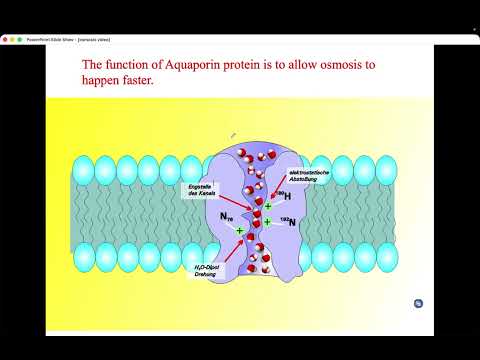
- Aquaporin channels increase the rate at which water crosses the membrane, helping cells move water faster than it can pass through the lipid bilayer alone.
- Phospholipids are amphipathic: their charged, hydrophilic heads interact with water, while their nonpolar, hydrophobic tails form the membrane’s interior.
5:00
Impermeant Sugar Gradients Drive Water Out of Membrane Bubbles
- Champlin models membranes as small phospholipid bubbles, with a small internal water volume surrounded by a much larger external volume.
- When sugar is added outside at 500 mM while the interior is at 125 mM, the sugar cannot cross the intact membrane, but water can.
- Water leaving the bubble reduces its internal volume and raises the trapped sugar’s concentration; net movement slows as the two sides approach equal concentration.
11:18
Isotonic, Hypertonic, and Hypotonic Conditions
- Champlin defines isotonic conditions as equal concentrations of dissolved particles inside and outside, with water moving both ways at equal rates.
- A hypertonic exterior has a higher solute concentration than the cell interior, so water leaves and the cell shrinks; a hypotonic exterior draws water in and makes the cell swell.
- The terms hypertonic and hypotonic describe the solution outside the cell relative to its interior.
16:00
Red Blood Cells, Saline, and Osmotic Potential Energy
- Red blood cells shrink in a hypertonic solution and can swell or burst in a hypotonic solution; isotonic conditions help them retain their usual volume.
- Champlin uses saline IV fluids as an example of matching external solute concentration to the body’s cells to limit harmful water shifts.
- In a tube separated by a membrane, water moving toward the more concentrated side raises the liquid level; the elevated water represents potential energy stored by the concentration gradient.
20:30
Osmolarity Counts Dissolved Particles, Not Just Solute Types
- For osmosis, Champlin adds the concentrations of different dissolved substances to compare total particle concentration across a membrane.
- He introduces osmolarity, commonly expressed in milliosmoles per liter, as a way to describe the total concentration of dissolved particles.
- Sodium chloride illustrates particle counting: 100 mM NaCl separates into sodium and chloride ions, yielding roughly 200 mOsm/L under the simplified example.
25:00
Sucrose Breakdown Changes Osmotic Particle Concentration
- A 100 mM sucrose solution contains 100 mM sucrose particles because each sucrose molecule is one particle.
- Breaking sucrose into glucose and fructose produces two dissolved particles per original molecule; the example raises the outside particle concentration to about 200 mOsm/L.
- Because the sugars are treated as unable to cross the membrane, water leaves the cell toward the higher external particle concentration.
28:00
Moles, Molecular Mass, and Preparing Glucose Solutions
- Champlin explains the mole as 6.02 × 10²³ particles and connects atomic or molecular mass to the mass of one mole in grams.
- For glucose, he uses a molecular mass of about 180 g/mol; 18 g dissolved to a final volume of 1 L makes a 100 mM solution.
- Molarity is moles per liter: 1 M equals 1 mol/L, and milli means one-thousandth, so 100 mM equals 0.1 mol/L.
37:00
Worked Preparation: 2 Liters of 100 mM Glucose
- To make 2 L of a 100 mM glucose solution, the required amount is 0.2 mol because 0.1 mol/L × 2 L = 0.2 mol.
- At approximately 180 g/mol, 0.2 mol of glucose has a mass of 36 g; dissolve that amount and bring the solution to a final volume of 2 L.
- The calculation scales both concentration and volume, avoiding the mistake of using the mass for a 1 M solution.
Summary, takeaways, and chapters were generated by AI from the video's transcript and may contain errors. The video belongs to its creator, The New Evolution for Everyone.