BIO105 Introductory Biology, Mond., Sept., 21st, David Champlin, USM
 Watch on YouTube →
Overview
David Champlin connects BIO105’s water chemistry to noncovalent interactions, membrane behavior, protein structure, pH, and metabolism. He distinguishes covalent bonds from ionic, hydrogen-bond, dipole, and London dispersion interactions, then applies those ideas to protein hydrolysis, membrane fluidity, and the osmotic advantage of storing glucose as glycogen.
Key takeaways
- Covalent bonds share electrons, whereas ionic interactions, hydrogen bonds, dipole attractions, and London dispersion forces are noncovalent; these weaker interactions help shape biological molecules.
- Water’s polarity lets it form hydrogen bonds and hydration shells, helping dissolve polar substances while excluding hydrophobic lipid tails.
- A one-unit decrease in pH means a tenfold increase in hydrogen-ion concentration; neutral pH 7 corresponds to approximately 10⁻⁷ molar hydrogen ions.
- Protein denaturation disrupts noncovalent interactions that maintain secondary and tertiary structure, but heating does not necessarily break the covalent amino-acid chain.
- Unsaturated fatty-acid double bonds create kinks that prevent close packing and increase fluidity; cholesterol and phospholipid composition also help cells regulate membrane fluidity.
- Storing glucose as glycogen reduces the number of dissolved particles compared with storing the same glucose units separately, limiting the osmotic burden on cells.
Chapters
0:00
Handwritten Notes, Attendance, and Ongoing Biology Study
- David Champlin requires handwritten notes for the week’s assignment, emphasizing that working on paper supports STEM learning.
- Students may use digital notes if they include visual elements such as labeled drawings; notes are also required after missing class.
- The course syllabus lowers final grades after too many absences because USM requires BIO105 to be an in-person course.
4:20
Quizzes, Osmosis Review, and the Chapters Ahead
- Returned quizzes are organized by last name, and students should collect any unclaimed papers.
- An osmosis-video quiz is scheduled for the end of Wednesday’s class; students should bring questions about molarity.
- Chapter 3 covers water chemistry, Chapter 4 continues molecular interactions, and Chapter 5 introduces proteins, polysaccharides, and nucleic acids.
7:00
Covalent Bonds, Molecular Shape, and Polarity
- Covalent bonds involve atoms sharing outer-shell electrons; Champlin contrasts them with noncovalent interactions, which do not share electrons.
- Common biological bonding patterns include hydrogen forming one bond, oxygen two, nitrogen three, and carbon four.
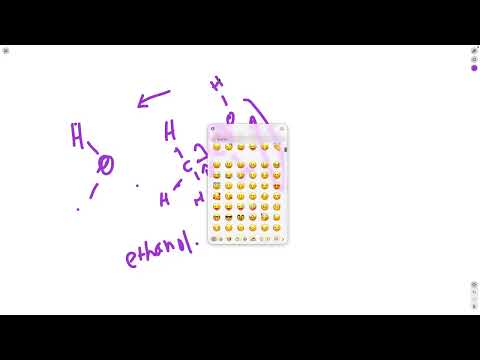
- Ethanol’s carbon–carbon bond can rotate, while carbon’s tetrahedral geometry and bond polarity constrain molecular structure.
- Electronegativity differences create polar covalent bonds; carbon–carbon and carbon–hydrogen bonds are typical nonpolar examples.
12:20
Ionic Interactions and Hydrogen Bonds in Water
- Ionic interactions attract formally charged ions; a positive ion is a cation and a negative ion is an anion.
- Hydrogen bonds are noncovalent attractions, not covalent bonds involving hydrogen, and occur between water molecules and within larger molecules.
- Water’s hydrogen-bond network contributes to surface tension, evaporative cooling, and the energy required for evaporation.
- A hydrogen bond can provide an alternative interaction for atoms in a molecule, influencing the stability of their covalent bonds.
16:20
Water Autoionization, Hydronium, and Acidity
- Water molecules occasionally separate into hydroxide and hydrogen-ion equivalents; free H+ is more accurately associated with hydronium in water.
- Neutral water has balanced hydrogen-ion and hydroxide concentrations, while adding acid increases hydrogen-ion concentration and lowers pH.
- Strong acids and bases are hazardous because they make aqueous environments highly reactive.
- Acidic stomach conditions help digest food molecules by promoting chemical reactions in water.
20:00
Hydrophilic Molecules, Hydrophobic Tails, and Hydration Shells
- Water dissolves compatible molecules by surrounding them with a hydration shell and interacting with their polar regions.
- Hydrophilic protein surfaces, such as those on insulin, help proteins remain dissolved in blood; hydrophobic regions favor oily environments.
- Hydrogen bonds within proteins help stabilize structures such as alpha helices, which contribute to aquaporin’s folded form.
24:00
Dipole–Dipole Interactions and the Van der Waals Umbrella
- A dipole has two regions of partial charge; polar covalent bonds such as O–H and C–O can act as dipoles.
- Dipole–dipole interactions attract oppositely charged ends of polar molecules, much like the alignment of bar magnets, though the force is not magnetic.
- Hydrogen bonding is a particularly important dipole–dipole interaction in biology.
- Champlin notes that scientists use “Van der Waals forces” inconsistently, so BIO105 focuses on more specific interaction names.
30:00
How a Dipole Can Induce Polarity in Another Bond
- A strong dipole can distort the electron distribution of a nearby weakly polar bond, increasing that bond’s polarity.
- Water’s strongly polar O–H bonds can influence nearby molecules as water dissolves them.
- Champlin connects induced dipoles to the way interactions with water can help destabilize bonds during biological reactions.
34:00
London Dispersion Forces Between Nonpolar Lipid Tails
- London dispersion forces arise from momentary uneven electron distributions that create temporary attractions between nearby molecules.
- Phospholipid tails consist largely of nonpolar carbon–hydrogen chains, so their interactions are weak but can add up along long tails.
- Water excludes hydrophobic tails, pushing them together; their proximity allows weak dispersion attractions to contribute to membrane organization.
39:00
Temperature, Unsaturated Fats, and Membrane Fluidity
- Higher temperature increases molecular motion and makes a phospholipid membrane more fluid, allowing water to cross more readily in Champlin’s membrane example.
- Cholesterol helps cells adjust membrane fluidity, and cells can also vary the phospholipids in their membranes.
- A double bond creates a kink in a fatty-acid tail, preventing close packing; saturated tails are straighter and pack more tightly.
- Vegetable oil’s unsaturated fatty acids are liquid at room temperature, while hydrogenating them to make margarine increases saturation and solidity.
47:00
Protein Folding, Denaturation, and Noncovalent Structure
- A newly synthesized protein is a covalently linked amino-acid chain that folds into a functional three-dimensional shape through noncovalent interactions.
- Aquaporin’s folded structure includes eight helices arranged into a barrel-like form.
- Heating a protein, as when cooking egg white, disrupts secondary and tertiary structure while leaving the covalent amino-acid sequence intact.
- Denaturation can inactivate a protein without breaking the primary chain of amino acids.
50:00
Hydrolysis, Dehydration, and Water’s Role in Polymer Reactions
- Hydrolysis uses water to split covalent links between monomers; dehydration reactions join monomers while releasing water.
- In the protein-digestion example, hydrolysis releases an amino acid from a chain, supplying building blocks from dietary protein.
- The same polymer chemistry applies to proteins, nucleic acids such as DNA and RNA, and polysaccharides.
- Champlin relates water interactions and pH to how biological reactions can rearrange covalent bonds.
1:00:00
The pH Scale and Tenfold Changes in Hydrogen-Ion Concentration
- pH describes hydrogen-ion concentration in water; acids add hydrogen-ion equivalents and bases remove them or reduce their concentration.
- The pH definition is the negative logarithm of hydrogen-ion concentration; neutral pH 7 corresponds to about 10⁻⁷ molar.
- Each one-unit decrease in pH represents a tenfold increase in hydrogen-ion concentration, while an increase in pH lowers that concentration.
- Champlin says BIO105 exam questions may ask students to predict the direction and magnitude of concentration changes across pH values.
1:09:00
Why Cells Store Glucose as Glycogen
- Animals store glucose in muscle cells as glycogen, a polysaccharide that can be hydrolyzed to release glucose when energy is needed.
- Storing many glucose units in one polymer reduces the number of separate dissolved particles and therefore limits osmotic pressure.
- A glycogen chain containing 100 glucose units can reduce the particle concentration compared with storing those units as 100 free glucose molecules.
- Plants also store sugars in polymer form; Champlin previews discussing this osmotic benefit alongside the Wednesday osmosis quiz.
Summary, takeaways, and chapters were generated by AI from the video's transcript and may contain errors. The video belongs to its creator, The New Evolution for Everyone.