BIO105 Introductory Biology, Mond., Oct., 5th, David Champlin, USM
 Watch on YouTube →
Overview
David Champlin connects cell-membrane structure to transport, showing how phospholipid bilayers and specialized proteins regulate movement through passive transport, ATP-powered active transport, and vesicle-based bulk transport. Examples including the sodium-potassium pump, LDL receptor and clathrin, kidney aquaporins, and neuronal neurotransmitter recycling also reinforce broader course themes of protein structure-function, cellular organization, and shared features across life.
Key takeaways
- Passive transport follows a concentration gradient without energy, whereas the sodium-potassium pump uses ATP to move ions against gradients and store potential energy across a membrane.
- A protein's amino-acid sequence determines how it folds, and that structure enables specific functions such as aquaporin's water channel or hemoglobin's four-subunit oxygen transport.
- Receptor-mediated endocytosis provides selective uptake: LDL binds its transmembrane receptor, recruits clathrin, and enters the cell in a coated vesicle.
- Cells regulate kidney water recovery by moving aquaporin-containing vesicles to or from the plasma membrane, changing channel abundance rather than switching the channels themselves.
- Exocytosis and endocytosis work together in neuronal signaling: neurotransmitters are released at synapses, then retrieved and reused as the membrane is recycled.
Chapters
0:00
Course Logistics and Career Exploration Through Networking
- Champlin confirms the first exam is scheduled for Monday the 19th, after clarifying that fall break falls on the preceding Monday and Tuesday.
- A Wednesday quiz will draw on Chapters 6 and 7; Champlin says he will post earlier quizzes with answer keys.
- Students can connect with classmates who share interests as an early form of professional networking and career exploration.
- Examples include medical students choosing specialties through clinical rotations and an aerospace intern who started a hot-air-balloon-building business.
8:36
Cell Theory, Common Ancestry, and Shared Features of Life
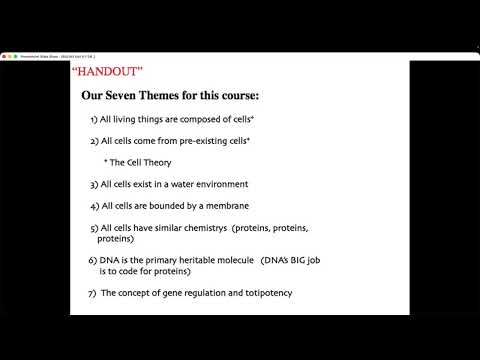
- Cell theory holds that all organisms are made of cells and that cells come from pre-existing cells; Champlin dates its development to the 1850s.
- Evolution explains the similarities and differences among organisms through descent from common ancestors over long timescales.
- All cells have water-based environments inside and outside, are bounded by phospholipid membranes, and rely on proteins for much of their structure and activity.
- Cells contain DNA as heritable information and use selected portions of it, called genes, to direct cellular functions.
13:47
Protein Folding Connects Amino-Acid Sequence to Function
- Ribosomes join amino acids through peptide bonds to create a protein's primary structure, as directed by genetic information.
- The sequence folds into local secondary structures, including alpha helices and beta-pleated sheets, and then into an overall tertiary structure.
- Aquaporin forms a channel from folded protein segments, while hemoglobin's four subunits illustrate quaternary structure and cooperative oxygen transport.
- Dietary proteins are generally broken into amino acids, which cells use to build their own species-specific proteins.
17:03
Phospholipid Membranes and Transmembrane Transport Proteins
- Cell membranes are selectively permeable: water can cross the phospholipid bilayer, but many water-soluble molecules need transport proteins.
- Hydrophilic molecules encounter the membrane's hydrophobic interior, creating a barrier between extracellular fluid and the cytoplasm.
- Transmembrane proteins span the membrane; peripheral or membrane-bound proteins attach without crossing it.
- Aquaporin provides a channel through which water can move across the membrane.
20:30
Passive Diffusion Versus the ATP-Powered Sodium-Potassium Pump
- Passive transport moves substances down their concentration gradients without cellular energy; facilitated diffusion uses membrane proteins to assist movement.
- Active transport uses energy, usually ATP, to move substances against a concentration gradient and perform work.
- The sodium-potassium pump moves sodium and potassium across the membrane, maintaining concentration gradients that store potential energy.
- Champlin previews ATP as a cellular energy intermediate in metabolism, which Chapters 8–10 will examine further.
27:13
Insulin Secretion and Vesicle-Based Exocytosis
- Insulin mRNA carries coding information from DNA to a ribosome, and its signal peptide directs the ribosome to the rough endoplasmic reticulum.
- Insulin is packaged into a vesicle that travels to the cell surface and fuses with the plasma membrane.
- Vesicle fusion releases insulin outside the cell while adding the vesicle's phospholipids to the cell membrane; this process is exocytosis.
- Aquaporin and lysosomal proton pumps also use vesicle traffic to reach their destinations, though their final locations differ.
33:34
Endocytosis, Vesicle Routes, and Cellular Cargo Transport
- Endocytosis brings material into a cell when the plasma membrane folds inward and pinches off as a vesicle; exocytosis exports vesicle contents.
- Vesicles are guided and transported rather than merely drifting: cellular tracks and energy-consuming transport move them to destinations.
- Neurons transport neurotransmitter-containing vesicles along long cellular extensions to synapses, where the contents can be released near target cells.
- Champlin groups passive transport, active transport, and bulk transport as distinct ways materials cross cell membranes.
36:34
Phagocytosis: Macrophages Engulf and Digest Bacteria
- In phagocytosis, a macrophage surrounds and engulfs a large particle such as a bacterium, enclosing it in a membrane-bound vesicle.
- The vesicle fuses with a lysosome, whose acidic environment promotes digestion and recycling of bacterial material.
- This process helps explain the presence of macrophages and cellular debris in pus at an infection site.
- Single-celled eukaryotes also use phagocytosis to capture and digest food particles.
40:42
Pinocytosis Brings Extracellular Fluid into Cells
- Pinocytosis forms vesicles containing a sample of the surrounding extracellular fluid and its dissolved molecules.
- The process is sometimes called “cell drinking” because the cell internalizes fluid in bulk rather than selecting one specific cargo molecule.
- In some single-celled eukaryotes, pinocytosis can bring in more water than movement through aquaporins.
- Unlike phagocytosis, pinocytosis does not engulf a distinct large object such as a bacterium.
43:00
LDL Receptors Selectively Capture Cholesterol Particles
- Low-density lipoprotein (LDL) carries hydrophobic cholesterol inside a particle with a phospholipid surface, allowing cholesterol to travel through blood.
- An LDL receptor is a transmembrane protein that binds LDL and changes shape when its binding pocket is occupied.
- Receptor-mediated endocytosis lets cells selectively internalize LDL instead of taking in an unspecific sample of fluid.
- Cholesterol is essential: cells in the ovaries and testes use it as a starting material to synthesize estrogen and testosterone.
50:12
Clathrin Coats Shape LDL Receptor Vesicles
- When LDL binds its receptor, the receptor's changed shape helps recruit clathrin from the cytoplasm.
- Clathrin trimers assemble into a triskelion-shaped structure that can bind multiple LDL-loaded receptors and cluster them in the fluid membrane.
- The clathrin coat's geometry bends the membrane into a coated pit, which deepens and pinches off as a coated vesicle.
- Clathrin is removed and recycled inside the cell, while LDL receptors can also be returned to the membrane for reuse.
58:00
Protein Synthesis Routes Reveal Where Cellular Proteins Belong
- Hemoglobin is synthesized by free ribosomes and released into the cytoplasm; signal-peptide-bearing proteins instead pause and dock at the rough ER.
- Insulin travels in a vesicle to the cell surface for secretion, aquaporin is delivered to the plasma membrane, and a lysosomal proton pump is sent to a lysosome.
- The LDL receptor follows the aquaporin route because it must become embedded in a membrane; clathrin is made by free ribosomes and remains cytoplasmic.
- Protein traffic includes both delivery and recycling, while membrane traffic moves phospholipids along with membrane proteins.
1:03:51
Kidney Aquaporin Traffic Adjusts Water Reabsorption
- Aquaporin channels do not switch between open and closed shapes; cells regulate water flow by changing how many aquaporins are present in the membrane.
- Kidney cells add aquaporins to the membrane by exocytosis to increase water recovery and reduce urine volume when the body needs to conserve water.
- Endocytosis removes aquaporins from the surface when fewer channels are needed.
- This membrane traffic adjusts water permeability in response to the body's hydration needs.
1:08:41
Neurotransmitter Release and Recycling at Synapses
- At synapses, neurons release neurotransmitters—including dopamine, serotonin, and glutamate—by exocytosis to communicate with nearby cells.
- Neurotransmitters bind receptors on a neighboring cell to produce a brief signal; removing them helps end that stimulation.
- Neurons retrieve and reuse neurotransmitters, and endocytosis also restores membrane added during vesicle release.
- Rapid, repeated exocytosis and endocytosis support thought and movement; some synapses recycle neurotransmitters thousands of times per second.
Summary, takeaways, and chapters were generated by AI from the video's transcript and may contain errors. The video belongs to its creator, The New Evolution for Everyone.