BIO105 Introductory Biology, Aquaporin video, David Champlin, USM
 Watch on YouTube →
Overview
David Champlin uses aquaporin, a membrane water-channel protein, to connect osmosis and kidney water balance with protein structure, gene mutations, and evolution. He explains how amino-acid sequences fold into channels that speed passive water movement, then describes gene duplication as a source of specialized aquaporin variants.
Key takeaways
- Aquaporins accelerate osmosis by providing water with a membrane-spanning route; they do not actively pump water.
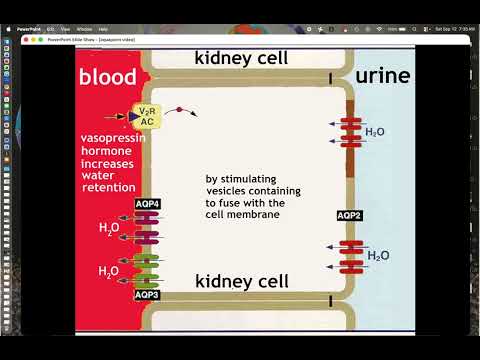
- Kidney cells regulate water recovery by changing how many aquaporin channels occupy the urine-facing membrane in response to vasopressin.
- Aquaporin’s structure matches its environment: hydrophobic amino acids interact with the membrane, while hydrophilic amino acids line the water-conducting pore.
- A protein’s DNA-encoded amino-acid sequence drives its folding, and its resulting three-dimensional shape determines its function.
- Gene duplication can preserve an original aquaporin function while allowing related copies to evolve tissue-specific roles or altered channel selectivity.
Chapters
0:00
Aquaporin Channels Speed Osmosis in Cells and Plants
- Aquaporin is presented as a donut-shaped cell-membrane protein whose channel lets water diffuse faster without pumping it.
- A plant with a mutated aquaporin gene cannot take up water quickly enough and responds by growing more roots, even when surrounded by water.
- IV saline must have an appropriate salt concentration: too little salt can make red blood cells swell and burst, while too much can make them shrink.
5:00
Kidney Vasopressin Signals Adjust Aquaporin Abundance
- The kidneys initially filter about 180 liters of fluid per day, then reabsorb much of its water while retaining waste for urine.
- When a person is thirsty, vasopressin signals kidney cells to add aquaporin-containing vesicles to the urine-facing membrane, increasing water reabsorption.
- When less water needs to be retained, kidney cells remove channels from the membrane so more water remains in the urine.
10:00
Phospholipid Bilayers Create a Barrier Aquaporin Crosses
- Cell membranes consist of phospholipid bilayers with a hydrophobic, water-repelling interior that slows water movement.
- Aquaporin spans the membrane: its hydrophobic exterior fits the bilayer, while its water-friendly channel provides a rapid route through it.
- Champlin situates water, proteins, and phospholipids within the course sequence, connecting chemistry to cell membranes and cell biology.
14:00
Aquaporin’s Amino-Acid Chain Forms a Selective Channel
- Aquaporin is a polymer built from amino-acid monomers, and its chain crosses the membrane as a transmembrane protein.
- The protein’s eight spiral segments fold into a barrel-like channel, rather than a solid donut.
- Water passes through a narrow pore whose size and water-attracting amino acids help select water over other molecules.
20:00
Protein Folding Links DNA Sequence to Aquaporin Function
- Primary structure is the amino-acid sequence encoded by DNA; secondary structure includes local spirals, and tertiary structure is the protein’s overall folded shape.
- Hydrophobic amino acids face the membrane’s oily interior, while hydrophilic amino acids line the water channel and exposed protein surfaces.
- A small number of channel-lining amino acids make key contacts with passing water; the lecture notes that each channel can pass billions of water molecules per second.
27:00
Aquaporin Mutations and Gene Duplication Diversify Water Transport
- Mutations that disrupt an aquaporin channel can interfere with water movement; Champlin cites potential effects in the eyes and kidneys.
- Champlin describes humans as having 10 aquaporin gene types, with different versions expressed in tissues such as the kidney and eyes.
- Gene duplication can create related copies that accumulate mutations and specialize; such related genes in one species are called paralogues.
- A duplicated aquaporin could evolve changes to its channel that allow small molecules besides water to pass.
Summary, takeaways, and chapters were generated by AI from the video's transcript and may contain errors. The video belongs to its creator, The New Evolution for Everyone.